A salwar kameez online shop in Bangladesh has a job that most clothing stores never face: many buyers want the fabric, the stitching and the finished outfit, all in one order. This guide is for three-piece boutiques selling through Facebook and Instagram, for tailoring houses with their own fabric range, and for freelancers who build stores for women's wear brands. We cover how to plan unstitched and ready sets, explain fabric, price tailoring and deliver on time for Eid.
The three-piece is the everyday and festive staple for women across the country. A large share is still bought unstitched. The buyer then hunts for a tailor, waits, and hopes the outfit comes back before the occasion. Boutiques that already offer stitching often spend half an hour on Messenger explaining fabric cost, tailoring cost and the ready date. A well-planned store can answer all of that on one page.
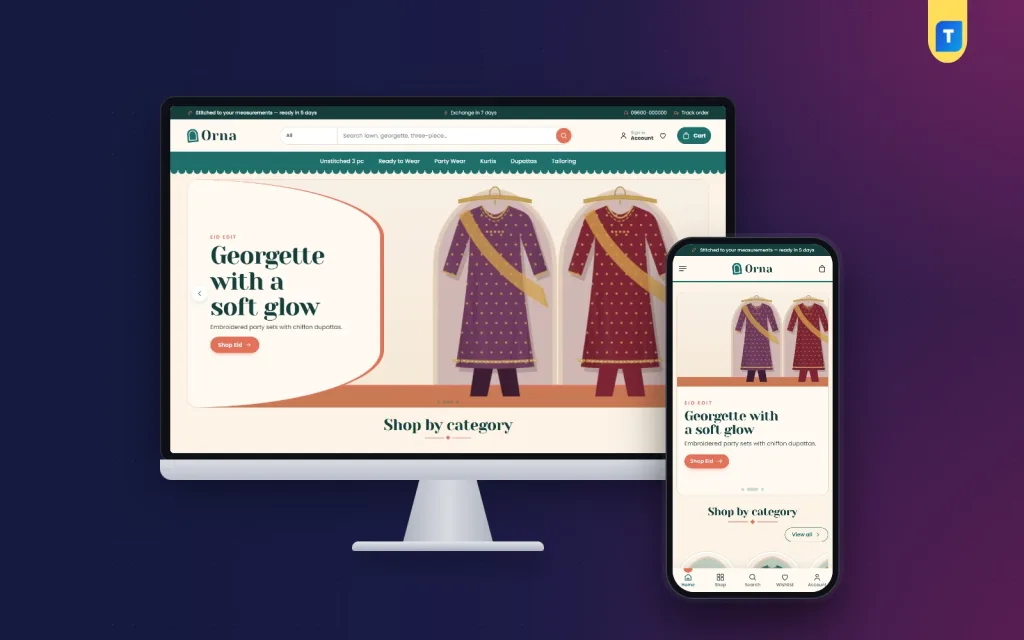
Our working example is Orna – Salwar Kameez WordPress Theme, made for three-piece boutiques that sell unstitched sets, ready-to-wear, party wear, kurtis, dupattas and tailoring. Arched images, scalloped edges and a teal, coral and cream scheme give it a Mughal-arch feel, with Yeseva One headings and easy Poppins text. Before the theme, though, let us plan the shop itself.
What a Three-Piece Boutique Needs Online
Women buying a three-piece online want three things answered quickly. What is the fabric really like: heavy or light, sheer or opaque, right for summer or winter? Will it fit, or how much does stitching cost and when will it be ready? And can I trust this seller with my money and my measurements? A store that answers these on the product page sells more and gets fewer messages.
The second need is range management. A typical boutique carries unstitched sets, ready-to-wear sets, party wear, kurtis and separate dupattas. Each behaves differently. Unstitched sets need fabric detail and a tailoring option. Ready sets need sizes and a fit note. Party wear needs close-up photos of embroidery and work. Mixing them all in one list confuses buyers, so separate categories are essential from day one.
Planning Your Salwar Kameez Online Shop
Write down your categories first: Unstitched 3 pc, Ready to Wear, Party Wear, Kurtis, Dupattas and Tailoring. Then decide how you will group within them, by fabric, occasion or price. Keep it simple. A buyer looking for summer office wear should be able to find lawn or cotton sets in two taps, and a buyer dressing for a winter wedding should find heavier fabric just as fast.
Describe fabric honestly
Fabric is where most complaints start. For every set, name the fabric clearly, such as lawn, cotton, georgette, khaddar or chiffon, and say how heavy and how sheer it is. Note whether the dupatta is chiffon, organza or cotton, and whether the set includes a lining. Shoot each fabric in daylight, with one close-up that shows weave and print. Honest descriptions mean fewer returns and more repeat buyers.
Price tailoring up front
If you stitch, decide your tailoring levels and prices before launch. Many boutiques use two: a basic stitch and a designer stitch with more detailing. Fix a realistic ready time for each, and add extra days during the Eid season. Decide how buyers send measurements, such as by a form, a phone call or a sample outfit, and write it on your FAQ page so nobody has to ask.
Build your salwar kameez collection around the calendar
Plan your salwar kameez collection for the year: lawn and cotton for summer, georgette and chiffon for Eid and parties, khaddar for winter, and heavier work for the wedding season. Order stock and book tailoring capacity weeks ahead of each peak. Eid in particular arrives faster than expected, and a boutique that stops taking stitching orders on time keeps its customers happy.
How Orna Handles a Salwar Kameez Online Shop
Orna puts tailoring right next to the fabric, with the price worked out on the spot. It has 24 homepage blocks, 17 live in the demo and 7 extra ones switched off by default. Homepage layout lets you turn blocks on or off and drag them into order, with arrows when you work on a phone. The hero slider uses arched slides, and Shop by category shows arch tiles.
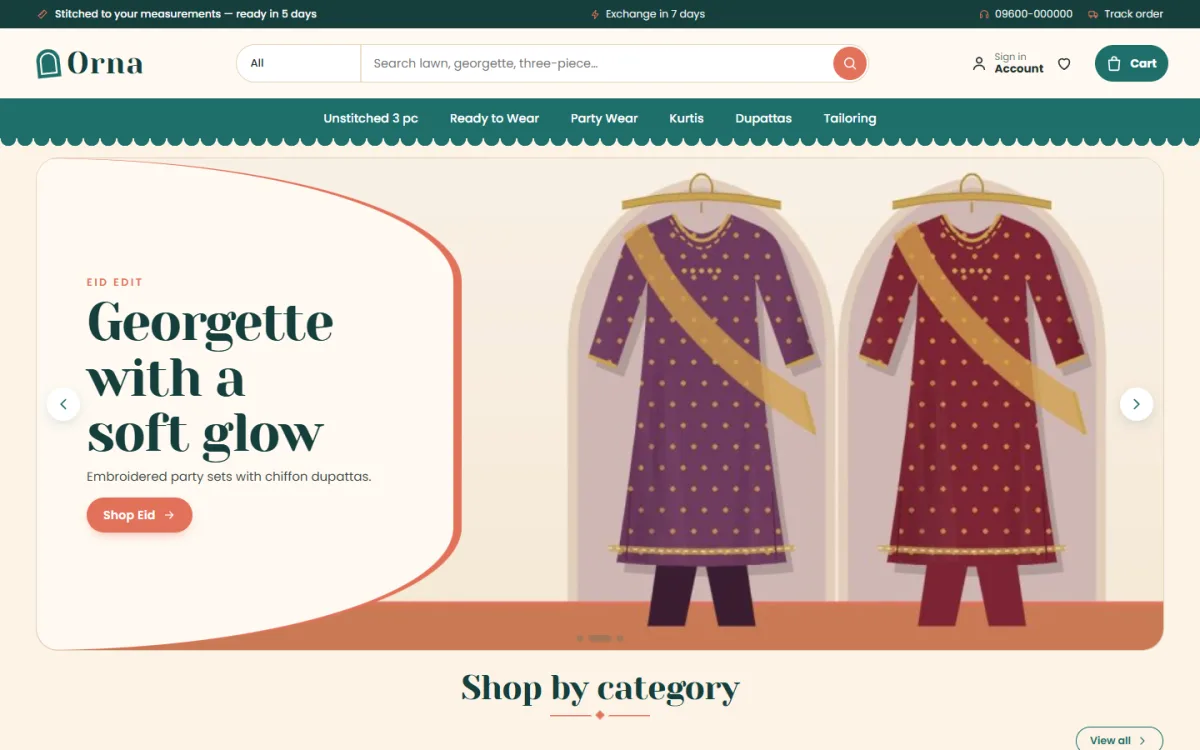
In the demo, a dark teal top bar promises stitching to your measurements, alongside a seven-day exchange note, a hotline and Track order. The search box suggests lawn, georgette and three-piece, and a scalloped teal menu lists Unstitched 3 pc, Ready to Wear, Party Wear, Kurtis, Dupattas and Tailoring. The main slide shows an Eid edit of embroidered georgette sets inside arched frames.
Stitch it for me
This is the block most boutiques will value. A shopper picks an unstitched set, then chooses no stitching, basic tailoring or designer tailoring. The block shows the fabric price, the stitching price, the total and the date the outfit will be ready. One button adds both the fabric and the tailoring service to the bag. The demo includes basic and designer tailoring as two services, and you change their prices like any product.
Know your fabric
The fabric guide gives lawn, cotton, georgette, khaddar and chiffon a tab each. Every tab shows a swatch, the seasons that fabric suits, a light-to-heavy scale, an opaque-to-sheer scale and the sets made from it. A buyer can see how sheer a georgette is before she messages you. Product pages then add a fit meter, the pieces and care details and an expected delivery date.
Offers, occasions and departments
New arrivals brings two rows of fresh pieces, and Best sellers sits in tabs by category. The Eid offer block runs a countdown with stock bars, Shop by occasion gives four cards, Shop by budget pairs price tiles with products, and three departments hold a banner and eight products each. Trending now, Top rated, an Our labels row, Style notes with your latest three posts and a promise strip for tailoring, exchange, delivery and COD follow.
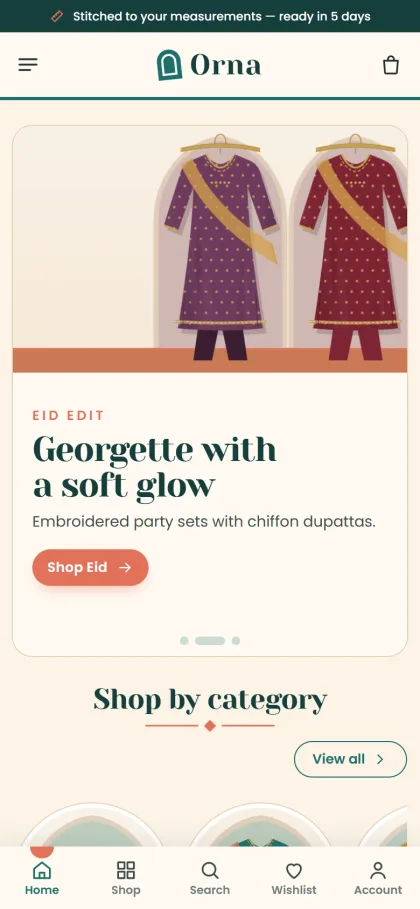
Most of your buyers will browse on a phone. Orna keeps the mobile header to menu, logo and cart, and product cards stay compact, so a buyer can compare several sets at once. The demo also shows a bottom bar for Home, Shop, Search, Wishlist and Account. The layout is fully responsive, and the Theme Options dashboard works on a phone, which helps when you are managing orders from the cutting table.
Setting Up the Store Step by Step
Orna needs WordPress 6.0 or newer and PHP 7.4 or newer, and is tested up to WordPress 7.1. Go to Appearance, Themes, Add New, Upload Theme, pick the Orna zip and activate it. Open Orna, Setup to install the bundled Themeve Commerce plugin in one click, then enter the licence key from your Themeve account under Orna, License. The WordPress documentation is useful if pages and menus are new to you.
Next, use Orna, Demo Import to load the Three-Piece Boutique demo. It adds 25 products from 2 labels: unstitched sets, ready-to-wear, party wear, kurtis, dupattas and two tailoring services, plus the stitching calculator, fabric guide, style notes, menus and pages such as About Orna, Delivery, FAQ, Our Stores, Returns and Exchange, Style Notes and Track Order. All labels and pictures are invented samples to replace with your own.
Then set tailoring, fabrics, palettes and fonts in Orna, Theme Options, or preview changes in the Live Customizer. Five palettes are included: Teal and coral, Plum and gold, Mint and rose, Indigo and mango, and Maroon and sand, with each colour adjustable. Font pairs are Yeseva One with Poppins, Playfair Display with Lato, Marcellus with Nunito Sans, or DM Sans alone. A settings search, a sticky save bar, reset and export or import are built in. No code is needed.
Before deciding, try the live demo on your phone. Pick an unstitched set, choose designer tailoring and watch the total and ready date change, then open the fabric tabs. Afterwards, look through the demo dashboard to see where the tailoring services sit in the product list and where orders arrive under the Shop menu.
Payments, Delivery and Selling in Bangladesh
Orna runs on Themeve Commerce, which looks after the bag, checkout, payments and couriers. Shoppers sign in or create an account in a popup and stay on the same page. Reviews open in a fold, a popup invites the first one, and the wishlist holds pieces for the next Eid. The one-page checkout ends with an Order placed popup, and the Track Order page lets buyers check on delivery.
Payment covers bKash, Nagad, SSLCommerz, cash on delivery and manual payment, with Steadfast and Pathao courier for delivery. Coupons and invoices are built in, and size guide, back-in-stock, offers and returns are already on. For stitched orders, it is sensible to take full or part payment in advance by mobile payment, since an outfit stitched to one buyer's measurements cannot be resold if the buyer refuses it at the door.
Facebook and Instagram are where most three-piece buyers discover boutiques. Orna supports the Facebook Pixel with Conversion API, so you can see which Eid ads bring real orders. Show the same set unstitched and stitched in your posts, mention the ready date, and link to the fabric tab rather than just the homepage. New orders can arrive as Telegram alerts, and SMS and OTP help you confirm orders and keep buyers updated.
Common Mistakes When Selling Three-Pieces Online
The first mistake is vague fabric text such as premium quality or soft fabric. Buyers want the actual fabric name and how it feels. The second is promising stitching dates you cannot meet in the Eid rush. Set a clear last date for stitched Eid orders and stop taking them on time. A salwar kameez online shop that delivers late before Eid loses that customer for years, not just for one season.
Other common errors include mixing unstitched and ready sets in one category, hiding the tailoring price until the buyer messages, and showing only edited studio photos. Some boutiques also forget to explain what is included: kameez, salwar and dupatta, or only two pieces. Finally, check the full order flow on a budget phone using mobile data, because that is how most of your customers will place their orders.
Frequently Asked Questions
Can my salwar kameez online shop sell tailoring as well as fabric?
Yes. In Orna, the Stitch it for me block adds the fabric and the chosen tailoring service to the bag with one button, showing the total and the ready date first. The demo includes basic and designer tailoring as two services.
Can I set my own tailoring prices?
Yes. Basic and designer tailoring come as two services in your product list, so you change their prices the way you edit any other item. You can match them to your own tailors' rates and adjust them before busy seasons.
Which fabrics does the fabric guide cover?
Lawn, cotton, georgette, khaddar and chiffon. Each tab shows a swatch, suitable seasons, weight and sheerness scales and the sets made from that fabric, which answers many questions before buyers contact you. You set the fabrics and their sets in Orna, Theme Options.
What if I sell panjabi or bridal wear too?
For a menswear house built around Eid panjabi, see Parbon – Panjabi Shop WordPress Theme. If your main business is wedding outfits, Kone – Bridal Wear WordPress Theme is made for bridal houses. Orna suits boutiques that sell fabric and stitching together.
Final Thoughts
Selling three-pieces online works when buyers understand the fabric, see the stitching cost and ready date up front, and trust you to deliver on time. Plan your categories, describe fabric honestly, set realistic tailoring dates and offer the payments buyers already use. For a Bangladeshi boutique that sells fabric and stitching together, Orna – Salwar Kameez WordPress Theme is a practical base for your next season.