A grocery ecommerce website for pure food has one job that a normal grocery site does not: it must prove that the honey, ghee, mustard oil and gur on the shelf are real. This guide is for small producers, family food brands and Facebook sellers in Bangladesh who already sell honey or date-palm gur by message and now want a proper shop. It also helps freelancers who build food stores for clients.
We will walk through what buyers of pure food worry about, how to organise products that are sold by weight, how to show where food comes from, and how to set up payments and delivery that suit local customers. The product side is shown with Khaati – Pure Food Shop WordPress Theme, a theme built for shops that sell honey, ghee and oils, gur, rice and grains, dates, nuts and seeds, spices and tea.
Why a Pure Food Grocery Ecommerce Website Is Different
Most people in Bangladesh have bought adulterated honey or ghee at least once. They have seen the same "100% pure" label on cheap jars and expensive ones. So when a stranger online offers pure Sundarbans honey, the first reaction is doubt. A pure food shop does not compete on price alone. It competes on trust, and trust is built from details: who made the food, where, when it was harvested, and how it was tested.
That changes how a grocery ecommerce website should look. A supermarket site can be a long grid of products with prices. A pure food site needs room for stories, for the name of a village or a beekeeper, for a lab result, and for a refund promise that the owner is willing to stand behind. If those details are buried in a FAQ page nobody opens, the shop looks like every other seller on Facebook.
Seasons matter too. Date-palm gur arrives in winter, mustard oil follows the mustard harvest, and litchi honey has its own short window. An online grocery business in this niche lives on launches: telling regular buyers that the new batch is in, and selling it before it runs out. The website must make those moments easy to announce and easy to buy from.
Planning Your Online Grocery Business Before Building
Start with sourcing. Write down every supplier, the district they work in, what they make and when. If you buy honey from a collector in the Sundarbans and ghee from a dairy family in Bogura, that information is not a secret to hide. It is the core of your marketing. Visit if you can, take photos, and note harvest months so you can plan stock and campaigns for the whole year.
Testing and proof
If you can afford it, send samples from each batch to a food testing lab and keep the reports. Even one or two reports per season give you something real to show. Pair that with a simple refund promise: if a customer can show the product is not pure, they get their money back. Only promise what you can afford to honour, and write the rules in plain words.
Sizes, weights and packaging
Pure food is sold in grams, kilograms and litres. Decide your standard sizes early, for example 250 g, 500 g and 1 kg for honey, and keep them consistent across products. Choose packaging that survives a courier trip: leak-proof lids for oil, thick glass or food-grade plastic for honey, and sealed bags for rice and dal. Breakage and leaks are the most common complaints in this trade.
Pages Every Pure Food Shop Needs
Beyond the product pages, a good grocery ecommerce website for pure food needs an About page that tells your story, a Delivery page with areas, charges and timing, a FAQ that answers common doubts about crystallised honey or cloudy ghee, and a refund page that explains your purity guarantee. A Track Order page saves you many phone calls, and a few short blog posts, such as why real honey crystallises, answer doubts before they reach your inbox.
How Khaati Turns a Grocery Ecommerce Website Into Proof
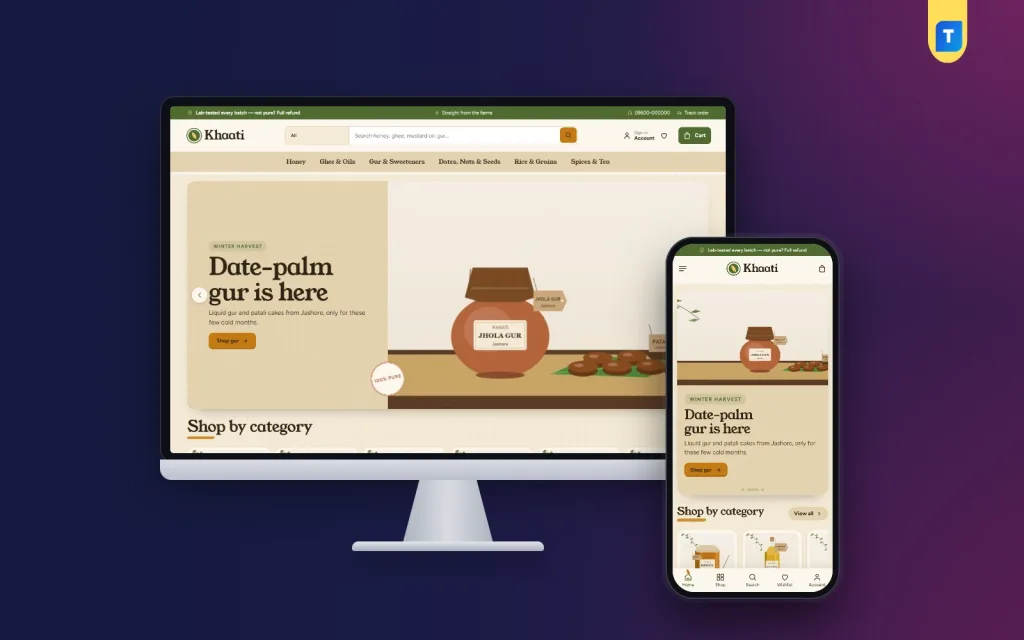
Khaati is designed around the two questions every pure food buyer asks: where did this come from, and how do I know it is real? The look is earthy, with leaf green and honey amber on a kraft paper background and Young Serif headings. In the demo, a green top bar repeats the promise of lab-tested batches and a full refund, next to a Track order link and a support phone number.
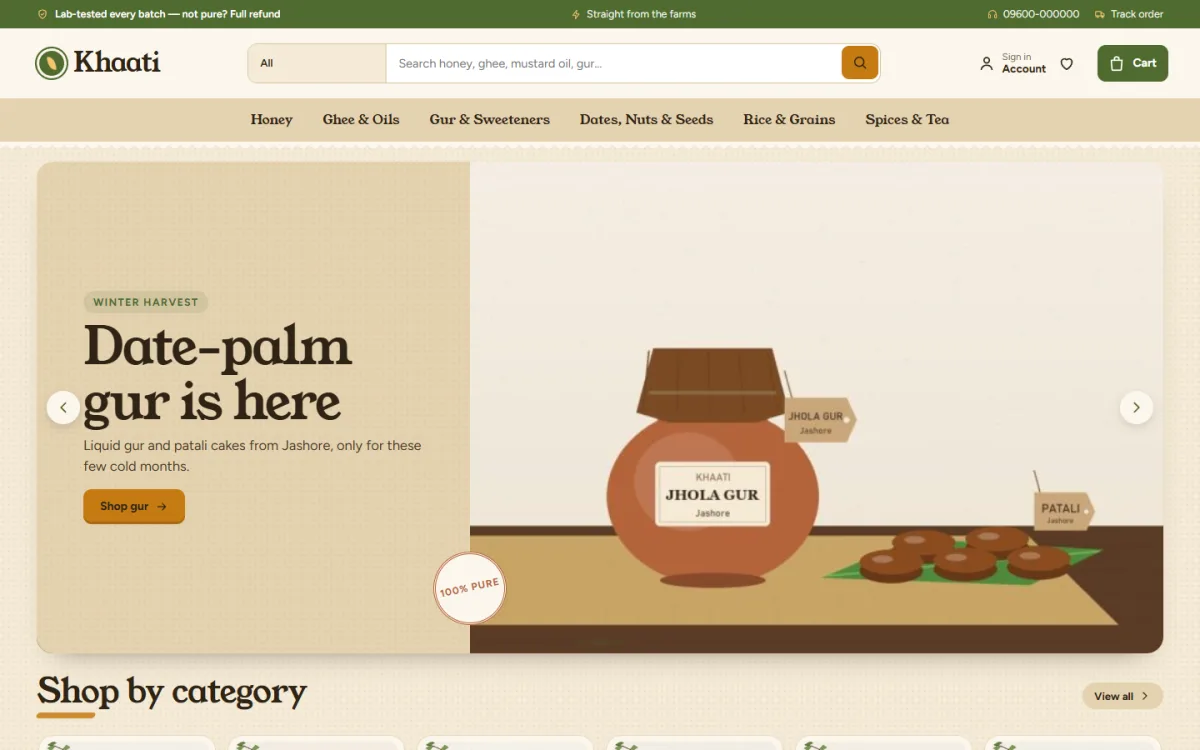
Under the logo sits a search bar with a category picker, and the menu below it lists Honey, Ghee & Oils, Gur & Sweeteners, Dates, Nuts & Seeds, Rice & Grains, and Spices & Tea. The slider shown in the demo announces the winter harvest of date-palm gur from Jashore, which is exactly the kind of seasonal launch described above. A Shop by category row follows it.
An origin map of Bangladesh
The Where it comes from block draws a map of Bangladesh with seven farm pins. Tap a pin such as the Sundarbans, Bogura, Tangail or Jashore and a panel explains who makes the food there and when it is harvested. The products from that place sit right under the story, so a buyer who reads about the honey can add a jar without searching the menu.
Purity proof batch by batch
The Purity proof block shows a lab report for each batch with a PASSED stamp and the test results, and beside it a simple test the customer can try at home. The reports in the demo are samples, so you replace them with your own results. Together with the Purity Refund page that comes with the demo, this block gives your refund promise real weight.
Weight options and harvest dates
Weight options price themselves in Khaati: a shopper picks a size and the price changes with it. Every product page also shows its harvest and a delivery date. For a business that sells honey in three jar sizes and rice by the kilo, this removes a lot of confusion at the moment of purchase.
The Homepage Blocks and the Phone View
The homepage has 24 blocks, and every one can be switched off or moved. You drag them into order in Theme Options, and on a phone arrow buttons do the same job. After the slider come kraft category tiles, the origin map and New harvest with two rows of the newest products. Best sellers appear in tabs by category, and Harvest offers run a countdown with stock bars for a fresh batch of gur or mustard oil.
Further down, three department blocks each hold a banner and eight products, Shop by need gives four cards, and Shop by budget pairs price tiles with products. Trending now is a sliding row, Top rated shows the highest customer ratings, Our farms lines up maker logos, and Kitchen notes shows your three latest posts. A promise strip covers lab testing, refund, delivery and cash on delivery.
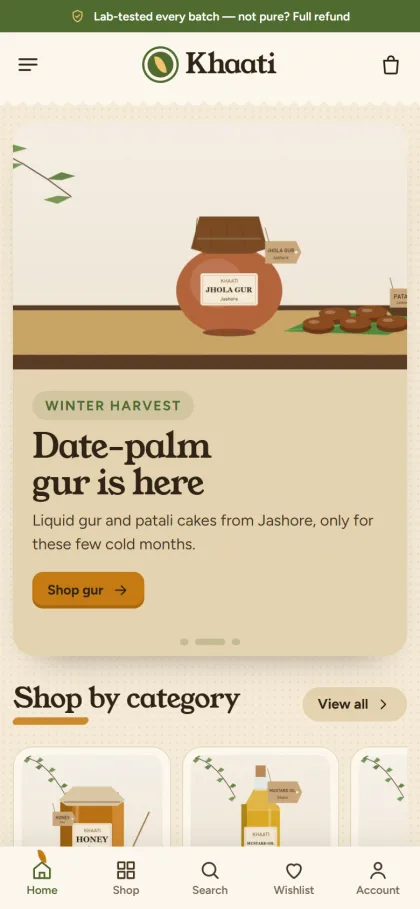
On a phone, the header shows the menu, logo and cart, and product cards stay compact. In the mobile screenshot, the slider stacks the gur picture above the text, and a bottom bar with Home, Shop, Search, Wishlist and Account is shown in the demo. Shoppers sign in or register in a popup without leaving the page, reviews sit in a fold, and a wishlist and back-in-stock alerts bring people back when a favourite honey runs out.
Setting Up the Shop Step by Step
Khaati needs WordPress 6.0 or newer and PHP 7.4 or newer, and it is tested up to WordPress 7.1. Upload the zip under Appearance, Themes, Add New, Upload Theme, and activate it. Then open Khaati, Setup and install Themeve Commerce in one click; it is bundled and runs the cart, checkout, payments and courier booking. Add your licence key from My Account, Licenses on Themeve under Khaati, License so updates arrive through your account.
Next, import the Pure Food demo from Khaati, Demo Import. It brings 23 products across honey, ghee and oils, gur, rice, dates, nuts and seeds, spices and tea, along with the origin map, purity proof, Kitchen Notes posts, menus and pages such as About Khaati, Delivery, FAQ, Our Stores, Purity Refund and Track Order. The farms and makers are invented, so replace them with your real suppliers.
Then open Khaati, Theme Options, which works on a computer or a phone. Pick one of five palettes, Leaf & honey, Clay, Mustard field, Mangrove or Jaggery, or set colours yourself. Font pairs include Young Serif with Figtree and Gelasio with Inter. Set your farm pins and lab results in their own groups. If menus and pages are new to you, the WordPress documentation explains the basics well.
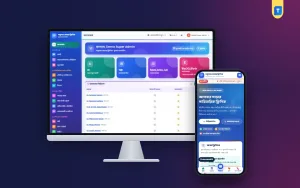
Before you decide, open the live demo on your phone and tap a few map pins, change jar sizes and walk through checkout. Then look at the demo dashboard to see where Theme Options and the Shop menu for orders live.
Payments, Delivery and Marketing in Bangladesh
The one-page checkout in Khaati takes bKash, Nagad, SSLCommerz, cash on delivery and manual payment. An Order placed popup confirms each order, the Track Order page follows it, and parcels go out with Steadfast or Pathao courier. Themeve Commerce also adds coupons, invoices, SMS and OTP, and new-order alerts on Telegram, all under one dashboard menu named Shop.
Cash on delivery is popular for food, but it brings returned parcels when buyers change their minds. For large orders or fragile items like glass jars of honey, confirm by phone first, or ask for the delivery charge in advance by mobile payment. Pack oil and ghee with extra care during summer, and tell customers that real honey may crystallise in winter so they do not think it is fake.
Facebook remains the main place where an online grocery business in Bangladesh finds buyers. Khaati includes the Facebook Pixel with Conversion API through Themeve Commerce, so you can see which ads lead to orders. Short videos of gur making beat plain product photos. Post in Bangla, reply to comments quickly, and link ads to the product or origin story rather than the homepage.
Common Mistakes Pure Food Sellers Make
The biggest mistake is claiming purity without proof. Saying "100% pure" on every page means nothing if there is no report, no source and no refund rule. Another mistake is listing one price for a product that comes in several sizes and then explaining the real price in the inbox. Buyers leave when the price they see is not the price they pay.
Many sellers also forget seasons. They keep a winter gur banner up in April, or run out of stock in the middle of a campaign because nobody watched the numbers. Others build a grocery ecommerce website that looks fine on a laptop but loads slowly on a phone with mobile data. Test every page on a cheap Android phone before launch, because that is how most of your buyers will see it.
Frequently Asked Questions
Do I need lab reports to start selling?
No, but they help a lot. You can start with clear sourcing stories and a refund promise, then add batch reports as you grow. In Khaati, the Purity proof block is ready for those reports, and the demo samples show how they will look once you add your own.
Can one product have several weights and prices?
Yes. In Khaati, weight options price themselves, so a customer picks 250 g or 1 kg and sees the matching price at once. This keeps honey, ghee, rice and dal listings tidy, with one product page per item rather than one per size.
Is there a theme for rice and dal or fruit shops?
Yes. If your shop focuses on staples, look at Gola – Rice and Dal Shop WordPress Theme. For a seasonal fruit business, Rosaal – Fruit Shop WordPress Theme is a closer fit. Khaati suits shops that sell honey, ghee, oils and gur with proof.
Can I make the shop look less rustic?
Yes. Choose the Mangrove or Clay palette, set your own colours, or switch to the Gelasio and Inter font pair in Theme Options. The blocks stay the same, so you keep the origin map and purity proof while giving the store a cleaner style.
Final Thoughts on Your Grocery Ecommerce Website
Selling pure food online works when buyers can see where the food comes from and how you know it is real. Plan your suppliers, sizes, tests and refund rules first, then pick a design that puts that proof on the homepage. A grocery ecommerce website built this way earns repeat orders season after season. If honey, ghee and gur are your main products, start with Khaati – Pure Food Shop WordPress Theme and fill it with your own farms and reports.