If you collect honey in the Sundarbans, keep bees beside a mustard field or buy from trusted collectors, knowing how to sell honey online lets you reach buyers in every district instead of waiting for local customers. This guide is for beekeepers, honey collectors and natural food pages with one star product. It covers what buyers doubt, what you should be ready to prove, how to pack jars, and how to build a page that takes the order.
Honey is one of the most doubted foods in Bangladesh. Buyers have heard stories about sugar syrup, honey thinned with water and jars heated to look clear. An ad alone cannot answer those doubts. What answers them is evidence: where the honey came from, who collected it, when, and how it reached the jar. The rest of this guide is about showing that evidence clearly.
As the example tool we use Mou – Honey Landing Page WordPress Theme, a one-page theme with a guide to each kind of honey, a forest-to-jar journey block and an order form with cash on delivery, bKash and Nagad. The theme gives you room to show proof. It cannot create proof for you, so the work starts with your own honey.
Selling Honey Means Selling Trust
Every honey buyer asks the same first question: is it pure? You cannot answer with an adjective. Words like pure, natural and raw appear on every page, including the ones selling the doubtful jars. Buyers believe specific details instead. Name the area and the season, show the collectors or your hives, print the harvest month on the label and explain how the honey is filtered and stored.
Be careful with claims you cannot back up. If you say no sugar, no syrup, never heated, be ready to show how you know. A lab test report for a batch, even an occasional one, is strong evidence when you have it. Photos and short videos from collection days help too. Avoid health or medical promises entirely. Describe taste, colour, season and use, and let buyers make their own decisions about health.
Explain the honey kinds
Many buyers do not know how khalisha, goran and mustard honey differ, and they hesitate when they cannot choose. Write a short, honest note for each kind you sell: where it comes from, when it is collected, how it tastes and how people like to use it. Mention that some honey, mustard honey in particular, can crystallise in cool weather. Buyers who know that in advance will not mistake a natural change for a fake product.
Be careful with the word organic
Honey often sits next to ghee, dates and oils in an organic food shop, and buyers may expect the same label from you. Only use the word organic if you hold a certification that allows it. Otherwise, describe what you actually do: wild collection, your own hives, no additives. Honest wording protects you if a buyer or a reviewer asks questions later.
How to Sell Honey Online: Jars, Delivery and Payment
Honey is heavy and leaks easily, so packing decides your reviews. Use well-sealed jars, add tape over the lid, wrap each jar in bubble wrap and pack it upright in a firm box. Glass looks premium but breaks, while food-grade plastic is lighter and safer for long routes, so choose according to your buyers. Mark the parcel as fragile and test your packing by sending a jar to a friend first.
For payment, offer cash on delivery for first-time buyers and mobile payment through bKash or Nagad for repeat buyers and distant districts. A refused honey parcel costs you two courier trips and maybe a broken jar, so call to confirm larger COD orders. Many sellers ask for the delivery charge in advance outside their own city, which filters out most fake orders.
Why One Landing Page Beats a Long Facebook Thread
When honey sells only through Facebook posts, every buyer asks the same things: which kind is best, where it comes from, how big the jars are, what delivery costs and what happens if they do not like it. A landing page answers those questions in order, then shows a short form. It also gives your ads one clear destination, so you can measure which ad and which honey actually sells.
A good honey page has a natural flow. Open with a clear promise and the order button, then name the doubts buyers have about market honey, explain each kind, show the journey from hive to jar, list the jar sizes, share photos, video and reviews, compare your honey with cheap alternatives, show delivery charges and your guarantee, and finish with the form.
How Mou Builds a Honey Page
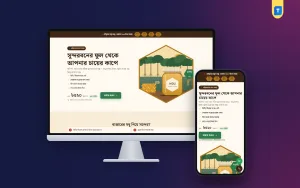
Mou is one long page for one product, with no site header or footer and the order form built into the page. It feels like a honey house, with hexagon frames, comb-brown bands, cream paper, forest-green buttons and Noto Serif Bengali headings. The design is warm and slow, which suits a product that people buy on trust.
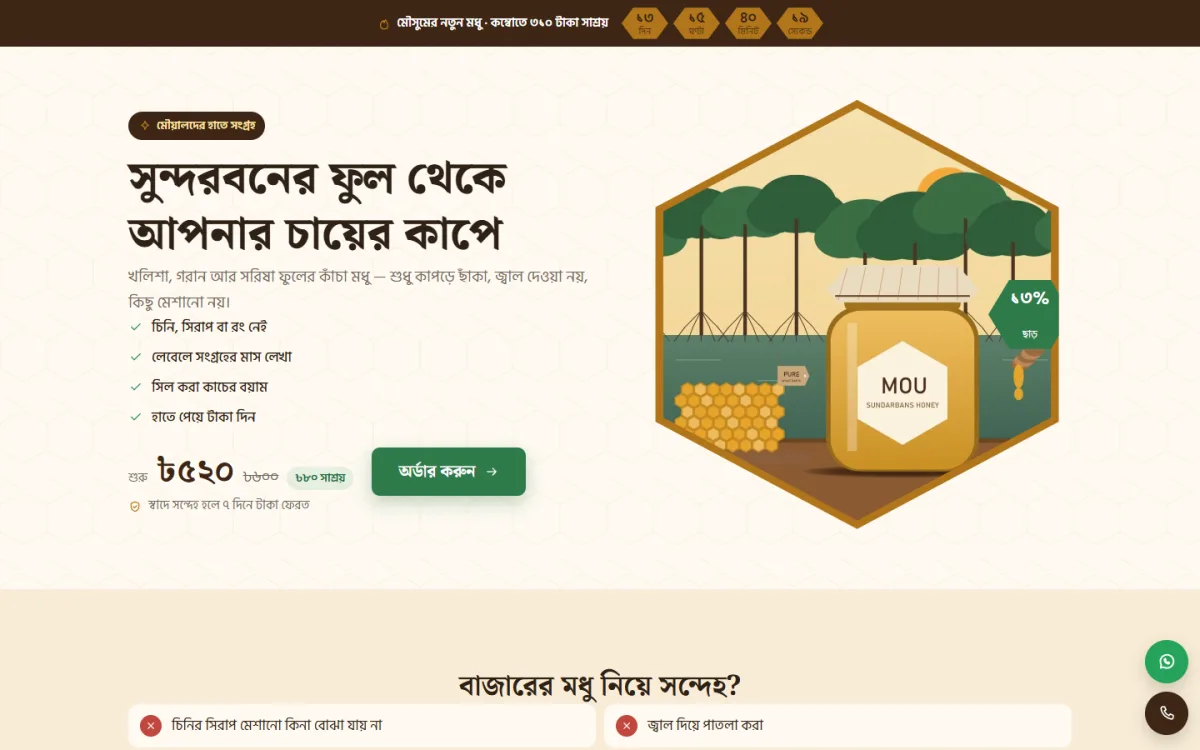
In the demo, the hero shows a badge about honey collected by hand, a Bangla headline about Sundarbans flowers, four check marks covering additives, the harvest month on the label, sealed jars and paying on delivery, and a money-back note under the order button. Just below, a section lists common doubts about market honey. All of that is sample text shown in the demo. Keep only the promises you can prove and the guarantee you will really honour.
Which honey is which
Each kind of honey is a hexagon in its own colour. Open one and it shows the season, the taste and the best use, with a button that picks its jar in the order form. A buyer stuck between khalisha and mustard can decide in a few taps instead of sending you a message and waiting for a reply.
From the forest to the jar
A picture sits beside honeycomb cells, one cell per step, showing how the honey travels from the hive to the buyer's kitchen. You write the steps, so it tells your real story, whether that begins in the mangrove forest or in a mustard field near your village. This block is where your proof lives, so use real photos and specific details.
Sixteen sections in your order
The sections are hero, problem and answer, honey kinds, journey, benefits beside the jar, packages, photos, video, review wall, comparison, specifications, steps, delivery charges, guarantee, FAQ and the order form. The "Landing page" box in the page editor lets you switch any of them off or move them. If your journey story is strong, put it right after the hero. If buyers trust other buyers most, lift the review wall.
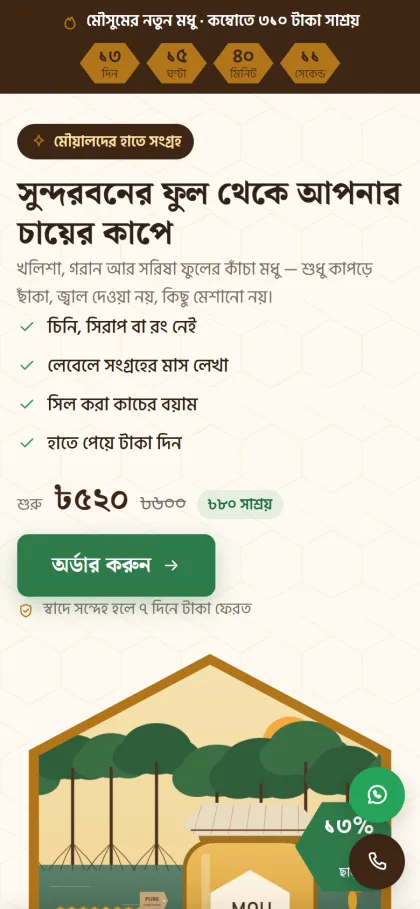
Most honey buyers find you while scrolling, so Mou is built for the small screen. A sticky order bar appears once the buyer passes the top and hides at the form. Floating call and WhatsApp buttons make it easy to ask one question before ordering, which is often all a cautious honey buyer needs.
Jars, Combos and Orders in Mou
The demo carries khalisha, goran and mustard honey plus a three-kind combo. These are product variations, shown as package cards and again as a picker inside the order form, and the checkout of the bundled plugin updates the price and delivery charge live as the buyer switches. The comparison section is the place to set your honey against cheap market honey, and the guarantee section holds your promise.
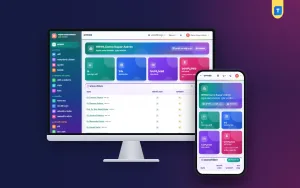
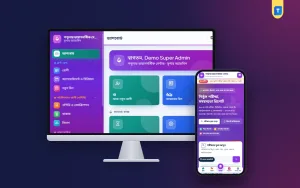
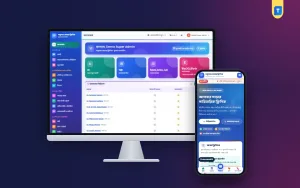
Buyers enter name, mobile, address and district, then pay cash on delivery or send money by bKash or Nagad to your numbers. Orders arrive under Shop in the WordPress dashboard. Themeve Commerce comes bundled with Telegram alerts for new orders, SMS and OTP, invoices, coupons, an order tracking page and Steadfast or Pathao courier. Connect the Facebook Pixel and the Conversion API to see which ad, and which honey, really sells.
Setting Up Mou Step by Step
Mou runs on WordPress 6.0 or newer and PHP 7.4 or newer, and it is tested up to WordPress 7.1. Upload the zip under Appearance, Themes, Add New, Upload Theme and activate it. Open Mou, Setup to add Themeve Commerce in one click, enter your license key from My Account, Licenses on themeve.com in Mou, License, and run Demo Import. The WordPress documentation helps with the basics.
The demo brings the honey product with photos and reviews, the landing page as your front page, and pages for privacy, terms, and returns and replacement, plus order tracking, checkout and thank-you pages. Edit the page in Pages and add your bKash and Nagad numbers in the store's payment settings. Mou, Theme Options offers 4 palettes, Wild honey, Mangrove, Mustard and Dark comb, and fonts in Noto Serif Bengali, Tiro Bangla or Baloo Da 2.
Before deciding, open the live demo on your phone and tap through the honey hexagons, then visit the demo dashboard to see where jars and orders are managed.
Common Mistakes Honey Sellers Make
The biggest mistake is promising purity without any way to show it. The second is copying a story from another page, such as a Sundarbans origin, when your honey comes from somewhere else. The third is weak packing, which turns a happy buyer into a sticky parcel and a one-star review. A fourth is hiding the delivery charge, which feels dishonest on a product that is sold on honesty.
Sellers also forget to explain crystallisation, then spend days answering complaints about honey that was perfectly normal. Others mix several kinds into one jar without saying so. Finally, many stop talking to buyers after the first order. Honey is a repeat purchase, so keep your buyer list and message people when a new season's harvest is ready.
Frequently Asked Questions
Can I sell ghee, dates or other natural foods with Mou?
Yes. Any page can become a landing page for any product, so black seed oil or ghee can get its own page next month with the same setup. If you plan to run a full organic food shop with many items, a store theme such as Khaati – Pure Food Shop WordPress Theme suits a large range better.
Can I tell my own collection story?
Yes. The forest-to-jar block shows one honeycomb cell per step, and you write each step yourself. Use your real locations, dates and photos, because specific details are what make buyers believe the story.
Is there a similar page for seasonal fruit?
Yes. Mukul – Mango Landing Page WordPress Theme follows the same one-page idea for mango boxes, with a harvest calendar. Many honey sellers in mango districts run both in summer.
Final Thoughts
Learning how to sell honey online is mostly learning how to show proof: real sources, harvest dates, honest descriptions of each kind, safe packing and a clear guarantee. Put that on one page with a short form and buyers have fewer reasons to doubt you. To build that page with honey hexagons and a forest-to-jar story, start with Mou – Honey Landing Page WordPress Theme.