If you are working out how to start a shoe business in Bangladesh, selling leather footwear online is a practical first step that does not need a big shop lease on day one. This guide is for family shoe sellers, small leather workshops and the freelancers who set up stores for them. We walk through choosing a range, planning sizes and stock, building the website, taking payment and getting pairs to customers without a pile of returns.
Shoes are a steady trade. Everyone needs them, children outgrow them every few months, and Eid and the wedding season bring a rush of buyers looking for something new. The hard part is not demand but trust. A buyer cannot try a pair through a screen, so your store has to answer the fit question, show the leather honestly and make exchanges simple. Get those three things right and one order turns into a regular customer.
As the working example we use Pothik – Leather Shoe WordPress Theme, a theme made for shoe houses that fit the whole family: office shoes for men, sandals for women, school pairs for children, soft comfort shoes for elders, plus nagra, kolhapuri and chappal. The business planning comes first, though, because no theme can rescue a range that nobody asked for.
Why Leather Footwear Makes Sense for a First Shoe Business
Leather pairs often carry better margins than plastic sandals, and they keep well on a shelf. A formal oxford or a pair of handmade nagra does not go out of style in a season the way trend sneakers do, so slow-moving stock is less of a worry. Bangladesh also has a long leather tradition and many small workshops that make shoes by hand, so you can buy short runs locally instead of importing or committing to huge minimum orders.
Leather also gives you a story to tell. Customers like knowing who stitched their shoes, what the sole is made of and how to care for the upper. That story is your edge against big marketplaces, where a pair is just a photo and a price, and it wins buyers who care about craft and repairs.
How to Start a Shoe Business: Planning Your Range and Stock
Before you buy a single pair, write a one-page plan. Name your customers, your categories, your sizes and where your stock will come from. This sheet decides your photos, your menus and even which homepage blocks you switch on later, so it saves hours once the store is being built.
Decide who you are fitting
A shoe house that serves families has a different job from a single sneaker brand. Think about the people who come in together: a father who needs office shoes, a mother looking for sandals, a child who needs school pairs and a grandparent who wants something soft and easy to slip on. Start with the two or three groups you know best, then add the rest once your suppliers and stock levels are steady.
Sizes, pairs and stock depth
Shoes are harder to stock than clothes because every design multiplies by sizes. Ten designs in seven sizes is already seventy items to track. Begin with fewer designs and fuller size runs in your best sellers, rather than many designs with gaps. Measure each design against a foot length chart, because a size 41 from one workshop can feel different from a 41 from another, and record those numbers before anything goes online.
Finding workshops you can rely on
Visit workshops in person where you can. Check the leather, the stitching and the sole, and ask how many pairs they can make each month. Agree on a sample, a delivery schedule and what happens with faulty pairs. Two or three reliable makers are better than ten you have never met. Keep notes on each maker's materials so every product page answers buyers accurately.
Turning a Shoe House Into a Shoe Ecommerce Website
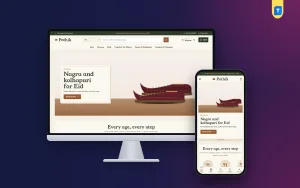
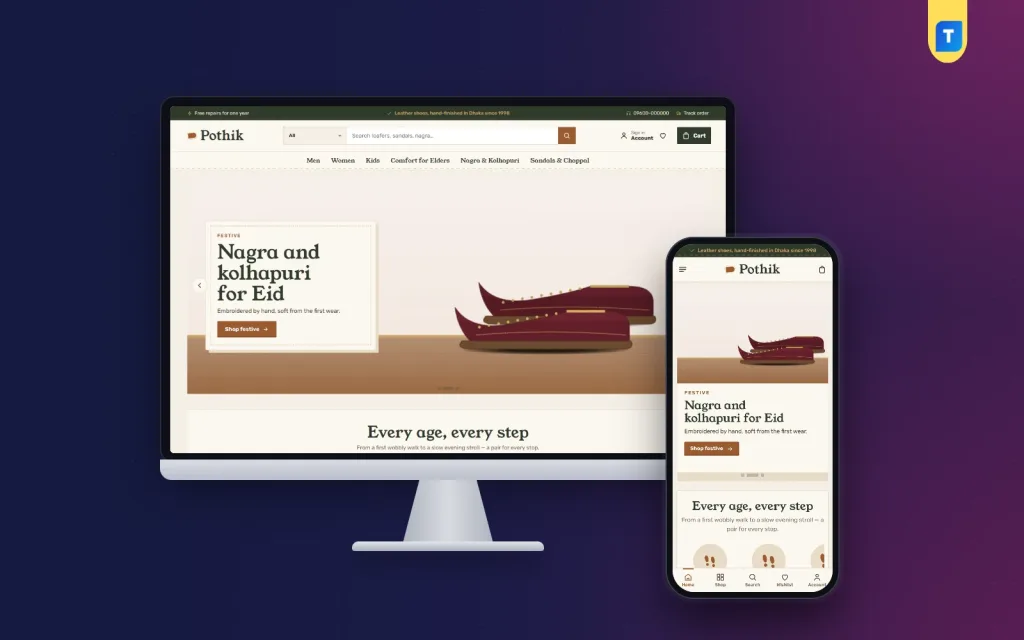
Once the plan is ready, the website becomes your counter. A good shoe ecommerce website shows the leather clearly, sorts pairs the way families shop and keeps sizes visible everywhere. Pothik is built around that idea. Its look is cream, cognac and dark olive, with Young Serif headings that feel like a painted shop sign, thin stitched rules under section titles and a hero card styled like a shoebox label.
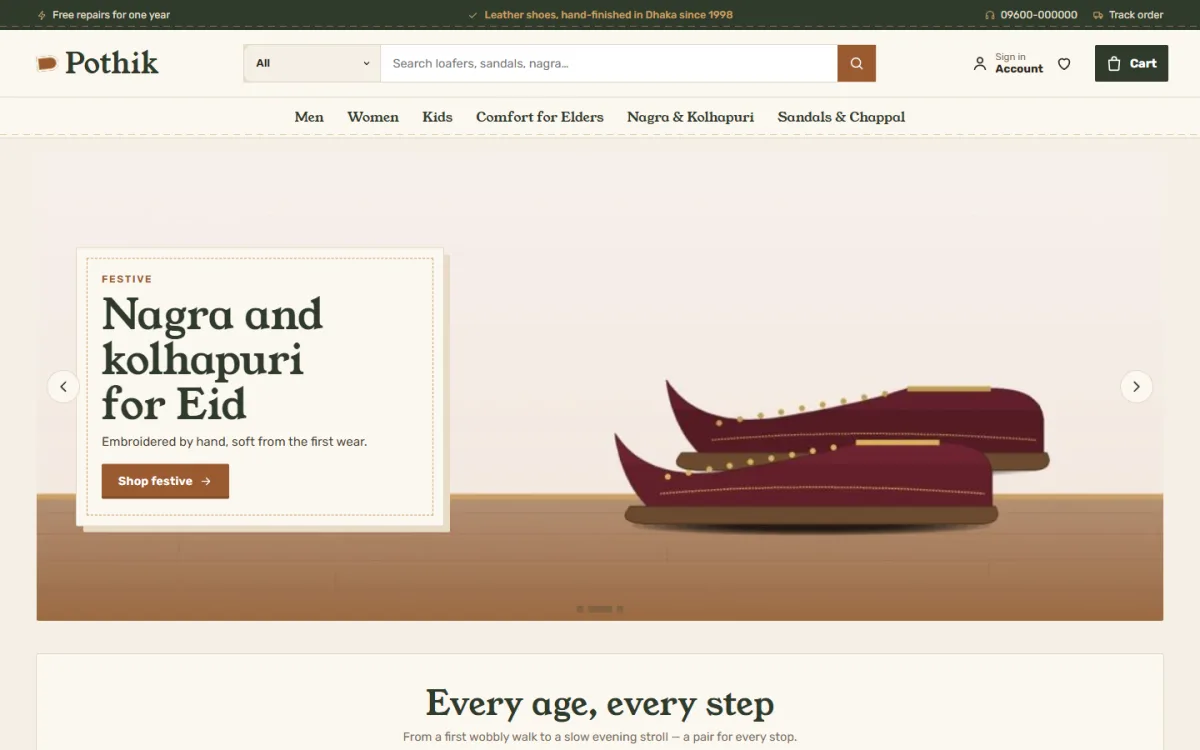
The desktop screenshot of the demo shows how this works in practice. A slim dark bar at the top carries a phone number and a Track order link. Below it, the search box has a category picker and suggests loafers, sandals and nagra. The menu reads Men, Women, Kids, Comfort for Elders, Nagra & Kolhapuri and Sandals & Chappal, and the hero slide promotes nagra and kolhapuri for Eid. The top bar wording is sample text, so write your own promises there.
The age path and the occasion shelf
Right under the hero sits Every age, every step. A footprint path runs from first steps to the golden years, and each stop opens a category or tag, so a mother looking for her toddler's first shoes and a son buying soft soles for his father both get there in one tap. Further down, the occasion shelf uses wooden shelves with brass name plates. The demo groups pairs under office, Eid and weddings, rain or shine, and around the house.
Pothik has 24 homepage blocks, fourteen switched on out of the box and ten in reserve. Others include framed category tiles, a New on the shelf row, Family favourites in tabs, two department banners with eight pairs each, four Made by hand craft cards, shop offers with a countdown and stock bars, shop by price tiles, workshop logos and your three latest cobbler's notes. Each block can be turned off or moved.
Shoebox cards and the product page
Product cards look like a shoebox, with a cognac lid stripe, stitching, a size sticker such as Size 39–45, a serif name and a leather-brown add button. The size sticker matters more than it seems, because a buyer sees at a glance whether a design comes in their size. On the product page, sizes and colours come from attributes, and the demo ships with size guides that buyers can check before they order.
What Your Customers See on a Phone

Most shoe buyers will reach your shop from a Facebook post on their phone, so judge any store by its mobile view first. In the Pothik mobile screenshot, the header shrinks to a menu icon, the logo and a cart. The hero picture sits above its text, the footprint stops of the age path begin right after the slider, and a bottom bar shown in the demo gives quick access to Home, Shop, Search, Wishlist and Account.
Product cards stay compact on phones, so two pairs sit side by side and shoppers scroll less. Sign in and registration open in a popup, so nobody loses their place while choosing a size. Test it yourself on an ordinary phone using mobile data.
Setting Up the Store Step by Step
Pothik needs WordPress 6.0 or newer with PHP 7.4 or newer, and it is tested up to WordPress 7.1. Go to Appearance, Themes, Add New, Upload Theme, choose the Pothik zip and activate it. Then open Pothik, Setup and install the bundled Themeve Commerce plugin in one click; it runs the cart, checkout, payments and courier tools. Activate your license under Pothik, License with the details from My Account in your Themeve account so updates arrive.
Next, run Pothik, Demo Import to load the Family Shoe House demo. It brings 35 products from 6 workshops, posts, menus and every page, including About, Cobbler's Notes, Delivery, Exchange & Repairs, FAQ, Our Stores, Track Order and Wishlist. The artwork and workshop names are invented samples, so swap in your own photos, sizes and stories before you share the link. Orders, products and store settings live under Shop in your dashboard.
Shape the look in Pothik, Theme Options. Switch homepage blocks on or off and drag them into place, or use the small arrows on a phone. Pick one of five palettes, Cognac & olive, Oxblood, Navy & tan, Espresso or Forest, or set each colour by hand. Four font pairs are included, starting with Young Serif and Rubik. A settings search, a sticky save bar and export, import and reset buttons keep the work tidy.
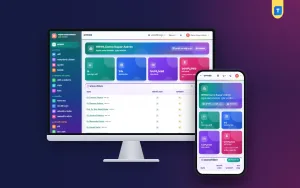
Before you commit, spend a few minutes with the live demo on your own phone, then open the demo dashboard to see where products, orders and settings sit. If WordPress is new to you, the WordPress documentation explains pages, menus and media in plain language and is worth an hour of reading before launch week.
Payments, Couriers and Exchanges in Bangladesh
Checkout in Pothik is a single page. Buyers can pay by bKash, Nagad, SSLCommerz, cash on delivery or manual payment, and an Order placed popup confirms the order. The Track Order page lets them follow the parcel later. Parcels go out with Steadfast and Pathao courier, each order gets an invoice, and SMS and OTP messages are built in. Coupons help during Eid, the wedding season or a quiet month.
Cash on delivery will be popular with first-time buyers, but shoes carry a special risk: a customer may refuse a pair at the door because it does not fit. Cut this down by putting the size guide in front of every buyer, calling to confirm larger orders and stating your exchange rules clearly. The demo's promise strip lists exchange, try at door, cash on delivery and repairs, so edit it to match exactly what your shop offers.
Facebook is still where most small Bangladeshi shoe sellers find buyers. Pothik includes Facebook Pixel and the Conversion API, so you can see which ads lead to orders, and new-order alerts reach you on Telegram while you are busy in the workshop. Post short videos of the leather and stitching, write captions in Bangla and English, and send ad traffic to an occasion or category page rather than the homepage.
Mistakes to Avoid in Your First Year
The biggest mistake is buying too many designs too early. Shelves full of single sizes look busy but sell slowly, and you end up cutting prices on pairs nobody wanted. The second is weak photos. Shoes need a side view, a top view, a sole view and a close-up of the stitching, all in the same light. If the cognac in your photo looks orange, buyers will send the pair back and leave unhappy comments.
Other common slips include no size guide, unclear exchange rules, slow replies and a shoe ecommerce website that still shows last Eid's banner in March. Update stock by size the day a size sells out. And do not try to sell every kind of shoe at once. Pick one lane and grow from it.
Frequently Asked Questions
Can I begin with only a few designs?
Yes, and it is usually the wiser route. A small range in full size runs teaches you what sells and keeps your money from being locked up in stock. Pothik lets you switch homepage blocks off, so a small catalogue still looks complete, and you can add departments, shelves and new rows as the range grows over the next few seasons.
How does Pothik handle sizes and colours?
Sizes and colours are set as product attributes, and each card shows a size sticker such as Size 39–45. The demo includes size guides that buyers can open before ordering. Writing real foot lengths for each design into those guides is the simplest way to reduce exchanges, so it is worth the effort for every new pair you add.
Is there a theme for sneakers and everyday shoes?
If your store sells sneakers and everyday pairs rather than leather shoes for the whole family, look at Kadam – Shoe Store WordPress Theme. Pothik suits shoe houses and workshops selling office shoes, sandals, school pairs, comfort shoes for elders and traditional nagra, kolhapuri and chappal under one roof.
Do I need to know coding?
No. Blocks, colours, fonts, shelves and the age path are all set in Pothik, Theme Options with switches, pickers and drag and drop. The bundled plugin installs in one click and the demo gives you a finished store to edit, so you can launch without a developer.
Opening Your Doors
Knowing how to start a shoe business comes down to a few honest steps: a focused range, reliable workshops, accurate sizes, clear photos, payment options people trust and a fair exchange policy. The website should carry all of that without getting in the way. If you sell leather footwear for families and want a store that feels like an old shop counter, set up Pothik – Leather Shoe WordPress Theme, line up your first pairs and open the doors.