Loyalty points examples are the quickest way to understand how a points scheme works and whether it would suit your shop. A customer buys something, earns a number, and that number gives them a reason to come back. The idea is old, but the details decide whether it works or gets ignored.
This guide gives you clear, practical examples from different kinds of shops. You will see how to set the earning rule, what rewards to offer, which mistakes to avoid, and how a small online shop in Bangladesh can run a simple scheme without a big budget.
Loyalty points meaning in plain words
First, the loyalty points meaning. Loyalty points are a score that a shop gives a customer for buying. The more the customer spends or the more often they buy, the higher the score. Later, the shop can reward the customer for having a high score.
That is all there is to it. A loyalty points system has three parts:
- Earning: what the customer does to get points, usually placing an order.
- Balance: the running total the customer can see.
- Reward: what the points are worth, such as a discount, a gift or early access to a sale.
The balance is the part many shops forget. A number that the customer can see and watch grow is what creates the habit.
Why a points scheme brings buyers back
Winning a new customer costs money in ads, discounts and time. Keeping an existing customer costs much less. A points scheme gives regular buyers a visible reason to choose your shop again instead of another page.
People like progress. A balance that climbs from 2,000 to 5,000 feels like something worth keeping. Even before you announce a reward, customers who see their number grow think twice before ordering elsewhere.
A scheme also tells you something useful. You can see who your best customers are, because their balances rise faster than everyone else's. That list helps with every offer and message you send.
Simple loyalty points examples for earning
The earning rule should be so simple that a customer can work it out in five seconds. Here are the most common forms.
- Points per taka spent. The customer earns 1 point for every 1 taka. An order of 2,500 taka gives 2,500 points. This is the easiest rule to explain.
- Points per order. Every order earns a fixed number, say 100 points, whatever the size. This favours frequent small buyers.
- Tiered points. Orders above a set amount earn more. For example, 1 point per taka up to 3,000 taka, and 1.5 points above that.
- Bonus points. Extra points for a first order, a product review, a birthday or a referral.
- Category points. Higher points on products you want to move, such as new arrivals or items with a higher margin.
For a new scheme, start with the first one. You can add bonus rules later, once customers understand the basics.
Loyalty points examples for rewards
Rewards give the points a meaning. Pick rewards that cost you little but feel valuable to the customer.
- Discount on the next order. For example, 1,000 points equals 50 taka off. Easy to understand and easy to track.
- Free delivery. Very valuable in Bangladesh, where courier charges are a common reason for dropping a cart.
- A small gift. A sample, a pouch or a card with the next parcel. It costs little and feels personal.
- Early access. Members see a sale or a new collection a day before everyone else.
- Special price on selected items. Points can give access to a member price on a few products.
- Cash-back style credit. Points turn into store credit that can pay part of an order.
Whatever you choose, set the value so that the reward is roughly 2 to 5 percent of what the customer spent. Higher than that and your margin suffers. Lower and nobody cares.
Loyalty points examples by type of shop
The best rule depends on what you sell and how often people buy it. Here are examples for common Bangladeshi online shops.
Grocery and household shop
People order every week. A flat rule of 1 point per taka works well, and a reward of free delivery after a set balance keeps them ordering from you.
Cosmetics and baby products
Buyers repeat the same items. Offer a small gift at a certain balance, such as a sample of a new product. It also introduces them to more of your range.
Fashion page
Customers buy before Eid, Puja and the winter season. Give bonus points for orders placed in the early weeks of a season, and a discount reward they can use on the next one.
Pharmacy-style and daily-use shop
Steady repeat orders suit a simple points rule with a modest discount reward. Keep it plain, because these customers value speed.
Gifts and accessories
People return for the next occasion. A balance that carries over to birthdays and anniversaries gives them a reason to remember you.
How to plan your own points scheme
Use these steps before you switch anything on.
- Look at your average order. If most orders are around 1,500 taka, a reward at 1,000 points will arrive after one order. Is that what you want?
- Decide how often customers should buy. A reward after three orders suits a monthly shop. A reward after ten orders suits a weekly one.
- Set the reward value. Keep it near 2 to 5 percent of spend.
- Write the rule in one line. For example: "Earn 1 point for every 1 taka. 1,000 points = 50 taka off."
- Tell customers where to see the balance. Mention it on your order confirmation and your Facebook page.
- Review after a month. Check how many customers have points, and whether repeat orders went up.
Good loyalty points examples all share one trait: they are boring and clear. Do not make the rule clever. A rule that needs a table to explain will not be read.
Mistakes that make a scheme fail
Many schemes fail for the same reasons. Watch for these.
- A rule that is hard to explain. If staff cannot say it in one sentence, customers will not understand it.
- Points that are hidden. If the customer cannot see the balance, the habit never forms.
- Giving points twice. If an order moves from "processing" to "completed" and back, some systems award points again. Points should be given once per order.
- Rewards that are too small. Customers will ignore a gain they cannot feel.
- Rewards that are too big. A scheme that cuts your margin to nothing is not worth running.
- No communication. Tell people about the scheme, or it might as well not exist.
- Too many rules. Start with one earning rule and add later.
How to measure whether it works
You do not need complex analytics. Track a few numbers every month.
- Repeat order rate. What share of customers bought again within 60 days?
- Average order value. Are members spending more per order?
- Number of members with a balance. More active balances mean more engaged customers.
- Reward cost. How much did the rewards you gave cost in total?
- Customer questions. If people keep asking how it works, your message is not clear enough.
When you review your own loyalty points examples against real orders, change one thing at a time. Compare the numbers with the month before you started. If repeat orders rise while the cost of rewards stays low, the scheme is working.
A ready-made option for WordPress shops
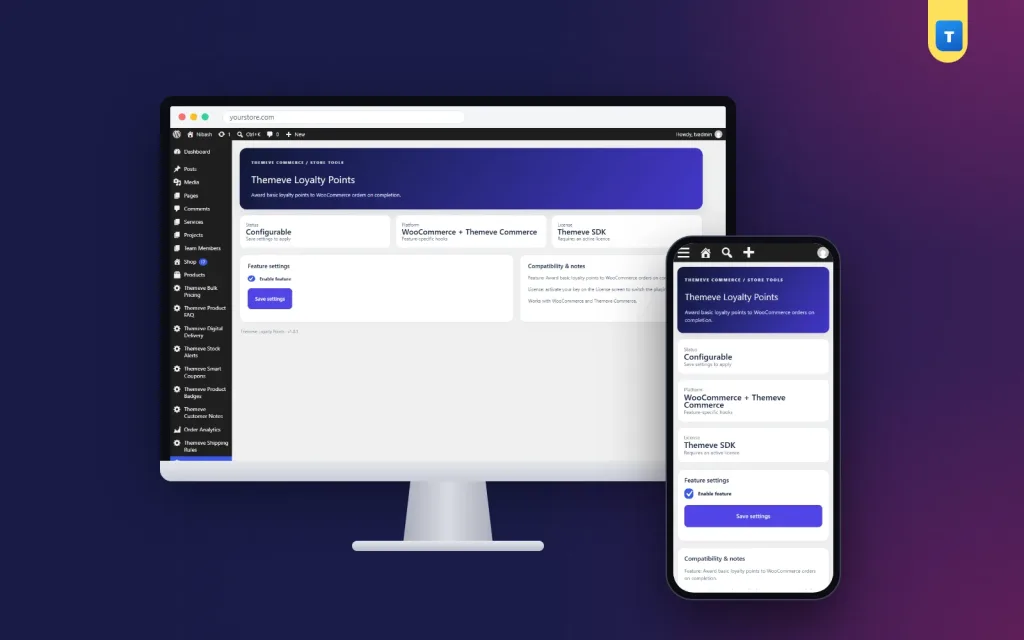
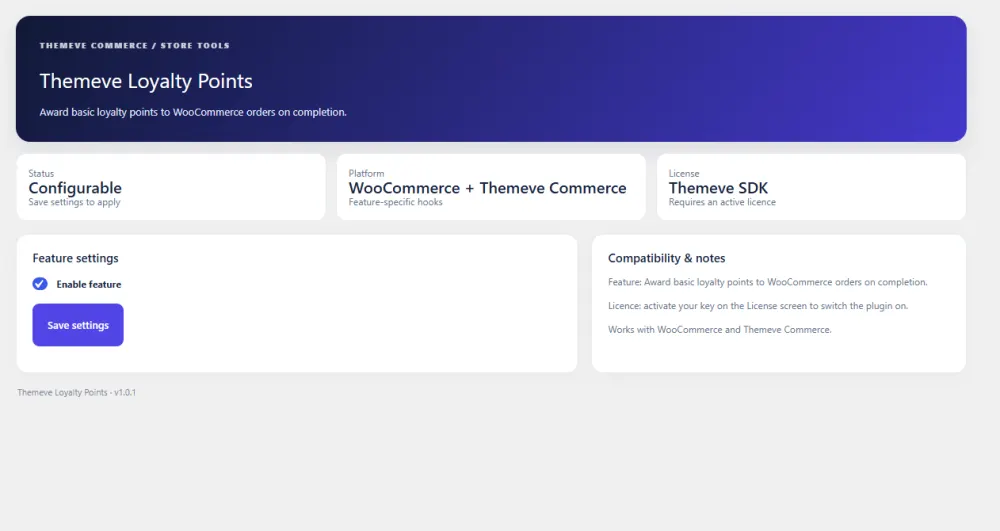
If your shop runs on WordPress, you can add a simple scheme without a developer. Loyalty Points gives customers 1 point for every 1 taka of a completed order, and it shows the balance on their My Account dashboard.
These are the facts worth knowing:
- Points are added automatically when an order is completed on WooCommerce.
- On Themeve Commerce, points are added when the payment completes.
- Points are given once per order only, so a status change never doubles them.
- There is a single on and off switch on one settings screen.
- It adds no JavaScript or stylesheet to your shop pages.
- It works on WooCommerce and on Themeve Commerce, and it starts counting as soon as it is switched on.
You decide how the points are rewarded, using any of the loyalty points examples above. You can read more on the Loyalty Points plugin page.
Seasonal campaign ideas for Eid and Puja
Seasons are the best time to push a scheme, because buyers are already active. Here are some ideas you can adapt.
- Double points week. Announce that orders in the week before Eid earn double. It creates urgency without a price cut.
- Welcome bonus. Give new customers a starting balance on their first order.
- Come-back reminder. Message customers whose balance is close to a reward and tell them how much more they need.
- Gift balance. Offer a small bonus when a customer brings a friend who places an order.
- Festival reward. Let customers use their balance for a special gift pack during the season.
These loyalty points examples work best when each campaign is short and clear. A time limit gives people a reason to act now.
Tips to get customers to notice their points
- Mention the points on every order confirmation.
- Pin a short post on your Facebook page that explains the rule.
- Add a line on your parcel card, such as "You earned 1,850 points with this order."
- Use the balance in your offers: "You are 150 points away from free delivery."
- Thank customers who reach a reward, in person or by message.
Even the best loyalty points examples fail if nobody sees them. A scheme that nobody sees cannot change behaviour. Visibility is as important as the rule itself.
A worked example with real numbers
Take a cosmetics shop in Dhaka. The average order is 1,800 taka, and the owner wants customers to come back every month. Here is how the numbers could look.
- The rule is 1 point for every 1 taka spent.
- One order earns about 1,800 points.
- The reward is 100 taka off at 2,000 points, which is about 5 percent of a typical order.
- So a customer reaches a reward after about two orders, which is close to the shop's two-month buying cycle.
- The reward cost for each redeemed 2,000 points is 100 taka, which a normal margin can absorb.
The owner then writes one line on the parcel card, tells regular buyers on Messenger, and checks repeat orders after 30 days. That is the whole plan. It needs no complex software and no long rules, and it can be changed after a month if the numbers do not look right.
Quick checklist before you launch
- The earning rule fits in one sentence.
- The reward value is about 2 to 5 percent of spend.
- Customers can see their balance in their account.
- Points are awarded once per order.
- You have told customers where to look and how to use the points.
- You have a date to review the results.
If you want to read more on the technical side, the official WordPress documentation is a good, reliable reference.
Frequently asked questions
What are some simple loyalty points examples for a small shop?
The simplest is 1 point for every 1 taka spent, with a reward such as 50 taka off at 1,000 points. Another is a flat 100 points per order and free delivery after a set balance. Both are easy to explain.
What is the loyalty points meaning for customers?
It is a score they earn by buying from you. The higher the score, the better the reward they can claim, such as a discount, a gift or free delivery.
Can you give loyalty points examples for a clothing shop?
Yes. Give 1 point per taka, add bonus points during the weeks before Eid or Puja, and offer a discount reward on the next order. Customers who buy each season will see their balance grow over the year.
How many points should a customer earn?
Aim for a reward value of roughly 2 to 5 percent of what they spent. Anything much lower feels meaningless, and anything much higher can hurt your margin.
Should points be given on every order?
Yes, but only once per order. Points should be added when the order is completed, and they should not be added again if the order status changes later.
Do customers need an account to see their points?
For the balance to show, they need to be logged in to their account. On a WordPress shop, the balance appears on the My Account dashboard.