
A health and wellness products website sells things people put on their skin, in their bodies and on their babies. That makes buyers more careful than in almost any other category. This guide explains how to plan such a site so that it earns trust: categories, product pages, honest claims, stock and expiry, payments, delivery and the content that brings buyers back, with notes for shops in Bangladesh.
Nothing here needs a big budget. It needs care, clear information and steady habits.
What makes a health and wellness products website different
A buyer choosing a T-shirt worries about size and colour. A buyer choosing a vitamin, a baby lotion or a face serum worries about safety, authenticity and whether it will work for them. Your site has to answer four questions on every product:
- Is it genuine? Where does it come from, and who imports or makes it?
- Is it right for me? Skin type, age, use and who should avoid it.
- Is it fresh? Expiry date and storage.
- What happens if something is wrong? Returns, replacements and a person to talk to.
Shops that answer these clearly win repeat buyers. Shops that hide them behind "inbox for price" lose them to the next tab.
Plan your categories
Group products the way people think about their needs, not the way your supplier's invoice lists them. A common structure is:
- Skincare, haircare and oral care
- Vitamins and supplements
- Personal care and hygiene
- Health devices and first aid
- Mother and baby
- Fragrance and makeup
- Sports nutrition and fitness
- Herbal and natural products
Ten or twelve top categories are plenty. Under each one, add filters for brand, price, concern and rating instead of creating dozens of tiny sub-categories.
Shop by concern
Many buyers search by problem, not product type: dry skin, hair fall, low energy, joint pain, baby rash. Tag products by concern and show a "Shop by concern" row on the homepage. It helps buyers who do not know product names.
Product pages that answer questions
The product page is where trust is won or lost. A strong page on a health and wellness products website includes:
- Clear photos of the real pack, front and back, so the label can be read.
- The product name, brand, size and price, with any old price shown honestly.
- What it is for and who it suits.
- How to use it, in short steps.
- Key ingredients, and warnings where they apply.
- Storage and expiry information.
- Delivery and return details next to the buy button.
- Reviews and a questions section.
A short FAQ on each product saves your team hours of repeating the same answers in chat.
Honest claims and legal care
This is the part most new shops get wrong. Do not write that a product cures, treats or prevents a disease unless the product is approved for that use and you can show it. "Supports healthy skin" is a description; "removes acne in 7 days" is a promise you cannot keep for every buyer.
- Copy claims only from the official pack or the maker's documents.
- Avoid before-and-after photos you cannot prove.
- Add a simple note that buyers with health conditions should ask a doctor.
- Check the local rules for selling medicines, supplements and devices online in your category.
Careful wording protects you legally, and it also builds trust. Experienced buyers distrust miracle language.
Stock, batches and expiry
Expired stock is a serious problem in this category. Build a routine: record expiry dates when stock arrives, sell the oldest batch first, and remove items before they get close to expiry. Mark products out of stock the moment they run out, so buyers are never told after ordering that half the parcel is missing.
For popular items that sell out, back-in-stock alerts let buyers leave an email and get a message when stock returns. For new launches, a pre-order option lets you collect orders before the shipment lands.
Prove that products are genuine
Fake cosmetics and supplements are common, and buyers know it. Show where your products come from: the importer, the distributor or the brand itself. Mention it on the About page and on product pages where it matters. If you can, show the importer sticker or batch number in a photo.
Reviews help too, but only real ones. Ask every buyer for a review after delivery and show both good and critical comments. A shop with only five-star reviews looks staged.
Payments and fake orders
Most buyers in Bangladesh still prefer Cash on Delivery for their first order, then move to bKash, Nagad or Rocket once they trust you. Offer all three paths:
- Cash on Delivery for first-time buyers.
- Send Money to your number, with the sender number and transaction ID checked before packing.
- A payment gateway such as SSLCommerz, or a wallet's merchant service, for automatic payment.
To cut fake COD orders, ask for a small advance on risky orders, such as the delivery charge, and block one phone number from placing many orders in a short time. Call new buyers before shipping large orders.
Delivery and packaging
Health and beauty items are small but fragile: glass bottles break, creams leak in heat and liquids spill. Pack with bubble wrap, seal lids with tape and keep heat-sensitive items out of direct sun before dispatch.
Inside your own area, your own rider can deliver the same day. Outside it, couriers such as Steadfast, Pathao and REDX are common. Set delivery charges by district or upazila, show them before checkout and offer free delivery above an amount to raise order size.
Bring buyers back
Health and wellness products are used up and bought again. A buyer who likes a moisturiser, a multivitamin or a diaper brand will need more next month. A health and wellness products website should be built around that cycle:
- Easy reorder from the order history.
- Loyalty points that turn into a voucher.
- Combo offers such as cleanser plus toner, or a monthly baby care bundle.
- Frequently bought together suggestions on the product page.
- A WhatsApp button for quick questions before buying.
Watch which search terms return nothing. They are a free list of products your buyers want.
Content that teaches and sells
Buyers in this category read before they buy. A blog with honest, simple guides brings visitors who are already interested: how to build a basic skincare routine, which sunscreen suits oily skin, what to pack in a home first-aid box, how to choose a baby lotion. End each post with links to the products it mentions.
Write for people, not for search engines. Google's guide to helpful, people-first content explains why clear, accurate pages earn more trust. A health care products website that teaches carefully builds a name that ads cannot buy.
Pricing, margins and offers
Price is easy to compare in this category, because the same branded serum or vitamin is often sold by several shops. Do not try to be the cheapest on everything. Be fair on the products people compare most, and earn your margin on bundles, your own label or harder-to-find items.
Show the real old price only when the product was really sold at it. Fake discounts are easy to spot and damage trust on a health and wellness products website faster than a slightly higher price. Tier prices for multi-packs, combo offers and free delivery above an amount raise the order value without cutting the price of single items.
If you also supply parlours, gyms or small pharmacies, give them reseller accounts with their own discount instead of sending price lists by message.
Customer support and privacy
Buyers often ask personal questions before buying: about skin problems, pregnancy, a child's allergy or a health condition. Answer politely, keep the answers general and suggest a doctor when the question needs one. Never share one buyer's details or orders with anyone else.
Keep customer data safe. Use strong passwords and two-factor sign-in for staff, give each team member only the access they need and keep regular backups. A health and wellness products website holds sensitive purchase history, and buyers expect you to treat it with care.
Reply fast on WhatsApp and phone during working hours. A quick, kind answer often turns a question into an order and a regular customer.
Design and phone layout
The look of a health and wellness products website should feel clean and calm. Clean, light colours suit the category: teal, green or soft blue with plenty of white space. Use one colour for buttons and prices, and keep it the same everywhere. Product photos should sit on plain backgrounds so labels are easy to read.
Design for phones first. Most orders come from a phone, often late at night. Keep the header slim, show two products per row with large buttons, put a search panel with suggestions one tap away and make sure nothing scrolls sideways. Test on a cheap Android phone on mobile data.
Measure and improve
Check a few numbers each week: orders per day, average order value, repeat buyers, returns and their reasons, COD parcels refused at the door, and the time from order to delivery. Read every critical review and every complaint, and look for patterns. If three buyers say a cream arrived leaking, the fix is in your packing, not in your ads.
Ask a few regular customers each month what they wish you sold. Their answers, together with the search terms that return nothing, tell you which products to add next. Small, steady improvements like these matter more than a big redesign.
A launch checklist for a health and wellness products website
- At least 100 to 150 products with real photos, sizes, uses and prices.
- Expiry dates recorded for every batch in stock.
- Product claims checked against the official packs.
- Return, replacement and privacy pages written in plain words.
- COD and one mobile payment tested with real small orders.
- A courier account connected, or your own rider ready.
- Packaging tested with one glass bottle and one cream.
- WhatsApp and phone numbers shown on every page.
- Every page checked on a phone.
Launch with your strongest categories first, then add more as you learn what buyers ask for.
Template, hosted service or your own shop?
Some owners start with a hosted service that charges monthly. Others buy a design and connect it to a cart. A third route is a self-hosted shop where you own the data, the design and the customer list.
Before you choose a health care products website solution, place a test order on its demo from your phone. If you cannot find the delivery charge, the payment options and the return policy in two minutes, your buyers will not either.
Starting your shop with Nirmol
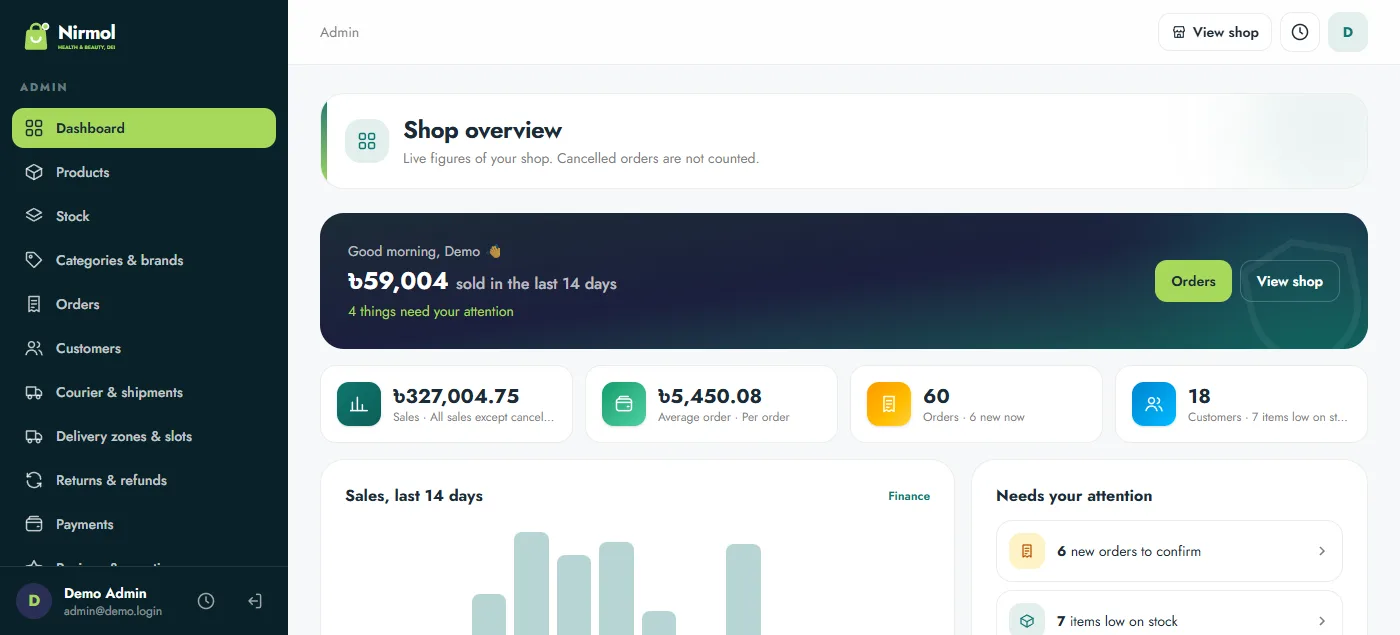
These parts come ready in Nirmol, the Laravel health and beauty products website. It is built for one shop with a teal and lime storefront: hero slider, service strip, Daily Discount, Best Selling and Top Selling bands, Shop by Category, Our Products tabs, Hot Deals with a countdown and a blog with tags and SEO fields.
It includes product pages with reviews, questions and a FAQ, back-in-stock alerts, pre-orders, tier prices, offers, loyalty points and reseller accounts.
Checkout takes district and upazila addresses, Cash on Delivery with an optional advance, Send Money with transaction ID, and bKash, Nagad and SSLCommerz gateways, with Steadfast, Pathao and REDX courier booking and a WhatsApp button.
Frequently asked questions
What should a health and wellness products website show on each product?
Clear pack photos, size, price, use, key ingredients, warnings, expiry or storage, and delivery and return details beside the buy button.
Can I sell supplements and medicines online?
It depends on the product type and local rules. Check what is allowed for your category before you list it.
How do I prove my products are genuine?
Name your importer or distributor, show labels and batch numbers in photos, and collect real reviews after every delivery.
Which payment methods should I offer?
Cash on Delivery for new buyers, plus bKash, Nagad or Rocket. Add a gateway for automatic payment when you have a merchant account.
How much does a health and wellness products website cost?
Hosted services charge monthly, custom builds cost the most, and a self-hosted shop is a one-time cost plus hosting and setup.