Starting an ISP business in Bangladesh looks simple from the outside: buy bandwidth, pull some cable, connect a few homes and collect a monthly bill. In practice it is a licensed, regulated business with real costs, long nights fixing fibre, and a constant fight to collect money on time.
Done well, it is also one of the steadiest local businesses you can build, because people now treat home internet like electricity.
This guide walks through the whole path in plain steps: the licence, the money you need, the network, choosing an area, pricing packages, billing and payments, staff and resellers, and how to grow. It is written for a first-time owner, a cable operator who wants to add broadband, or a small provider who wants to run things more professionally.
How the ISP business in Bangladesh works
Most home internet in the country reaches people through a chain. At the top are the international gateways and the IIG companies that bring bandwidth into the country. Below them are nationwide and divisional ISPs that buy that bandwidth in bulk. At the bottom are thousands of local providers who run cable or fibre through a neighbourhood and sell 5, 10, 20 or 40 Mbps packages to homes and shops.
A local provider earns the gap between what it pays upstream for bandwidth and what customers pay every month. Out of that gap come salaries, cable repairs, electricity for the switches, office rent and router replacements. Margins per customer are small, so the business only works at volume, with low churn and steady collection.
Three things decide whether a new provider survives the first two years:
- Coverage density. Two hundred customers in four nearby buildings cost far less to serve than two hundred spread over a whole union.
- Service quality. People forgive a higher price but not daily drops and a phone nobody answers.
- Collection. A provider with 600 customers and 25% unpaid bills is in more trouble than one with 400 customers who all pay on time.
Licence and legal papers you need
Internet service is regulated by BTRC, the telecom regulator. You cannot legally sell internet to the public without a licence in the right category. ISP licences are issued by area: nationwide, central zone, divisional, district and upazila (thana) level. A new local provider usually starts with an upazila or district licence, because the fees and conditions are lower.
Before applying, collect the usual papers:
- Trade licence from your city corporation, municipality or union parishad.
- TIN certificate and, for a company, the incorporation papers from RJSC.
- NID copies and photos of the owners or directors.
- Bank solvency certificate.
- Office address proof and a simple technical plan of the network.
Fees, categories and rules change from time to time, so check the current guidelines on the BTRC website or with a licensed consultant before you spend money on equipment.
Some people start as a reseller under a licensed ISP while their own licence is being processed. That can be a good way to learn, as long as the agreement with the upstream provider is in writing and you follow its rules.
Plan also for the paperwork that comes after the licence: annual renewal, revenue sharing or fees where they apply, VAT on bills, and records that show who your customers are. Keeping clean customer data from the first day saves trouble later.
How much money it takes to start
There is no single number, because a 150-user building network and a 2,000-user area network are different businesses. Still, the cost always falls into the same buckets. Write each one down in your ISP business plan before you buy anything.
- Licence and legal costs: application, licence fee, trade licence, company formation if you need it.
- Core equipment: a MikroTik or similar router for PPPoE, core switch, OLT if you use fibre (GPON or EPON), UPS and batteries.
- Distribution: fibre cable, splitters, ONUs or media converters, access switches, poles, clamps and boxes.
- Customer side: ONU or Wi-Fi router per home, if you include it in the connection fee.
- Bandwidth: your monthly upstream bill, often with BDIX and cache links on top.
- Office and staff: a small office, two or three line technicians, someone on the phone, and a manager.
- Software and website: billing, customer records, an online payment system and a company site.
- Working capital: at least six months of running costs, because the first months rarely cover themselves.
The most common mistake in a new ISP business in Bangladesh is to spend everything on equipment and nothing on working capital. Cable gets cut, a switch burns in a storm, and a month of slow collection leaves no money for bandwidth. Keep a reserve.
Building the network: bandwidth, fibre and routers
Start with the upstream. Ask two or three larger providers for prices on dedicated bandwidth, BDIX and cache. BDIX traffic and caches for popular video and social sites make the network feel much faster at lower cost. Ask about their uptime, backup links and how fast they respond at night.
For the last mile, most new networks now choose fibre (FTTH with GPON or EPON). It costs more at first than old UTP cable, but it carries more speed, does not suffer from lightning the same way, and needs fewer powered boxes on poles. In a dense building, a mix of fibre to the building and good cable inside can still make sense.
The heart of a small provider is usually a MikroTik router acting as the PPPoE server. Each customer gets a PPPoE username and password, and a profile that sets the speed of their package. Switching a customer off is as simple as disabling that PPPoE secret.
That is why it matters later that your billing system can talk to the router, instead of a staff member doing it by hand every evening.
Keep a simple map of every cable route, splitter and box from the start. When a customer calls with a red light on the ONU, the technician should know which box to open without guessing.
Choosing an area and pricing your packages
Walk the area before you build. Count buildings, look at the cables already on the poles, and ask shopkeepers and building guards which providers people use and what they complain about. In almost every ISP business in Bangladesh, your best start is a dense pocket that existing providers serve badly: new apartment blocks, a growing market, a college area with student messes, or a housing project.
Price your packages from cost, not from a rival's poster. Work out your cost per customer (bandwidth share, staff, cable repairs, office and software), add a margin, and then compare with what the area pays. Keep the list short. Three to five packages, from a basic home plan to a heavy user plan, are easier to sell and support than twelve.
Make every package clear: speed, price, BDIX or cache speed, whether YouTube and Facebook get extra speed, the connection fee, and what is included (ONU, router, setup). A clear package page cuts the number of calls your office gets from people who only want to know the price.
Billing, payments and running an ISP business in Bangladesh
This is where many small providers lose money without noticing. The classic model is a line man who collects cash at the door every month. It works, but it is slow, cash can go missing, and a customer who is not home on collection day stays unpaid for weeks. Meanwhile the connection keeps running.
A modern setup moves most of that online:
- Automatic bills made a few days before each connection expires, with an SMS reminder.
- Online payment with bKash, Nagad and cards, or at least Send Money to your number with a Transaction ID.
- Quick pay by Customer ID, so a customer can pay from their phone in a minute without a password.
- Automatic renewal the moment payment arrives, and automatic suspension after a few grace days.
- A payment log and due list the owner can check from a phone at any time.
A billing system that connects to MikroTik closes the loop: pay, and the PPPoE account is switched on; stay unpaid past the grace days, and it is switched off. Staff no longer decide who gets a few extra days, which is where a lot of quiet losses come from.
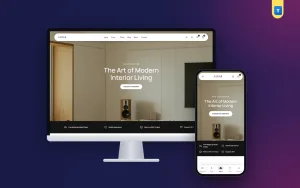
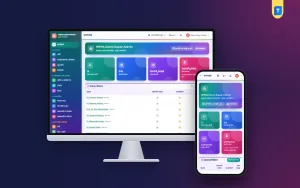
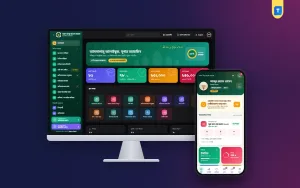
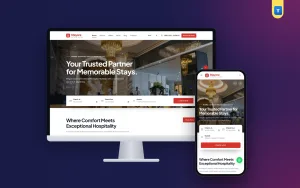
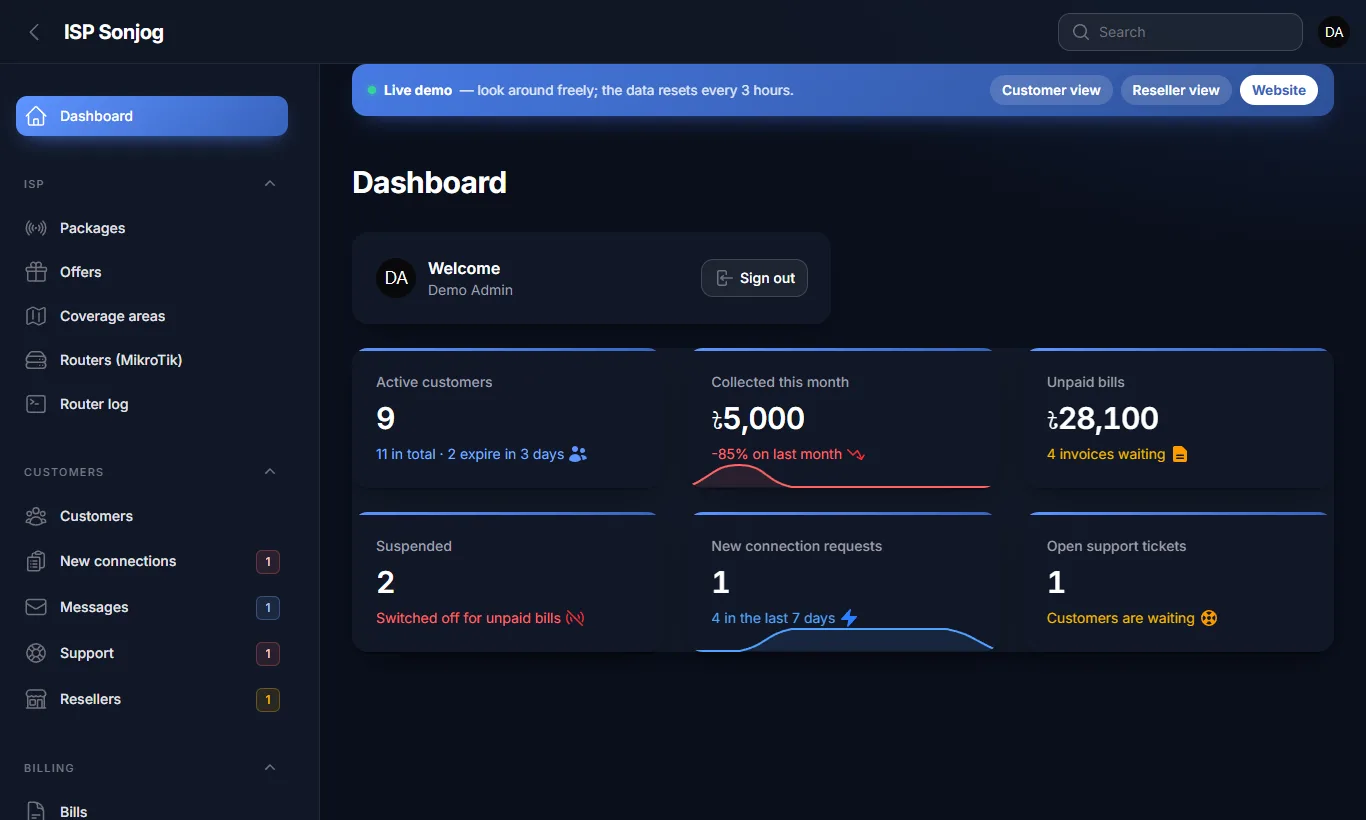
If you are setting this up now, look at a ready script instead of building from zero. ISP Sonjog is ISP billing software for Bangladesh that combines a company website, Selfcare, bKash, Nagad and SSLCommerz payments, a reseller wallet and MikroTik auto on/off in one Laravel dashboard. You can open the live demo and sign in as admin, customer or reseller to see how the monthly cycle works.
Staff, resellers and customer support
A small provider usually needs three kinds of people: technicians who pull cable and fix faults, someone who answers the phone and handles new connections, and an owner or manager who watches money and bandwidth. Train technicians to note every job, because repeat faults in one building tell you where the network is weak.
Resellers are a common way to grow an ISP business in Bangladesh without opening a new office. A reseller takes an area or a market, finds customers, and handles first-level support. In return they keep a commission on each bill.
The model works when the rules are written down: the commission rate, who owns the customers, how bills are paid, and what happens if a reseller leaves. A wallet system, where the reseller tops up money and renews customers from it, keeps the accounts clear for both sides.
For support, give customers more than one phone number. A support ticket page, a WhatsApp number and an SMS after every payment cut the call load and build trust. Track how long faults take to fix. If a building has the same problem every week, fix the cause, not just the symptom.
Growing and marketing your ISP
Most new customers will come from neighbours and word of mouth, so service quality is the first marketing of any ISP business in Bangladesh. On top of that, a few simple steps help:
- A real website with packages, a coverage map, a new connection form and a pay-bill page. People check online before they call.
- A Facebook page with clear package posts, outage notices and quick replies.
- Offers that make sense: a free month on a six-month advance, a free router with a higher package, or a building deal for a whole apartment block.
- Posters and leaflets in the buildings you already serve, with the hotline and package prices.
- Referral rewards for customers who bring a neighbour.
Watch a few numbers every month: active customers, new connections, disconnections, collection rate, average revenue per user and bandwidth cost per user. Review your ISP business plan every six months against these numbers, and expand into a new area only when the current one is stable and collecting well.
Growth also means planning upstream capacity ahead of demand. Evenings and Friday nights show the real load. If speeds drop at peak time, customers notice long before your reports do.
Frequently asked questions
Do I need a licence to start an ISP business in Bangladesh?
Yes. Selling internet to the public needs a BTRC licence in the right category, such as upazila, district, divisional or nationwide. Check the current rules before you invest.
How many customers does a small ISP need to break even?
It depends on your costs, but many small providers need a few hundred paying customers in a dense area before monthly income covers bandwidth, staff and repairs.
Is fibre better than cable for a new provider?
For most new networks, yes. Fibre costs more at the start but carries higher speed, needs fewer powered boxes and usually breaks less often.
What software does an ISP business in Bangladesh need?
At minimum: customer records, monthly billing, online payment with bKash and Nagad, a way to switch MikroTik users on and off, and a website with a pay-bill page.
Can I start as a reseller first?
Many people do. Working under a licensed provider teaches you the network and the customers, but get the agreement in writing and follow the provider's rules.