An islamic store website design template should look calm and respectful, and it should also sell. Customers who come for a panjabi, a bottle of attar or a prayer mat want to feel they are in the right place, and they want to order without trouble. Both goals depend on the layout.
This guide shows how to plan and build an online Islamic shop in Bangladesh. It covers the homepage, product pages, seasonal changes for Ramadan and Eid, gift boxes, payments, couriers, a launch checklist and common mistakes.
What an Islamic shop sells online
Islamic shops are rarely limited to one product type. A typical store in Bangladesh sells a mix like this:
- Clothing: panjabi, jubba, pajama and topi.
- Fragrance: attar, perfume oils and miswak.
- Prayer items: tasbih, prayer mats and Quran stands.
- Books: Quran, hadith collections and children's titles.
- Food: dates and Ramadan items.
- Gift boxes for Eid, weddings and Hajj returns.
This mix is the first design problem. Clothes need sizes and size guides. Attar needs volume and notes. Books need author and edition. A good layout lets each product type show the right details without clutter.
Know your buyers and your seasons
Sales in an Islamic shop follow the calendar. Plan your site around it.
- Ramadan: dates, prayer mats, tasbih, Quran and modest wear.
- Eid: panjabi, gift boxes, attar and children's clothes.
- Jumu'ah: a steady weekly rise in panjabi, topi and attar.
- Hajj and Umrah: ihram, travel sets, prayer items and gifts for returning pilgrims.
- Weddings: gift sets and formal panjabi.
Your homepage should move with these seasons. Put gift boxes on top before Eid. Move prayer times higher in Ramadan. In a quiet month, feature your best sellers and new arrivals. Choose an islamic store website design template where each homepage block can be switched off or moved, since you will change the page several times a year.
Plan your islamic store website design template needs
Before you compare designs, write down what you need. This stops you from picking something pretty that does not fit.

- List your product groups and how many products each has.
- Note which products need sizes, colours or volumes.
- Decide if you want to show prayer times on the site.
- Decide if you will sell gift boxes or sets.
- Collect photos on a clean, light background.
- Write a short "about us" in simple words.
- List your payment methods and your courier.
A good islamic store website design template saves you from rebuilding the page each season, but it cannot replace this planning step.
If you only have ten products, a simple design is enough. If you have hundreds across six groups, you need good category navigation and filters.
Colours, fonts and tone in an islamic store website design template
An Islamic shop should feel clean, warm and quiet. That does not mean plain. A few careful choices create the right feeling.
- Colours: ivory, emerald green, gold and sand are common and work well together.
- Fonts: a classic serif or a calligraphic style for headings, and a simple sans for body text.
- Patterns: light geometric or girih patterns as background accents, never behind text.
- Photos: natural light, clean backgrounds and no crowded flat lays.
- Language: respectful and plain. Avoid loud sale slogans.
Keep the page uncluttered. White space is part of the tone. Do not use music that plays on load, and avoid flashing banners.
Islamic store ecommerce website design: the homepage
A good homepage for an Islamic shop has more blocks than a general shop, because it carries content as well as products. A sensible order looks like this:
- A header with logo, search, account and cart.
- Round category tiles for panjabi, attar, tasbih, books and the rest.
- A main slider with one seasonal message.
- Prayer times for the five daily prayers and Jumu'ah.
- "Shop by need" cards, such as for prayer, for gifts and for home.
- New arrivals and best sellers.
- A gift box section.
- A daily reminder with a short hadith or ayah and its reference.
- Occasion cards for Jumu'ah, Ramadan, Eid, and Hajj and Umrah.
- Latest articles from your blog.
- A footer with address, contact and policies.
Islamic store ecommerce website design works best when the content blocks and the shopping blocks support each other. A prayer time panel or a reminder is a reason to visit, and the product rows are the reason to buy. You do not have to use every block. Pick the ones that help your customers, and drop the rest.
Prayer times and daily reminders
A prayer times panel gives visitors a reason to return. It can also add trust, since it shows the shop understands its audience. Keep it simple.
- Show the five daily prayers and Jumu'ah.
- Type the times yourself for your city, and update them when they change. This avoids relying on an outside service that may fail.
- Place the panel below the slider or in the sidebar, not above the header.
A daily reminder block shows a short hadith or ayah with its reference. Check every text with a trusted source before you publish it. Use short passages, give the reference, and keep the wording accurate. If you are not sure, leave the block off. Wrong text hurts trust far more than no text.
Navigation, search and filters
With so many product types, navigation matters more than in a single-category shop. A visitor looking for attar should not scroll past forty panjabi.
- Use round category tiles on the homepage, one for each main group.
- Keep the main menu to six or seven items.
- Add filters for size, colour, price and fabric on clothing pages.
- Let search suggest product names as people type.
- Show a "Shop by need" path for people who do not know the product name, such as gifts for parents or items for Ramadan.
- Keep the cart and account links in the same place on every page.
Most of your visitors will arrive on a phone, often from a Facebook post or a shared link. Make sure the first screen on mobile shows what you sell, and that the search bar is easy to reach with a thumb. Every extra tap loses some buyers.
Product pages for clothing, attar and books
One template must serve different product types. Here is what each needs.
Panjabi, jubba and topi
- A size guide by length and chest. Topi goes by head size.
- Fabric details and care notes.
- Colour options as variations, not separate products.
- Photos of the front, back and fabric close-up.
Attar and miswak
- Volume options, such as 3 ml, 6 ml and 12 ml.
- Notes on the scent and whether it contains alcohol.
- A clear, honest description of the origin.
Books, prayer mats and tasbih
- Author, publisher and edition for books.
- Size and material for mats and tasbih.
- Photos that show real scale.
Be careful with claims. Do not describe religious benefits of a product unless you can support them from a reliable source.
Gift boxes and seasonal bundles
Gift boxes are a strong seller before Eid and during the wedding season. A buyer wants to send one parcel without choosing ten items.
- Offer two or three ready sets at clear prices, such as a "Starter" and a "Premium" box.
- List exactly what is in each box, with a photo.
- Add a gift note field at checkout.
- State the last order date for delivery before Eid.
- Pack in simple, clean boxes. Presentation is part of the product.
- Offer a plain card with a short message, since many boxes go to family and friends.
For custom orders, add a short form or a WhatsApp link, since buyers often want to adjust a set.
Payments, couriers and delivery in Bangladesh
Match your checkout to how people already pay.
- bKash and Nagad, with the transaction ID checked before dispatch.
- A card gateway such as SSLCommerz.
- Cash on delivery for lower-value orders.
- A small advance by bKash on larger cash on delivery orders, to reduce fake orders.
Connect a courier such as Steadfast or Pathao so you can print labels and send a tracking link. Before Eid, couriers get busy, so tell customers the realistic delivery dates and close ordering early enough.
Show the delivery charge before the last step. Surprise costs are the most common reason for abandoned carts.
A ready-made option: Barakah
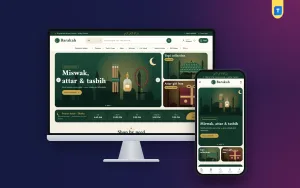
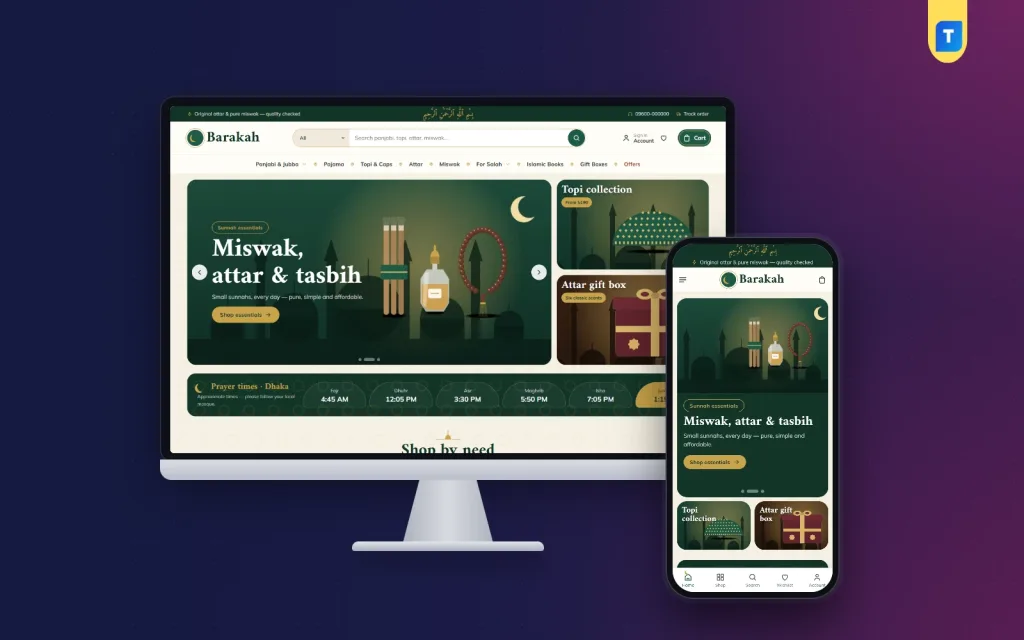
If you want a head start, Barakah is a WordPress theme for Islamic shops in Bangladesh. It uses ivory, emerald and gold with Amiri headings and girih patterns, and it gives you a working shop, not only a front page.
What it includes:
- 22 homepage blocks that you can switch off or re-order.
- A prayer times panel that you type in Theme Options.
- Shop by need cards shaped like a mihrab.
- A daily reminder block for a hadith or ayah.
- Gift boxes and blessed moments sections.
- Five colour palettes, from Emerald to Sand, and four font pairs.
- A size guide for panjabi and topi.
- A one-click demo with 43 products from 6 makers.
- bKash, Nagad, SSLCommerz and cash on delivery, with Steadfast and Pathao courier support.
- A login popup and one-page checkout.
The Themeve Commerce shop plugin is bundled, so WooCommerce is not needed. If you want an islamic store ecommerce website design that is ready for your own products, see the Barakah product page and open the live demo.
Launch checklist
Check each item before you announce the shop:
- Every product has a clear title, price and photo.
- Clothing has a size guide, and attar has volume options.
- Religious texts are checked against a reliable source.
- Prayer times are set for your city.
- Test orders work with bKash, Nagad and cash on delivery.
- The courier sends a tracking link.
- Return, delivery and privacy pages are live.
- Gift box contents are listed in full.
- The site loads quickly on a mobile connection.
Place a test order from your own phone and follow it to the door. Then ask a family member to place one without your help. If they get stuck, your customers will too.
Also read every page aloud once. Spelling mistakes in a shop that sells Quran stands and books look careless. Check Arabic text for correct marks and spacing, and have someone who reads Arabic confirm it.
Common mistakes to avoid
- Too much decoration. Patterns and gold should support the products, not hide them.
- Unchecked religious text. Always verify and give the reference.
- No size guide. It is the top reason for clothing returns.
- Blurry photos. Fabric and detail must be clear.
- Ignoring the calendar. Update the homepage before every season.
- Late Eid cut-off dates. Promise only what the courier can deliver.
- Exaggerated claims. Keep descriptions honest and plain.
After launch, review once a month. Check which groups sell, which products get views without orders, and what customers ask. Then improve the page, not the slogan.
If you want to read more on the technical side, the official WordPress documentation is a good, reliable reference.
Frequently asked questions
What should an islamic store website design template include?
It should include category tiles for each product group, size guides, seasonal blocks, gift boxes, simple prayer times and local payment options. It should also let you rearrange the homepage.
How long does it take to set up an islamic store website design template?
With ready content, a day or two. Most of the time goes on photos, product titles and policy pages, not on the design itself.
Can one design suit clothing, attar and books?
Yes, if the product pages support variations and good descriptions. Sizes for clothing, volumes for attar and author details for books all need their own fields.
How do I update the homepage for Ramadan and Eid?
Switch off blocks you do not need and drag the seasonal ones, such as gift boxes or prayer times, to the top. Change the banner message too.
Is an islamic store ecommerce website design possible without WooCommerce?
Yes. Some themes, including Barakah, bundle their own shop plugin for cart, checkout, payments and couriers.
Which payments should I offer?
bKash, Nagad and cash on delivery at least. Add a card gateway if you sell higher-priced sets, and ask for a small advance on large orders.
Do I need to code to change colours and fonts?
No. A good template lets you choose a colour palette and a font pair in the theme options, and you can set each colour yourself if you wish.