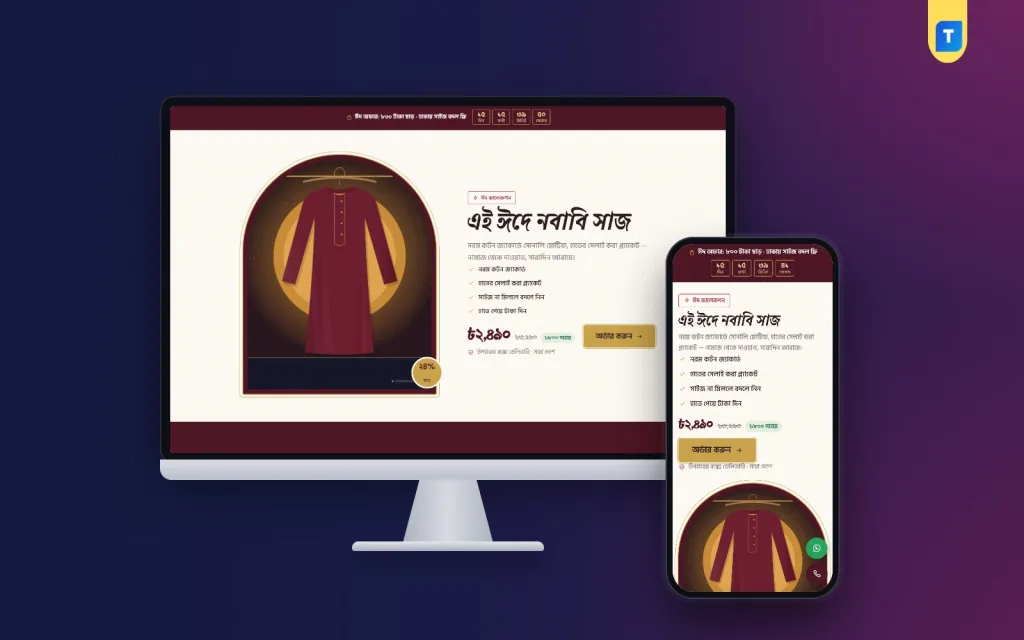
The best landing page website design ideas start with the buyer, not with colours or fonts. A landing page is one page that has one job: to turn a click from an ad into an order. If you sell clothes in Bangladesh, and especially if you run Eid campaigns, a clear landing page can bring in more sales than a full shop that buyers must search through.
This guide gives practical ideas you can use today. It covers the structure of the page, the content each section needs, size and fabric problems that are common in clothing, payment with bKash, Nagad and cash on delivery, and a checklist for launch. The examples come from panjabi sales before Eid, but the ideas suit any single product.
What a landing page does
A landing page is the first page a visitor sees after clicking your Facebook or Google ad. It has no big menu and no distractions. The visitor reads, decides and orders from a form on the same page.
This makes it different from a shop in three ways:
- It sells one product, or one product in several sizes.
- It follows a fixed story, from attention to trust to order.
- It repeats the promise of the ad, so the buyer feels they are in the right place.
Think of it as a shop assistant who talks to every visitor in the same careful way. It greets them, shows the product, answers the usual questions and then helps them order. It never gets tired, and it is open at midnight when many buyers scroll Facebook.
If the page is clear, a buyer can go from the ad to a placed order in under two minutes on a phone.
Start landing page website design ideas from the buyer's problem
Before you collect pictures or choose a theme, find out what stops people from buying. For a panjabi, the list is short:
- Which size will fit me?
- What is the cloth like, and will it be comfortable in summer heat?
- How do I wash and iron it?
- Will it arrive before Eid?
- What if the size is wrong?
Look at the comments and messages on your last few posts. The same questions come back every time. Each of those questions should have its own block on the page, placed in the order a buyer would ask it.
Wrong sizes cause exchanges, extra delivery trips and unhappy buyers. A page that solves the size problem before the order makes the biggest difference of all.
Layout ideas for the page structure
A simple order works for most clothing pages:
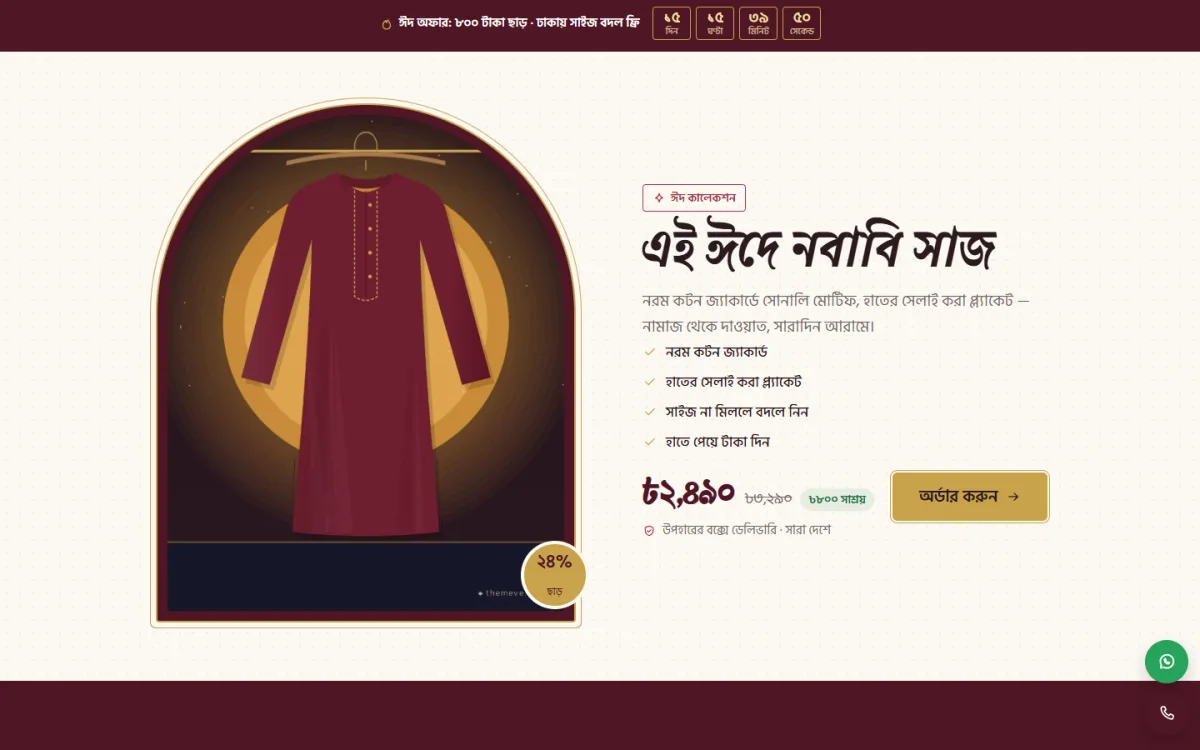
- Hero. A strong photo of the panjabi, a short headline and a visible button.
- Offer line. Price, discount and the Eid deadline, if the deadline is real.
- Design and colour. A few photos from different angles.
- Size finder and size chart. The tool that removes doubt.
- Fabric and care. Close-up photos and wash rules.
- Packages. One piece, two pieces, or a set with a pyjama.
- Reviews. Real quotes with names.
- Exchange promise. Clear words about what happens if the size is wrong.
- Order form. Short, with payment choices.
- Questions and answers. Delivery time, courier, exchange.
Each block should take no more than two phone screens. Short blocks keep people reading.
Landing page website design ideas for size and fit
Size is the biggest barrier in online clothing sales. These landing page website design ideas help buyers choose with confidence:
- A chest-size finder. The buyer enters a chest measurement, and the page tells them the size.
- A highlighted chart row. After the finder gives a result, the matching row in the size chart is marked.
- A button that picks the size. One tap fills the size in the order form, so there is no second guess.
- A how-to-measure picture. A simple drawing that shows where to place the tape.
- A full chart for careful buyers. Some people like to check each number.
Write the chart in inches, since most buyers measure that way. Add a line about fit, such as regular or a little loose, so buyers know what to expect.
Show the fabric and the care
Photos rarely show cloth well. A buyer cannot feel it through a screen, so the page has to help.
- Show a close-up of the weave in good daylight.
- Name the fabric and say how it feels.
- List two or three fabric points, such as breathable, soft or light.
- Give simple care rules: how to wash, how to dry, how to iron.
- Warn about colour that may run in the first wash, if true.
Buyers who know what they are getting, and how to look after it, are less likely to return the order.
Photos that work for clothing
Clothing sells through pictures. You do not need a studio, but you do need steady, honest photos.
- Use daylight near a window, with a plain wall behind.
- Show the front, the back and a side view.
- Show the collar, the buttons and the hem up close.
- Show the panjabi on a real person, ideally in the sizes you sell.
- Use the same colours in the photo as in the real cloth. Avoid heavy filters.
- Compress every image so the page loads fast.
A short note on models: if you cannot hire one, ask a friend or a family member who matches your most common size. Photograph the same panjabi on two different body types if you can. Buyers compare themselves to the person in the picture, and it helps them judge fit.
Never use another brand's photos. Buyers notice, and it harms trust.
Mobile ideas that raise orders
Most buyers in Bangladesh open your ad on a phone. A page that looks fine on a laptop can be a mess on a small screen. Design for the phone first.
- Use one column, large text and short lines.
- Make buttons wide enough for a thumb.
- Add a sticky order bar at the bottom of the screen.
- Add a floating WhatsApp button, since many buyers want to ask one quick question.
- Avoid auto-playing videos and pop-ups.
- Test on a cheap Android phone on a slow mobile connection.
If the page opens slowly or the form is hard to tap, many buyers leave before they see your offer.
Packages, prices and offers
Pricing for Eid needs some thought. Buyers compare prices on Facebook before they order. If your panjabi costs more than similar ones, the page must show why: better cloth, careful stitching, a size promise. If it costs less, do not make the page look cheap.
Show packages as cards. A single panjabi, a pair for father and son, and a set with pyjama give the buyer clear choices. Put the price and the saving on each card, and let the buyer pick the same package in the order form.
An Eid countdown can help buyers act, but only when the date is real. Say exactly when the last order will reach them before Eid, and stop the offer when it ends. A timer that resets every day is easy to spot and damages trust.
Show the delivery charge for inside and outside Dhaka before the buyer fills the form. Hidden charges are a common reason for cancelled orders.
Build a form that fits Bangladeshi buyers
Keep the form short. Every extra field loses some buyers.
- Name, phone number, full address, size and package.
- Cash on delivery as the default, with bKash and Nagad as options.
- The total price shown before submitting.
- A size-exchange promise near the button, in plain words.
After the order, show a thank-you message and call to confirm. A short call checks the address, confirms the size and cuts fake orders.
Write the thank-you message in the same tone as the rest of the page. Tell the buyer the size and package they chose, the total price and when you will call. This small step builds trust and lets them spot a mistake straight away.
In the busy weeks before Eid, plan for delivery too. Book your courier early, pack the orders the same day, and tell buyers the last date for orders that will arrive in time.
A ready-made option for panjabi sellers
If you want to avoid building each block yourself, Nobab is a WordPress theme made for clothing sellers who run Eid campaigns on ads. It shows one panjabi on one long page, with no site header or footer, and the order form sits inside the page.
From its feature list:
- A chest-size finder that picks the size.
- A size chart row that is highlighted for the buyer.
- A fabric and care close-up in an arch.
- 16 sections you can switch off or reorder.
- Size packages as cards, with a picker in the form.
- An order form with cash on delivery, bKash and Nagad.
- A size-exchange promise near the form.
- An offer line with an Eid countdown, a sticky order bar and a floating WhatsApp button.
- Four palettes and three font choices.
The demo shows a panjabi in five sizes. Any page can sell any product, so you can reuse it for other outfits. It needs WordPress 6.0 or later and PHP 7.4 or later. You still bring your own photos, text and prices.
Panjabi landing page website design checklist
Before you launch a panjabi landing page website design, check each point:
- The headline matches the ad.
- The first photo shows the real panjabi.
- The size finder gives the right size on a test.
- The size chart is in inches and easy to read.
- Fabric and care are explained.
- Prices and delivery charges are visible.
- The exchange promise is written clearly.
- Cash on delivery, bKash and Nagad all work.
- A test order reached your phone.
- Stock and courier are ready.
Build it step by step
- Buy a domain and hosting.
- Install WordPress and your chosen theme.
- Write all text first: headline, fabric notes, care rules, questions.
- Prepare and compress photos.
- Fill in the sections and hide those you do not need.
- Enter sizes, packages, prices and delivery charges.
- Connect the form to your phone or email.
- Place a test order and check the message arrives.
- Open the page on a slow phone connection.
- Start your ads with a small budget.
Many sellers skip the test order. A broken form during the Eid rush costs far more than the five minutes it takes to check.
Mistakes to avoid
- No size help, so buyers guess and return.
- No price on the page.
- A menu that lets buyers wander away.
- Photos that do not match the real cloth.
- A fake Eid countdown.
- A long order form.
- No exchange promise.
- No confirmation call after the order.
Fix these first. Small changes to the size block and the form often lift orders more than a new design would. When you test more landing page website design ideas, change one thing at a time and give each change a few days of traffic.
Watch three numbers: visits, orders and the cost of each order. Many visits and few orders point to the page. Few visits point to the ad. Also track how many orders you had to exchange, since that tells you if your size help works. If you use Nobab, you can edit the size chart and finder without rebuilding anything.
If you want to read more on the technical side, the official WordPress documentation is a good, reliable reference.
Frequently asked questions
What are good landing page website design ideas for a clothing seller?
Use one product per page, add a size finder, show fabric close-ups, offer cash on delivery, bKash and Nagad, and promise an exchange for wrong sizes. Keep the page short enough to read on a phone.
How long should a landing page be?
Long enough to answer the buyer's questions, short enough to read quickly. Ten to sixteen short blocks is common for clothing.
Can I use one landing page for all my products?
It is better to make one page per product or campaign, so the page matches the ad that brought the buyer.
Do I need a developer?
No. With a ready-made WordPress theme you install it, replace the text and photos, set prices and test an order.
Which landing page website design ideas help most with size problems?
A chest-size finder, a highlighted size chart row and a button that fills the size in the order form. These cut exchanges after the order.
When should I start my Eid campaign?
Start early, three to four weeks before Eid, and set a clear last date for orders that can arrive on time.