Good salwar kameez ecommerce website design starts with how three-piece outfits are really bought in Bangladesh: often unstitched, often with tailoring, and often in a rush before Eid. A website that ignores this will lose sales to a Facebook page and a Messenger chat.
This guide is for boutique owners, fabric sellers and small labels who want their own online shop. It covers the pages you need, how to show fabric and sets, how to sell stitching, how to set up payment and delivery, and a launch checklist. Follow it step by step, and you will have a clear plan before you spend money on design.
How salwar kameez is bought online
Before you design anything, understand the buyer. A salwar kameez shopper online is usually doing one of these things:
- Buying an unstitched three-piece set and planning to take it to a tailor.
- Buying an unstitched set and asking the seller to stitch it.
- Buying ready-to-wear in a standard size.
- Buying party or wedding wear and caring most about the look and the date it arrives.
- Buying kurtis, dupattas or single pieces to mix and match.
Each type of buyer asks different questions. The unstitched buyer asks about fabric and length. The stitching buyer asks about price and time. The party buyer asks, "Will it reach before the function?" Your site should answer all three without a chat message.
Pages and sections to plan first
Write the page list before you pick colours. It keeps the project simple.
- Home. Hero banner, categories, new arrivals, best sellers, offer, trust strip.
- Shop. Filters for fabric, occasion, colour, size and price.
- Category pages. Unstitched, ready-to-wear, party wear, kurti, dupatta.
- Product page. Photos, fabric, pieces included, size, price, delivery date.
- Fabric guide. What lawn, cotton, georgette, khaddar and chiffon feel like.
- Stitching and tailoring page. Rates, time and measurement guide.
- Size chart. For ready-to-wear sets.
- Cart and checkout.
- Delivery, exchange and returns.
- About and contact.
Keep the menu to seven items or fewer. Put the extra pages in the footer. Look at a few sites for salwar kameez website design ideas, but do not copy them. Note what you like, such as clear category tiles, and build your own version.
Salwar kameez ecommerce website design for the homepage
The homepage should feel like walking into a well-kept boutique. Show the newest sets first, and give clear ways to browse.
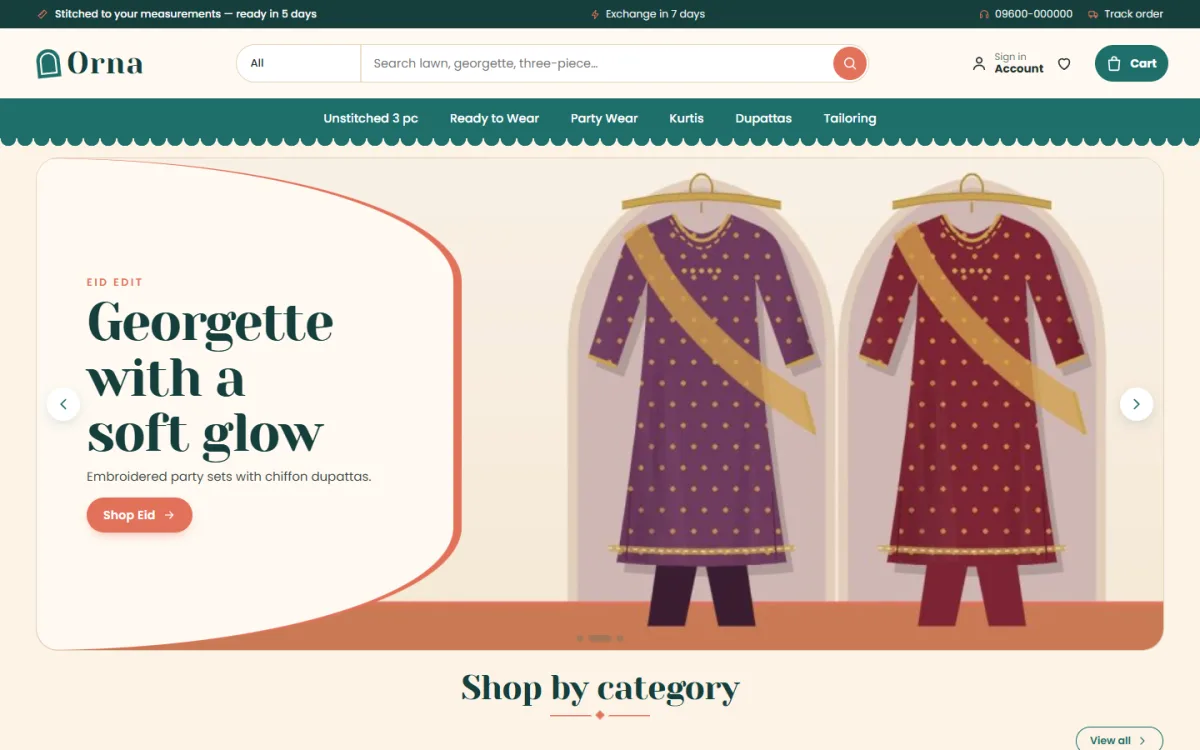
- Hero banner. One strong photo, one short line, one button. If you run a festival sale, say so here.
- Shop by category. Tiles with a photo and a name.
- New arrivals. Two rows of fresh pieces.
- Best sellers. Tabs by category let people browse without leaving the page.
- Occasion cards. Casual, office, party, wedding, Eid.
- Budget tiles. "Under 2,000", "Under 3,500" and so on, with products below.
- Offer block with a countdown. Festival weeks are the busiest time of the year, and a clear end date creates real urgency.
- Trust strip. Tailoring, exchange, delivery and cash on delivery.
Do not put every block on the page. Show what your customers use most, and keep the rest switched off.
Showing fabric the right way
Fabric is the heart of a salwar kameez. A buyer who cannot touch it needs words and pictures that do the job.
Add a fabric guide
A simple guide with a tab or section for each fabric works well. For each one, give:
- A close-up photo or swatch.
- The seasons it suits. Lawn and cotton for summer, khaddar for winter, georgette and chiffon for parties.
- How light or heavy it feels, on a simple scale.
- How sheer it is, on a simple scale, so buyers know whether they need a lining.
- The sets you sell in that fabric.
Write product details that help
On each product, list the pieces included: kameez length, salwar length, dupatta length. Say whether the dupatta is printed, plain or embroidered. State the fabric of each piece, because many sets mix them.
Selling stitching and tailoring
Many boutiques already offer stitching, but explaining the cost in Messenger can take half an hour. A website can do it in seconds.
A good stitching option on the product page has:
- A choice between no stitching, basic tailoring and designer tailoring.
- The fabric price, the stitching price and the total shown together.
- The date the outfit will be ready.
- One button that adds the fabric and the tailoring to the cart.
- A measurement guide or a place to upload measurements.
When you plan your salwar kameez ecommerce website design, treat the stitching option as a feature of the product, not a side note. Be honest about time. If tailoring takes ten days, say ten days. Missing an Eid deadline loses a customer for good, while a clear date builds trust.
A tailoring service also raises the value of each order. The customer pays for fabric and service in one go, and you collect the details at the start rather than chasing them later.
Salwar kameez website design ideas for photos
These salwar kameez website design ideas apply to every shop, whatever its size. Photos decide whether a customer trusts the fabric.
- Shoot in soft daylight. Strong flash changes the colour.
- Show the full set: kameez, salwar and dupatta laid out together.
- Add a model photo for the drape and the length.
- Take a close-up of the print or embroidery.
- Photograph the fabric against a plain background so the colour is true.
- Use the same style for all products, so the shop looks organised.
- Resize images before upload to keep the pages fast.
State the model's height and the kameez length. A short line such as "Model is 5 ft 4 in, kameez length 42 in" helps buyers imagine the fit.
Colours, shapes and mood
Pick a look that matches your customer. A bridal and party boutique may use gold and deep red. A casual lawn label may use fresh teal and cream. Think about the following:
- One main colour, one accent and a soft background.
- Rounded or arched shapes feel traditional. Square shapes feel modern.
- Keep text easy to read. Use dark text on a light background for product details.
- Choose a heading font with character and a plain font for body text.
- If your pages contain Bangla, test that the font looks right on phones.
The design should frame the clothes and not compete with them.
Salwar kameez ecommerce website design for mobile
Most of your buyers will be on a phone, many on a mobile connection that is not always fast. Design for the phone first.
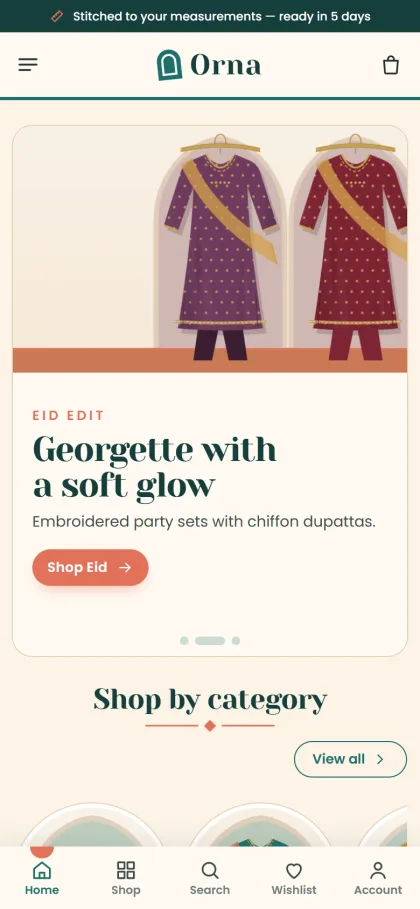
- Use large buttons and a sticky add-to-cart bar.
- Keep the filter panel easy to use with one thumb.
- Load images as the visitor scrolls.
- Avoid big sliders with heavy files.
- Keep checkout to one page.
- Test on an older phone before launch.
A shop that opens in two or three seconds sells more than a beautiful shop that takes eight.
Payment, checkout and delivery
Bangladeshi customers expect several choices at checkout.
- Cash on delivery for first-time buyers.
- bKash and Nagad for people who like to pay at once.
- Card payment through a gateway such as SSLCommerz.
- One-page checkout with name, phone, address, area and payment method.
- Delivery charge shown before the last step.
- Courier booking from the dashboard with Steadfast or Pathao.
- Order tracking or status updates by SMS or message.
For stitched orders, show two dates: the ready date and the expected delivery date. Customers plan around both.
Festival and Eid planning
Eid is the biggest sales season for a three-piece boutique. Plan for it weeks ahead.
- Load your Eid collection at least a month before.
- Set a last order date for stitching, and show it on the homepage.
- Use an offer block with a countdown and stock bars for popular sets.
- Add a gift option or a note field for family orders.
- Talk to your courier early about volume and cut-off dates.
- Test your site speed, because traffic spikes in the last week.
Turn the offer block off after the season. Old countdowns make a shop look neglected.
A ready-made option for three-piece boutiques
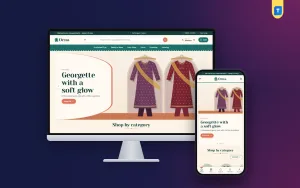
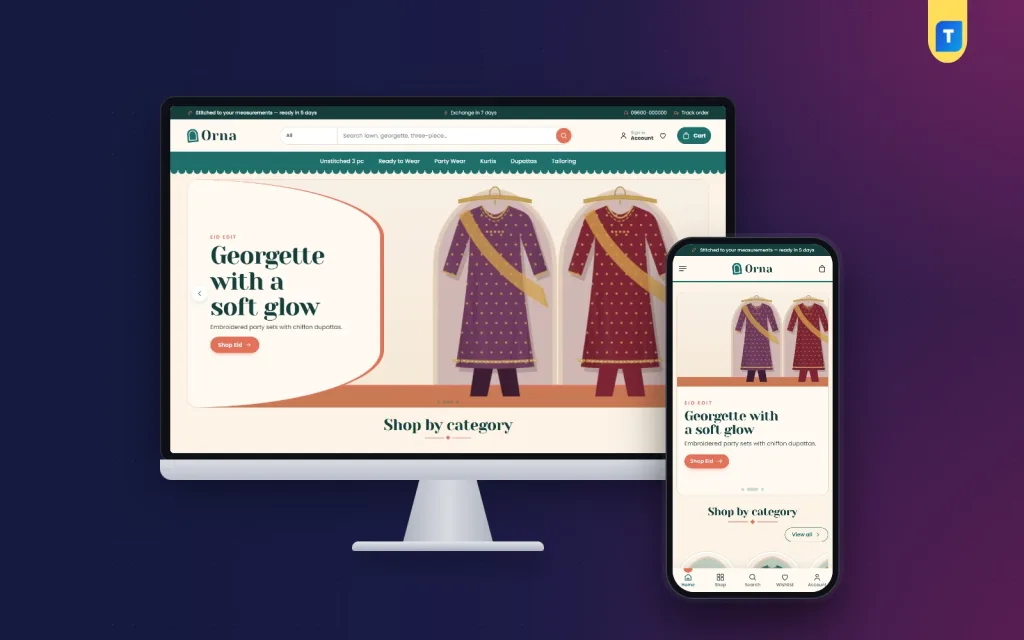
You can build this from a general fashion theme, or start with one made for the job. Orna is a WordPress theme for salwar kameez boutiques, with arched images, scalloped edges and a teal, coral and cream scheme.
From its product page, these are the parts that matter for this kind of shop:
- A "Stitch it for me" calculator that shows fabric price, stitching price, total and ready date.
- One button that adds fabric and tailoring together.
- A fabric guide for lawn, cotton, georgette, khaddar and chiffon, with light-to-heavy and opaque-to-sheer scales.
- 24 homepage blocks that you can switch on or off and drag into order.
- An Eid offer block with a countdown and stock bars.
- A one-click demo with 25 products from two labels.
- bKash, Nagad, SSLCommerz and cash on delivery, plus Steadfast and Pathao courier tools.
The store system comes with the theme, so you do not need a separate shop plugin. To see how the stitching block works, open the Orna salwar kameez theme page and try the demo.
What to write on your product and category pages
Strong words matter as much as strong photos. Search engines and shoppers both read your text, so write it with care.
- Use a clear product name: fabric, colour and type, such as "Printed Lawn Three-Piece, Teal".
- Open the description with one plain sentence on who the set is for.
- List the pieces and their lengths in bullet points.
- Add care advice: dry clean, gentle hand wash or machine wash.
- Write a short intro of 60 to 100 words at the top of each category page.
- Do not copy text from another shop or a supplier. Write your own.
Good salwar kameez ecommerce website design includes good writing, because a page with only a photo and a price gives buyers too little to trust.
Mistakes to avoid
- No fabric details. Buyers will message you, or leave.
- Unclear stitching terms. State the price, the time and what is included.
- Dark or yellow photos. Colour mistakes lead to returns.
- Missing dupatta details. Many buyers care about it as much as the kameez.
- Too many pop-ups. One login or offer pop-up is the most you need.
- Hidden delivery charge. Show it early.
- Forgetting the exchange rule. Put it on the product page.
Measuring what works
After launch, look at a few numbers every week. You do not need a complex report.
- Visitors and where they come from: Facebook, search or direct.
- Add-to-cart rate: if it is low, improve photos and details.
- Checkout drop-off: if people leave here, check the delivery charge and the form length.
- Top products: feature them on the homepage.
- Customer questions: add each repeat answer to the site.
Change one thing at a time. If you change five things together, you will never know which one worked. Treat your first design as a draft and let real orders guide the next version of your salwar kameez ecommerce website design.
Launch checklist
Check each item on a phone and on a computer.
- Every product lists its pieces, fabric and sizes.
- Each product has at least four photos.
- Stitching rates and ready dates are filled in.
- The fabric guide is complete.
- Cash on delivery, bKash and Nagad all work in a test order.
- The courier is connected and a test parcel can be booked.
- Delivery charges and times are shown.
- Exchange and return policy is written in plain language.
- The contact page and address are correct.
- HTTPS is on and the site opens fast on mobile.
- Backups are scheduled.
Place two or three test orders yourself, one with stitching and one without.
Moving from Facebook to your own website
Many salwar kameez sellers in Bangladesh start on Facebook. Keep the page, but let the website become the home of your catalogue.
- Link every Facebook post to the product page.
- Add the website address to your page bio and your Messenger auto-reply.
- Move your best sellers first, then add the rest in batches.
- Offer a small first-order code to bring repeat buyers across.
- Keep answering questions on Messenger, and add common answers to the site.
Over a few months, fewer buyers will need to ask you anything, because the site already answers.
If you want to read more on the technical side, the official WordPress documentation is a good, reliable reference.
Frequently asked questions
What does good salwar kameez ecommerce website design need?
It needs clear photos, fabric and piece details, a size chart, a stitching option with price and ready date, mobile speed, and checkout with cash on delivery, bKash and Nagad.
How do I sell unstitched salwar kameez with tailoring online?
Let the buyer pick the set, then choose no stitching, basic tailoring or designer tailoring. Show the fabric price, stitching price, total and ready date together, and add both to the cart with one button.
Which salwar kameez ecommerce website design works best on mobile?
A simple layout with large buttons, small images, a sticky add-to-cart bar and a one-page checkout. Test it on a low-cost phone before you launch.
Do I need WooCommerce to sell salwar kameez on WordPress?
No. Some themes come with their own store system, so you can sell without a separate shop plugin. Always check what is in the package.
How many products should I add at launch?
Start with 20 to 30 well-photographed sets. A small tidy range looks better than a large one with poor photos.
Can I show Eid offers with a countdown?
Yes. Many store themes include an offer block with a countdown and stock bars. Remember to turn it off when the season ends.