
A good skin care website does what a good beauty counter does: it listens first, then suggests. Buyers arrive with a problem, such as oily skin, dark spots or a dry winter face, and leave with a routine they trust. This guide covers how to plan such a site, from categories and product pages to ingredients, shades, payments, delivery and content, with notes for beauty sellers in Bangladesh.
You do not need a big brand to do this well. You need honest information, clear photos and a shop that is easy to use on a phone.
What buyers expect from a skin care website
Beauty buyers are careful. Before they order, they want answers to a few questions:
- Is it genuine? Fake cosmetics are common, and buyers know it.
- Will it suit my skin? Oily, dry, combination, sensitive or acne-prone.
- What is inside? Key ingredients, and anything they must avoid.
- How do I use it? When, how much and with what.
- Can I return it? What happens if it arrives damaged or wrong.
Shops that answer these on every product earn repeat orders. Shops that answer them only in chat lose buyers who do not want to ask.
Organise by need, not only by product type
Product categories are the base: skincare, makeup, haircare, fragrance, bath and body, and tools. But many buyers do not know product names. They know their problem. Add a second way in:
- Shop by concern: acne, dark spots, dryness, dull skin, pores, sun care.
- Shop by skin type: oily, dry, combination, sensitive.
- Shop by routine step: cleanse, tone, treat, moisturise, protect.
Tag every product with its concerns and skin types once, and these pages fill themselves. Filters for brand, price and rating finish the job.
Product pages that build trust
The product page is the heart of a skin care website. A strong page includes:
- Clear photos of the real product, including the back label.
- Name, brand, size or volume and price.
- Best for: the skin types and concerns it suits.
- Claim badges you can back up, such as fragrance-free or alcohol-free.
- Key ingredients, with the full list in an accordion.
- How to use, in short steps, and where it fits in a routine.
- Delivery and return details near the buy button.
- Reviews, ideally with photos, and a questions section.
Use accordions to keep long information tidy. The page stays light, and careful buyers can still read everything.
Ingredients and honest claims
Ingredient lists matter more every year. Many buyers check for niacinamide, hyaluronic acid, retinol or sunscreen filters, and many avoid fragrance or alcohol. Copy the full list exactly from the pack, and highlight the two or three ingredients that do the main work.
Be careful with claims. "Helps reduce the look of dark spots" is fair if the maker says so. "Removes pigmentation in 7 days" is a promise you cannot keep for every buyer. Avoid before-and-after photos you cannot prove, and never claim a cosmetic treats a disease. Honest wording protects you and earns trust from experienced buyers.
Ingredient spotlights
A short homepage section that explains one ingredient each month, what it does, who it suits and which products contain it, teaches buyers and sells at the same time.
Shades for makeup
Makeup adds one more problem: shade. Buying the wrong foundation or lipstick shade is the most common reason for unhappy makeup buyers. Help them choose:
- Shade swatches with real photos, not just coloured circles.
- Each shade as a variant with its own stock, so sold-out shades show clearly.
- A shade finder that suggests shades by skin tone or undertone.
- Shade links that open the product with a shade already chosen, for use in posts and ads.
A makeup website Bangladesh buyers trust shows shades on several skin tones, not only on one model.
Routines raise the order value
Skincare works in routines, and buyers like being told what goes together. A routine builder that suggests a cleanser, a serum, a moisturiser and a sunscreen for one skin type, and adds all four to the bag at once, helps the buyer and raises your average order.
Combo offers work the same way: a starter routine at a small discount, a cleanser and toner pair, or a travel kit. Show "frequently bought together" items on each product page.
Design that feels like beauty
Beauty shops sell a feeling as much as a product. Soft, warm colours such as plum, blush or nude, an elegant heading font and generous white space set the mood. Rounded or arch-shaped photo frames feel gentle and look different from general shops.
Keep the decoration calm. Auto-scrolling text bars and flashing banners make a beauty site feel cheap and are hard to read on a phone. A static line with your main promises, such as authentic products and cash on delivery, works better.
Photos
Use one background for all product photos, show texture shots of creams and swatches of colours, and add lifestyle photos of real people using the products. A gallery of buyers' own looks, shared with permission, is strong social proof.
Phone first
Most beauty orders come from phones, often from an Instagram or Facebook link. Design the phone layout first:
- A clean header with the menu, logo and bag.
- Search as a full panel with suggestions.
- Two products per row with large buttons.
- Accordions on product pages so details do not push the buy button away.
- A bottom tab bar for the bag and account.
Test on a cheap Android phone over mobile data. If a page takes too long, buyers go back to the post and message you instead.
Payments and fake orders
Cash on Delivery is still the first choice for many beauty buyers in Bangladesh, especially for a new shop. Offer COD alongside bKash, Nagad or Rocket Send Money, and add a gateway such as SSLCommerz once you have a merchant account.
To cut fake COD orders, verify phone numbers with a code, ask for a small advance on risky orders and call new buyers before shipping large ones. A list of incomplete checkouts shows buyers who stopped at the last step and may only need a reminder.
Delivery and packaging
Cosmetics are fragile. Glass bottles break, pumps leak and creams melt in heat. Wrap each item, tape lids and keep parcels out of the sun. Inside your city, your own rider can deliver quickly; outside it, Steadfast, Pathao and REDX are the common couriers.
Set delivery zones and charges, show them before checkout and consider free delivery above an amount. Write a return rule for damaged or wrong items, and make it easy: a request with a photo from the order page.
Pricing and offers
Branded beauty products are easy to compare, so be fair on the items buyers check most and earn your margin on bundles, gift sets and your own label. Show an old price only when the product was really sold at it; fake discounts are quickly spotted in beauty groups and hurt trust.
Plan offers around the calendar: Eid, Pohela Boishakh, winter skincare, wedding season and the monsoon. A welcome coupon for first orders, free shipping above an amount and a small gift with larger orders work better than deep discounts that train buyers to wait for sales.
Gift wrapping and a short handwritten note cost little and get shared on social media, which is free advertising for a new shop.
Content that teaches
A skin care website with useful articles grows steadily. Write simple guides: a basic routine for oily skin, how to choose a sunscreen, how to layer serums, how to find your foundation shade. Link each article to the products it mentions.
Write for people first. Google's guide to helpful, people-first content explains why honest, accurate pages earn more trust than pages stuffed with keywords. Running a makeup website Bangladesh readers return to means answering their real questions in plain words.
Customer care and skin questions
Beauty buyers ask personal questions: whether a cream is safe in pregnancy, what to use on a teenager's acne, why a serum stings. Answer kindly and generally, point to the ingredient list, and suggest a doctor or dermatologist when the question is medical. Never guess.
Keep a small library of saved replies for the questions you hear most, and turn the best ones into product FAQs. A skin care website that answers before the buyer asks saves your team hours each week.
Treat buyer data with care. Purchase history can reveal private details, so use staff roles, strong passwords and two-factor sign-in, and never share one buyer's orders with anyone else.
Choosing the software
There are three common routes. A hosted builder is quick but charges monthly and may not support local payments and couriers well. A blog platform with shop plugins is flexible but can become slow and fragile as plugins pile up. A self-hosted shop on a modern framework gives you the source code, local payments, couriers and no monthly fee, but needs some setup.
Whatever you choose, check that it supports what beauty needs: skin-type and concern tags, shades as variants with their own stock, ingredient and how-to-use fields, routine bundles, COD with fake-order protection and a phone layout that feels premium. Place a test order on the demo from your own phone before you decide. If your skin care website cannot show shades and ingredients cleanly, no amount of design will fix it.
Bring buyers back
Beauty products run out, and a happy buyer will reorder. Make that easy:
- Reorder from the order history in one tap.
- Loyalty points for every order.
- Back-in-stock alerts for sold-out favourites.
- Welcome and free-shipping coupons for first orders.
- Affiliate links for beauty creators who recommend you.
- A WhatsApp button for quick questions about skin types and shades.
Measure and improve
Each week, look at orders, average order value, repeat buyers, returns and their reasons, and search terms that found nothing. Read every review. If many buyers return one shade, the swatch photo may be wrong; if many ask about one product in chat, its page is missing an answer. A skin care website gets better through small, steady fixes.
A launch checklist for your skin care website
- At least 40 to 60 products with real photos, sizes, ingredients and how to use.
- Skin types, concerns and shades tagged on every product.
- Claims checked against the official packs.
- COD and one mobile payment tested with real small orders.
- A courier account connected and packaging tested.
- Return, privacy and terms pages written.
- A welcome coupon and one routine bundle ready.
- Every page checked on a phone.
Opening your beauty shop with Rupsha
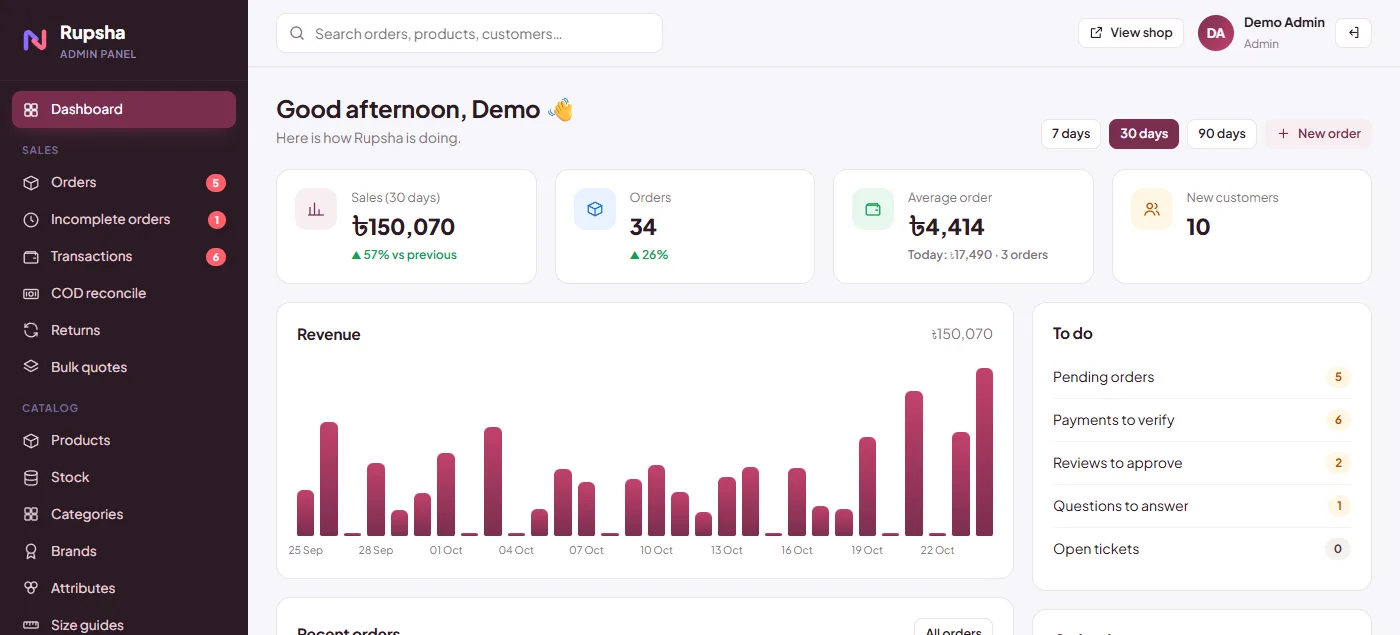
These parts come ready in Rupsha, the Laravel beauty ecommerce platform. It has a plum and blush storefront with arch photos, shop by concern, category arches, a four-step routine builder, an ingredient spotlight, a lipstick shade finder and a gallery for buyers' looks.
Product pages show claim badges, best-for skin types, shade swatches and accordions for ingredients and how to use. Checkout supports COD with optional advance, manual Send Money and bKash, Nagad and SSLCommerz gateways, with Steadfast, Pathao and REDX couriers, loyalty points, affiliates, coupons and a WhatsApp button.
Frequently asked questions
What should a skin care website show on each product?
Real photos, size, price, skin types, key and full ingredients, how to use, claims you can back up, and delivery and return details.
How do I prove my products are genuine?
Name your importer or distributor, show labels and batch numbers in photos, and collect real reviews after every delivery.
How can buyers choose the right shade online?
Show real swatch photos on several skin tones, make each shade a variant with its own stock and offer a simple shade finder.
Which payment methods do beauty buyers prefer?
Many first-time buyers choose cash on delivery. Regular buyers often switch to bKash, Nagad or a card.
How much does a skin care website cost?
Hosted builders charge monthly, custom builds cost the most, and a self-hosted shop is a one-time cost plus hosting and setup.