Good clothing website design starts with one simple idea: help a stranger find a piece they like, trust your shop, and pay without stress. Colours and fonts matter, but they come second to that job.
This guide is for people in Bangladesh who sell dresses, shirts, panjabi, bags or shoes and want a proper website instead of only a Facebook page. You will see how to plan the pages, choose the look, set up payment and delivery, and avoid the mistakes that cost sales.
What good clothing website design really means
Many owners think design means a pretty homepage. In practice, clothing website design covers everything a buyer touches, from the first photo to the order message on their phone.
A well-made shop does five things:
- It loads fast on a mobile connection.
- It shows the clothes clearly, with large photos and honest prices.
- It lets people find the right size and colour in a few taps.
- It explains payment, delivery and returns in plain words.
- It feels like one brand, not a mix of random parts.
If one of these fails, the best photos will not save the sale. A buyer who cannot find the size chart leaves. A buyer who is unsure about delivery charges leaves too.
Start with your buyer, not with your template
Before you look at any layout, write down who buys from you. Be specific. "Women aged 22 to 35 in Dhaka who shop at night on their phone" is useful. "Everyone" is not.
Answer these questions on paper:
- Who is the typical buyer, and what is her or his budget?
- Which device do they use, and on which network?
- What makes them nervous when they order online?
- Do they prefer bKash, Nagad or cash on delivery?
- How do they hear about you: Facebook, Instagram, friends or Google?
Your answers shape every later choice in your clothing website design. A label that sells premium linen shirts needs calm pages with space around each photo. A shop that sells daily kurtis at low prices may need tighter grids, price filters and clear offers.
Choose a clear brand identity first
Design is easier when the brand is already decided. You need a name, a logo, two or three colours and one or two fonts. Nothing more.
The name deserves time. A good name is short, easy to spell in English and Bangla, and free on Facebook, Instagram and as a domain. If you are still stuck, read a few designer boutique name ideas from different markets, then build your own from a word that matches your style: a flower, a season, a Bangla word with a soft sound, or a founder's initial.
Test every name with three checks:
- Say it aloud on the phone. Can a stranger write it down correctly?
- Search it on Google. Does another clothing shop already use it?
- Check that the .com or .com.bd domain is free.
Once the name is fixed, pick colours. Two or three is enough: one main colour, one neutral for backgrounds and one accent for buttons. Stay with them on every page.
Plan the pages before you design them
Page planning is the quiet part of clothing website design. A small clothing shop does not need fifty pages. It needs the right ones, placed where people expect them.
The core pages are:
- Home: your best pieces, main categories and one clear offer.
- Shop and category pages: grids of products with filters.
- Product page: photos, price, size, colour, add to cart.
- Cart and checkout: short and simple.
- Size guide: a chart with real measurements.
- Delivery and returns: charges, time, exchange rules.
- About: who you are and why people can trust you.
- Contact: phone, WhatsApp, Facebook and address.
Draw each page as a rough box sketch on paper. Where does the menu sit? Where does the cart button go? This takes thirty minutes and saves days later.
Clothing website design for the homepage: a shop window
Your homepage has one job: send people deeper into the shop. Think of it as a shop window on a busy street. People give it a few seconds, and strong clothing website design makes those seconds count.
A good order for the blocks is:
- A hero picture with a short line and one button.
- Three or four category tiles, such as women, men and accessories.
- New arrivals in a sliding row or a simple grid.
- Best sellers, so new visitors see what others like.
- A strip with delivery, cash on delivery and exchange details.
- Customer reviews or photos.
- A short brand statement and a sign-up box.
Keep each block clean. One strong picture works better than six small ones. If you have only twelve products, show fewer blocks. A small shop that looks finished beats a large one that looks empty.
Photography and product pages
Photos decide most clothing sales. People cannot touch the cloth, so the picture must do it for them.
Follow these basics:
- Use daylight near a window or a plain white wall.
- Show the front, back, a close view of the fabric and one worn photo.
- Keep the same background and light for every product.
- Crop to the same ratio, for example 4:5, so the grid looks tidy.
- Compress images before upload so pages stay light.
On the product page, put the price near the title. Show size and colour choices as buttons, not a long drop-down. Add a short note on fabric, length and care. Mention the model's height and the size she wears. These small details cut questions and returns.
Clothing website design for phone buyers
Most of your buyers are on a phone, often late in the evening. A shop that looks good only on a laptop will lose them, so treat the phone as the main screen.
Check these on a real phone, not only in a browser preview:
- The header shows only the menu, logo and cart.
- Buttons are big enough for a thumb.
- Text is readable without zooming.
- Product cards are compact, so two fit side by side.
- The checkout form asks only what is needed.
- Pages open in under three seconds on a mid-range phone.
Speed matters. Large uncompressed photos, heavy sliders and too many plugins slow a site down. Choose a light theme, compress your pictures and remove what you do not use.
Colour, fonts and spacing
You do not need to be a designer to get these right. For clothing website design, consistency matters more than skill.
Colour. Use light backgrounds for most shops. Dark pages suit streetwear, but they make soft fabrics harder to judge. Keep the accent colour for buttons and sale labels only.
Fonts. Pick one font for headings and one for body text. A serif heading with a plain body font gives a premium feel. A rounded font feels friendly and young. Do not use more than two.
Spacing. White space is not wasted space. It tells the buyer that your pieces are worth looking at. Crowded grids make good clothes look cheap.
Set up payment and delivery for Bangladesh
Payment is part of clothing website design too. Local buyers trust what they know. Offer the methods they already use, and explain each one clearly.
- bKash and Nagad: show the merchant number or use a gateway so payment is checked automatically.
- Cards and banking: add a gateway such as SSLCommerz for people who prefer cards.
- Cash on delivery: still the choice for many first-time buyers. Consider a small advance for high-value orders to reduce fake orders.
For delivery, work with a courier that gives tracking, such as Steadfast or Pathao. Show your charges before checkout, not after. Write the delivery time for Dhaka and for outside Dhaka separately. Tell buyers how exchange works, how many days they have and who pays the return charge.
A ready-made option: Shaaj
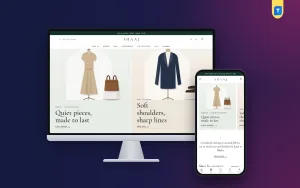
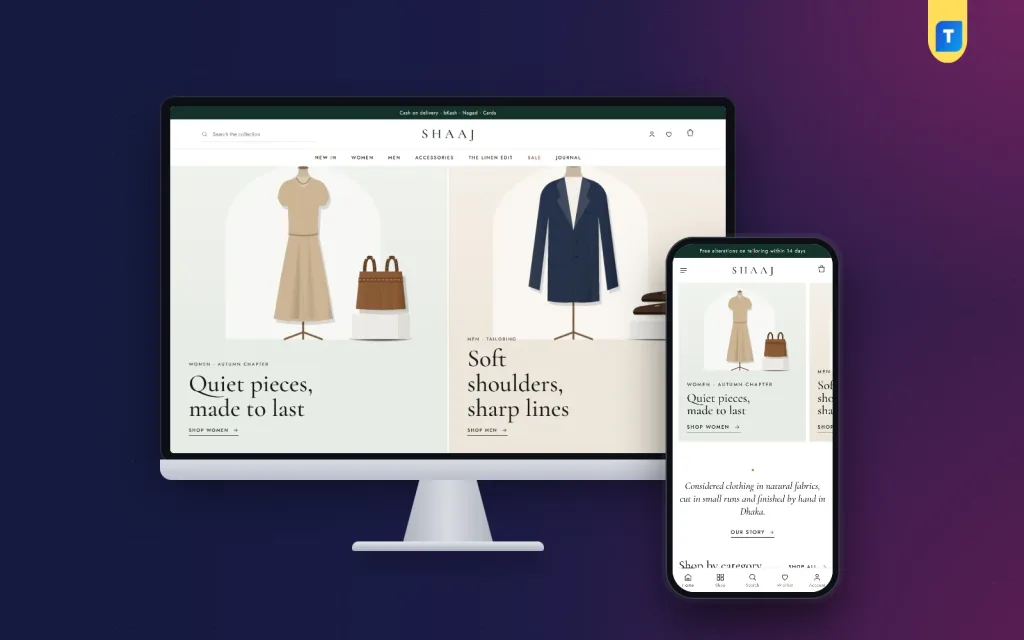
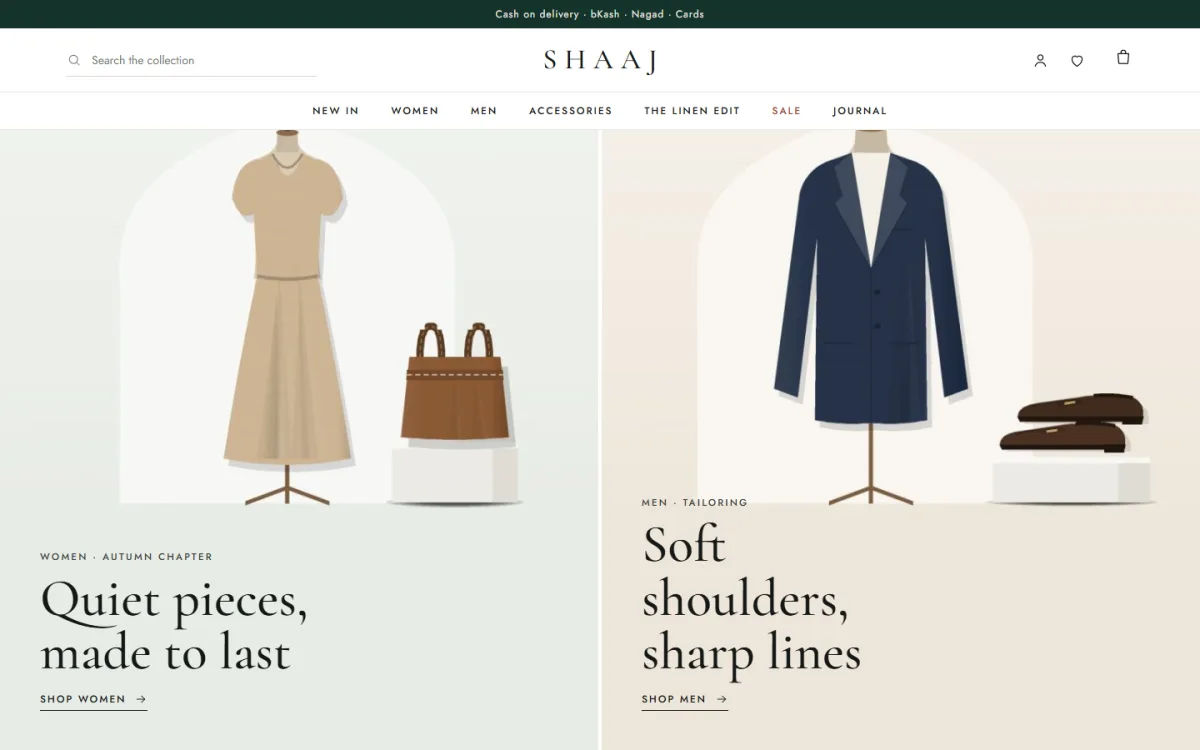
If you want a premium look without hiring a design team, Shaaj is one option to look at. It is a luxury boutique WordPress theme made for fashion labels in Bangladesh, with ivory pages, serif headlines and thin hairline details.
These facts come from the theme itself:
- 17 homepage blocks that you switch on, switch off and re-order.
- A two-panel hero for women and men, a private sale block with a countdown, and a gifts-by-price section.
- Five palettes and four font pairs, changed in Theme Options.
- No jQuery, with one stylesheet and one script file.
- Size guides, a reviews popup and a login popup.
- bKash, Nagad, SSLCommerz and cash on delivery, with Steadfast and Pathao courier support.
- A one-click demo with 40 products, and the Themeve Commerce shop plugin included, so WooCommerce is not needed.
It suits labels with a small, chosen range. If you only have twelve products, you can switch off most blocks and still have a finished page.
Build trust on every page
Online clothing buyers worry about fake shops, wrong sizes and refused returns. Good clothing website design can calm those worries. A theme such as Shaaj also gives you a reviews popup and size guides, which help here.
- Show a real phone number and a physical address if you have one.
- Add customer photos and reviews with names and dates.
- Write a clear returns page in short sentences.
- Use your own photos, not copied ones.
- Link to your Facebook and Instagram pages so people can check your history.
- Install an SSL certificate so the address starts with https.
Trust is built by many small things. None is dramatic, but together they decide whether a first-time buyer completes the order.
Words and search setup
Write words that sell without shouting
Good copy is short and specific. Skip big promises and describe the piece.
Compare these two lines:
- "Amazing premium shirt for you."
- "Linen shirt, 100 percent cotton-linen blend, relaxed fit, 28 inch length, machine wash cold."
The second one answers real questions. Use this pattern for every product: fabric, fit, length, colour, care. Add one line on how it looks when worn.
For category pages, write two or three sentences at the top. They help buyers and also help search engines understand the page. Use plain words that people really type, such as "cotton panjabi for Eid" or "leather office bag for women".
Basic search and social setup
A new shop needs visitors. Do the simple things first.
- Give each product a clear title and a unique description.
- Write a short page title and meta description for the home and category pages.
- Add alt text to photos, describing what is shown.
- Submit your sitemap to Google Search Console.
- Install the Facebook Pixel so you can see which posts bring buyers.
- Post new arrivals on Facebook and Instagram with a link to the product page.
Do not expect fast results. Search takes time, and no one can promise a position on Google. Social posts and word of mouth will bring your first buyers while the site grows.
Mistakes to avoid and a launch checklist
Mistakes to avoid
Most weak shops fail in the same few ways. Check this list of clothing website design mistakes before you launch.
- Too many colours, fonts and banners on one page.
- Small, dark or inconsistent photos.
- No size chart, or one that shows only S, M and L without centimetres.
- Hidden delivery charges that appear at the last step.
- A checkout that asks for an account before the order.
- Slow pages caused by large images and many plugins.
- No mobile testing.
- Copying another brand's text and pictures.
Launch checklist
Go through this list one item at a time before you share the link.
- Domain and hosting are active, and https works.
- All products have photos, price, size and stock.
- Test an order with each payment method.
- Test the courier booking and tracking.
- Read every page on a phone for spelling and layout.
- Check the size guide, delivery and returns pages.
- Set up order emails or SMS so you see new orders at once.
- Back up the site and keep the login details safe.
After launch, look at your orders every week. See which products people view but do not buy. Often a better photo or a clearer size note fixes it.
If you want to read more on the technical side, the official WordPress documentation is a good, reliable reference.
Frequently asked questions
How much does clothing website design cost in Bangladesh?
It depends on the route. A custom build by an agency can cost a large amount and take weeks. A ready-made WordPress theme costs far less and can go live in days, though you still pay for a domain and hosting. Many small labels start with a theme and upgrade later.
How many products do I need before I launch?
Ten to fifteen well-photographed products are enough to start. It is better to launch a small, clean shop than to wait until you have a hundred items.
Do I need a developer to manage the shop?
Not for daily work. With a good theme, you can add products, change colours and re-order homepage sections yourself. A developer helps only with custom changes.
What makes clothing website design different from other shops?
Clothes depend on size, fit and fabric, so buyers need more detail and better photos than for most products. Size guides, colour options and clear exchange rules are part of the design, not extras.
Should I offer cash on delivery?
For most Bangladeshi buyers, yes. Many people still prefer to pay at the door. You can limit risk by taking a small advance on expensive items and by confirming each order by phone.
Can I sell on Facebook and my website together?
Yes, and it works well. Use Facebook for reach and your website for the full catalogue, proper checkout and order tracking. Put the product link in every post.
How do I pick a name for my boutique?
Choose something short, easy to say and free as a domain and a Facebook page. Reading a list of designer boutique name ideas can start your thinking, but test the final name with real people before you print anything.