Good islamic website design ideas start with one question: what does a visitor need to feel before they trust the shop? For an Islamic store, the answer is calm, clear and respectful. People want to see honest prices, clear photos and a design that fits the goods they came for.
This guide walks you through the ideas that work, step by step. It covers colour, type, layout, pages, products, payments and mistakes to avoid. It is written for small shop owners in Bangladesh who sell thobes, attar, dates, prayer mats, books or Hajj and Umrah kits, but most of it applies to any Islamic website.
Start with the goal of the website
Before you pick colours, decide what the site must do. A design that suits a mosque page does not suit a shop. Write down one main goal and two smaller ones.
- Sell products: thobe, kurta, pajama, lungi, kufi, attar, honey, dates, black seed, miswak and gifts.
- Share information: prayer times, event notices, donation drives or Ramadan guides.
- Collect orders by phone or Facebook: a simple catalogue that sends people to WhatsApp or Messenger.
- Bring several sellers together: a bazaar where many merchants share one website.
Most shops need the first goal and a little of the second. Keep that in mind as you read the rest. Every design choice should help a buyer find a product and pay for it.
Islamic website design ideas for colour and mood
Colour sets the mood in the first second. Islamic design has a long tradition of rich, warm and balanced colours. You do not need to copy old patterns, but you can borrow the feeling.
- Deep green: calm, familiar and easy on the eye. Pair it with cream or white.
- Maroon with brass or gold: warm and formal. It suits attar, books and gift shops.
- Midnight blue with soft gold: good for Ramadan and evening themes.
- Parchment and sand backgrounds: softer than pure white and kind to long reading.
- Teal and turquoise accents: a nod to tile work, best used in small doses.
Pick two main colours and one accent. Use the accent only for buttons and prices. If every part of the page shouts, nothing stands out.
Check contrast
Dark text on a pale background is easy to read. Gold text on cream is not. Test every heading and button on a phone in daylight. If you squint, change the colour.
Choose type that is easy to read
Many Islamic sites use a decorative Kufic style for headings. It looks good in small amounts. Body text must stay plain.
- Use one decorative font for headings and one simple font for paragraphs.
- Keep body text at 16 pixels or larger.
- Avoid all-capital paragraphs. They are hard to read.
- If you show Arabic text, use a font with full diacritics and check every word with someone who reads Arabic.
Never place Quranic verses or the name of Allah as decoration where they may be covered, cropped or placed near items that could be disrespectful. When in doubt, leave it out and use a simple geometric pattern.
Patterns and shapes that feel right
Islamic website design ideas often lean on geometric patterns, the most common Islamic design element. They are also the easiest to overdo. Here is how to use them with care.
- Use a pattern as a thin band between sections, not as a full page background.
- Use octagon, star or arch shapes for category tiles.
- Keep the pattern lighter than the text, so it never fights with a heading.
- Repeat the same pattern across the site so it feels like one brand.
An arch-shaped frame around a product photo is a simple idea with a strong feel. It recalls a mihrab without any heavy decoration.
Plan the homepage in a clear order
Strong islamic website design ideas begin with a clear page order.
Most buyers decide in a few seconds whether to stay. A tidy order helps them. This is a homepage plan that works for most Islamic shops.
- Top bar: delivery note, phone number and language switch if you have one.
- Header: logo, search box, cart and a short menu.
- Hero banner: one clear offer, such as a Ramadan collection or new attar arrivals.
- Category tiles: six to ten categories with simple names.
- Best sellers: a row of products people buy most.
- Seasonal block: Ramadan, Eid, Jumu'ah or Hajj season.
- Small-buy block: items under a fixed price, such as under ৳500.
- Trust block: delivery, payment and return notes.
- Reviews or photos: real buyers, real products.
- Footer: contact, address, policies and social links.
You do not need all ten. A small shop with 30 products can run well with five of them.
Show prayer times without making the site heavy
A prayer times strip is a popular idea on Islamic sites. It is useful, and it tells a visitor that the shop understands its audience. But there is a catch. Many sites pull times from outside services, and these can fail or show the wrong city.
- Show times for one city, the one where your shop is based.
- Type the times yourself each week if you want full control.
- Keep the strip slim and put it near the top, not in the middle of the page.
- Check the times against your local mosque calendar.
If you cannot keep it updated, skip it. A wrong time hurts trust more than no time.
Design the product page for modest clothing, attar and gifts
The product page is where the sale happens. Islamic goods have special needs, so a generic layout is often not enough.
Clothing: thobe, kurta, pajama, lungi and kufi
For islamic bazaar website design ideas on clothing, the size guide comes first.
- Show a size guide with chest, length and sleeve in inches and centimetres.
- Show the fabric, such as cotton, linen or voile, and say how it feels.
- Add photos from the front, back and a close-up of the stitching.
- State the return rule for wrong sizes in plain words.
Attar, dates, honey and black seed
- Show weight or volume in a large font.
- Name the origin and the year of harvest if you know it.
- Say whether the attar is alcohol-free.
- Add a note about storage.
Prayer mats, Quran stands, tasbih and miswak
- Show the real size next to a common object, like a hand or a book.
- Name the material.
- List what is in the box.
Short, plain facts beat long, poetic lines. A buyer wants to know what it is, what size it is and when it arrives.
Islamic website design ideas for seasons: Ramadan, Eid and Hajj
Islamic shops live by the calendar. Sales jump before Ramadan, before both Eids and before the Hajj season. Plan your design for these peaks.
- Ramadan: a banner for dates, prayer mats, iftar sets and books, with a countdown if you wish.
- Eid: a block for panjabi, kurta, attar and gifts, with a clear last-order date for delivery.
- Jumu'ah: a weekly tile for attar, kufi and miswak.
- Hajj and Umrah: a kit rail showing ihram sets, travel pouches, prayer mats and guide books.
Make these blocks easy to switch off. After Eid, an old banner with an old date makes the shop look abandoned. A design where you can turn blocks on or off in a minute is worth more than a design with a fancy animation.
Handle many sellers on one site
Some owners run a bazaar, with many merchants under one name. Islamic bazaar website design ideas need a few extras.
- A row of merchant logos on the homepage.
- A merchant of the month block, so buyers discover new sellers.
- A merchant name on each product tile.
- A page for each merchant with a short story and their products.
- Clear rules for returns, since the buyer deals with one site even if the goods come from many hands.
A bazaar feels busy by nature, so the best islamic bazaar website design ideas use space with care. Use light backgrounds and clear spacing so that busy does not turn into messy.
Build trust in a market where people hesitate
Trust is the quiet half of every design. In Bangladesh, many buyers are still careful about online shops. They worry about fake goods, late delivery and hidden costs. Your design can answer these worries before they ask.
- Put your phone number and shop address in the header or footer.
- Show the payment options near the cart: bKash, Nagad, cards and cash on delivery.
- State delivery times for Dhaka and outside Dhaka.
- Add a Track Order page so buyers can follow their parcel.
- Show real photos, not only studio shots.
- Write an honest About page with the owner's name and a photo.
Cash on delivery still matters a great deal. If you hide it, you may lose many orders. Say clearly where it is available.
Make the site fast and easy on phones
Islamic website design ideas must also work on small screens. Most of your visitors will come from a phone, often on a slow network. A beautiful design that takes ten seconds to load will lose people.
- Compress every photo before upload. Aim for under 200 KB per product photo.
- Use two product cards per row on phones.
- Keep the phone header simple: menu, logo and cart.
- Make buttons big enough for a thumb.
- Avoid auto-playing video and large sliders with many slides.
Test with a mid-range Android phone and mobile data, not only office Wi-Fi.
A ready-made option
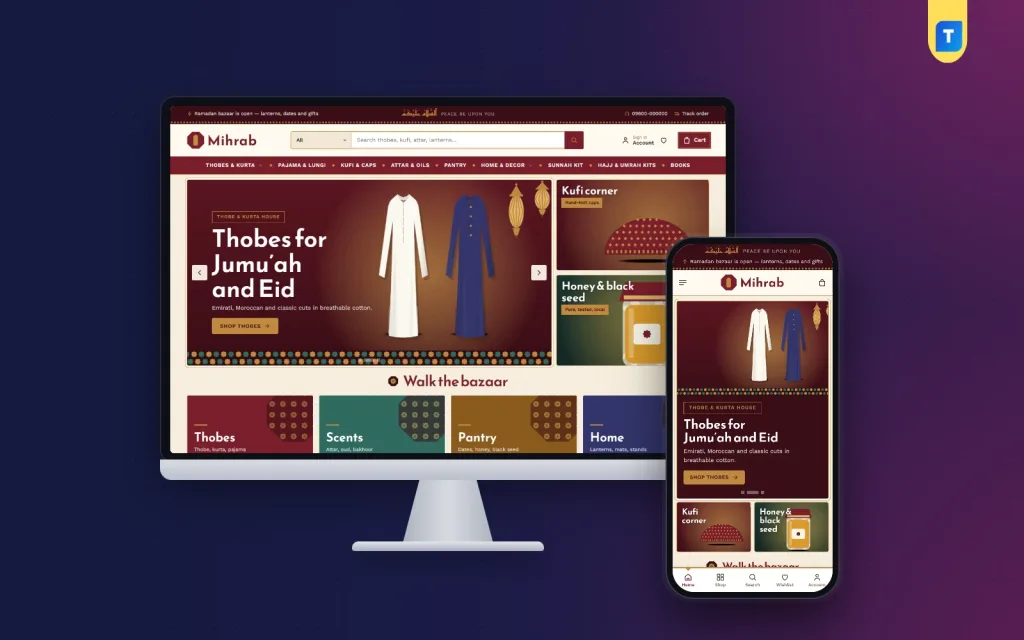
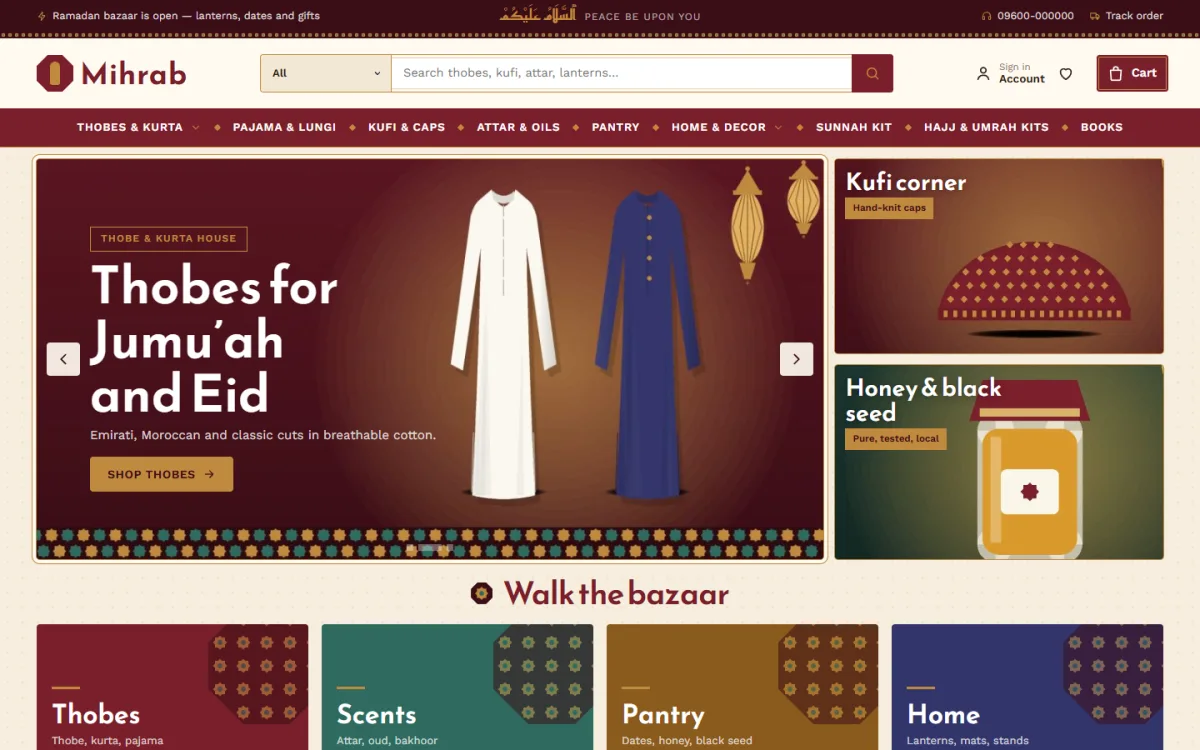
If you do not want to design every part from scratch, a ready theme can save weeks. Mihrab is an Islamic bazaar WordPress theme in maroon, brass and parchment. It has 22 homepage blocks that you can switch off or re-order, a salah times ledger you type yourself, octagon aisle tiles for categories and a Hajj and Umrah kit rail.
It also has merchant logos with a merchant of the month, an Under ৳500 block, seasonal tiles for Ramadan, Eid and Jumu'ah and a size guide for thobe and kufi. bKash, Nagad, cash on delivery and Steadfast or Pathao courier booking work through the bundled Themeve Commerce plugin. The demo has 39 products from 6 merchants, so you can see a full shop before you add your own goods. You can read the full list of features on the Mihrab product page.
Common mistakes to avoid
Many islamic website design ideas fail because of small errors, not big ones.
- Too many ornaments: a busy pattern behind text makes reading hard.
- Stock photos of strangers: buyers prefer your real goods.
- Music that plays on load: it startles people in a mosque, an office or a bus.
- Unverified Arabic text: a spelling mistake in a verse is a serious error.
- Images of people placed carelessly: choose models and styles that fit your audience's values.
- Old banners: an expired Ramadan sale in July looks careless.
- Hidden delivery cost: show it before checkout.
- No size guide: clothing returns will eat your profit.
A launch checklist
Use this list before you share the link with anyone. It is the last step of any plan built on islamic website design ideas.
- Home, shop, product, cart, checkout and contact pages all open without errors.
- Every product has a photo, a price, a size or weight and a short description.
- Size guides are correct for each clothing item.
- Prayer times, if shown, match the local mosque.
- Payment options work in a test order.
- Courier details and delivery charges are set.
- Policy pages for returns, privacy and terms are in place.
- The site loads in under four seconds on mobile data.
- Your phone number and address are visible.
- Seasonal banners show the right dates.
If you want to read more on the technical side, the official WordPress documentation is a good, reliable reference.
Frequently asked questions
What are the best islamic website design ideas for a small shop?
Keep it simple. Use two main colours, one decorative heading font, a thin geometric band between sections and clear category tiles. Add a size guide, a Track Order page and visible payment options. These matter more than heavy ornament.
Which colours suit an Islamic website?
Deep green, maroon with brass, midnight blue with gold and soft parchment backgrounds all work well. Choose two main colours and one accent, and test contrast on a phone.
Should I show prayer times on my shop website?
Only if you can keep them correct. A slim strip with times you type yourself is safer than a feed that may show the wrong city. If you cannot update it, leave it out.
Can I use Arabic text and patterns on my site?
Yes, with care. Have a person who reads Arabic check every word. Use patterns as thin bands or tile shapes, and do not place sacred text where it can be cropped or covered.
How many products do I need before I launch?
Thirty well-presented products are enough for a good start. It is better to have 30 with clear photos and honest details than 300 with missing information.
What are good islamic website design ideas for Ramadan and Eid?
Add a seasonal banner, a dates and prayer mat block, a gift block and a clear last-order date for delivery. Make these blocks easy to switch off when the season ends.
Do I need a developer to build an Islamic shop website?
Not always. A ready WordPress theme with a demo import lets you set up a full shop yourself. You then replace the sample products and text with your own.