A clear logistics management definition is simple: it is the planning and control of how goods, and the information about them, move and are stored from where they start to where they are needed, at the right time, in the right condition and at a sensible cost.
This guide explains that idea in plain words, breaks it into its main parts, gives real examples from Bangladesh and shows how companies measure and manage it day to day.
It is written for business owners, traders, students, new logistics staff and anyone who has to move goods for a living and wants to understand the whole picture.
Logistics management definition in plain words
Think of a shirt made in a Gazipur factory and sold in a shop in Europe. Fabric has to arrive on time, the finished shirts must be packed, trucked to Chattogram port, loaded on a ship, cleared at the other end and delivered to a warehouse and then to shops.
Someone has to plan each step, book the transport, track the cargo, keep the papers right and pay the bills. That work is logistics management.
Textbooks word it in different ways, but almost every logistics management definition shares four ideas: flow (goods and information moving), storage (goods waiting in the right place), timing (arriving when needed, not before or after) and cost (doing it without waste).
Logistics or supply chain?
The two words are often mixed up. Supply chain management covers the whole chain: choosing suppliers, buying, making, selling and returning. Logistics is the part that moves and stores things inside that chain. A simple way to remember it: the supply chain decides what to buy and make; logistics gets it there.
Inbound, outbound and reverse
- Inbound logistics brings raw materials and parts into the business.
- Outbound logistics takes finished goods to customers.
- Reverse logistics brings goods back: returns, repairs, recycling and empty containers.
The main parts of logistics management
Any useful logistics management definition breaks down into a handful of jobs. Most companies do all of them, even if they call them by other names.
Transport
Choosing the mode (road, rail, sea, air or a mix), the carrier and the route, then booking and tracking each move. Transport is usually the largest logistics cost.
Warehousing
Storing goods safely, receiving them, putting them away, picking and packing orders and shipping them out. Location matters: a warehouse near the port saves days for exporters; one near the city saves hours for retailers.
Inventory control
Knowing what you have, where it is and when to reorder. Too little stock stops sales; too much ties up cash and space.
Order processing
Turning a customer order into a shipment: checking stock, preparing papers, booking pickup and confirming delivery.
Packaging and handling
Packing that protects goods without wasting space or weight, and handling that avoids damage at each transfer.
Documents and compliance
Invoices, packing lists, delivery challans, bills of lading, airway bills, customs declarations and permits travel with the goods. A missing paper can stop a truck at a checkpoint or a container at the port for days, so document control is a quiet but vital part of the work.
Information and tracking
Every move creates data: booking numbers, statuses, documents, proof of delivery. Sharing that information with customers and partners is now as important as moving the goods themselves.
Logistics management examples from Bangladesh
A definition becomes clear with real cases. These logistics management examples show the same ideas at very different sizes.
1. A garment exporter
A factory in Ashulia ships ten containers a month to Europe. Logistics here means booking covered vans to Chattogram, coordinating with the shipping line and the freight forwarder, preparing export papers and keeping the buyer informed of each step. A delay of two days can mean a missed vessel and a costly air shipment instead.
2. An online shop
A Dhaka shop sends 300 parcels a day. Logistics means stocking the best sellers, packing orders by noon, handing parcels to couriers, tracking them, collecting cash on delivery and handling returns. The margins are thin, so every refused parcel hurts.
3. A cement or steel distributor
Heavy goods move from a plant to dealers in many districts by truck. Logistics means planning full loads, choosing routes, managing a fleet or hired trucks and making sure dealers never run out during the building season.
4. A cold-chain food company
Fish, dairy or frozen food must stay cold from the plant to the shop. Logistics means refrigerated trucks, cold storage, temperature records and very tight timing.
5. A project cargo move
A power plant needs a 60-tonne transformer moved from the port to a site in the north. Logistics means route surveys, special trailers, permits, police escorts and careful scheduling around bridges and river crossings.
6. A medicine distributor
A pharmaceutical company supplies thousands of pharmacies across the country. Logistics means depots in each division, vans on fixed weekly routes, careful expiry-date control and fast replacement of urgent items for hospitals. Here, a stock-out is not only lost sales; it can affect patients.
All six logistics management examples share the same pattern: plan, move, store, track and pay, with information flowing alongside the goods.
Why the logistics management definition matters for a business
Some owners think logistics is just "sending trucks". Using a fuller logistics management definition changes how a company decides and spends.
- Cost: logistics can take a large share of the final price of many goods. Small gains here go straight to profit.
- Customer trust: buyers judge a supplier by whether goods arrive on time, in good condition and with clear updates.
- Cash: faster delivery and less stock free up money.
- Risk: planning for strikes, floods, port congestion and festival rushes keeps the business running when things go wrong.
In-house or outsourced?
Many companies run some logistics themselves and buy the rest from a third-party logistics provider. A small exporter may use its own staff for papers but hire trucks and a forwarder. A large retailer may own warehouses but use couriers for the last mile. There is no single right answer; the goal is to know where each part is done best.
Common problems and fixes
- Empty return trips: trucks go full and come back empty. Sharing loads or booking return cargo cuts the cost per trip.
- Port delays: containers wait days at the port. Early papers and a good forwarder save time.
- No updates: customers call again and again. Recording each status and sharing tracking stops most calls.
- Festival rush: before Eid, trucks and drivers are scarce. Booking early and planning stock ahead avoids the crunch.
Each fix follows directly from the logistics management definition: plan the flow, time it well and keep the information moving with the goods.
How logistics is measured
You cannot manage what you do not measure. These are the numbers most logistics teams watch every week.
- On-time delivery rate: the share of shipments delivered by the promised date.
- Cost per shipment or per kilo: the true cost of moving each unit.
- Damage and loss rate: how many shipments arrive damaged or go missing.
- Transit time by route: how long each route really takes, not how long it should take.
- Order cycle time: from order to delivery.
- Inventory turns: how many times stock is sold and replaced in a year.
- Return rate: how many goods come back, and why.
Reading the numbers together
One number alone can mislead. A route with a high on-time rate but a high damage rate is not a good route. A cheap cost per kilo with long transit times may cost more in lost sales. Look at three or four numbers side by side every month, route by route and client by client, and act on the worst one first.
Chargeable weight
Freight is often priced by chargeable weight, the larger of the actual weight and the volume weight. A light but bulky box can cost as much as a heavy one. Knowing this helps shippers pack better and compare quotes fairly.
Tools that support logistics management
Paper files and phone calls still run much of the work in Bangladesh, but software is changing that quickly.
- Booking and pricing tools that calculate a price by route, mode and weight.
- Tracking systems that record every status and share it with customers.
- Dispatch boards that show each branch's drivers, pickups and deliveries.
- Driver apps for status updates, delivery photos and cash collected.
- Warehouse systems for stock, picking and packing.
- Reports on routes, clients, drivers and on-time rates.
The aim is not software for its own sake. It is to make the information flow as reliable as the goods flow, which is the second half of every logistics management definition.
Start small
A company does not need every tool at once. Start with the one that removes the most phone calls, usually tracking, then add pricing and dispatch. Each step makes the logistics management definition real in daily work: fewer surprises, clearer costs and customers who know where their goods are.
Choosing a partner
If you buy logistics from others, compare partners on the numbers above, not only on price. Ask for their on-time rate on your routes, how they report damage, how fast they share proof of delivery and who answers the phone at night. A cheap carrier that misses a vessel costs far more than a fair one that never does.
Websites for logistics companies
For transport and freight companies, the website has become part of the toolset. Buyers check it before they ask for a quote; clients use it to track cargo. A site that shows services, past projects, a quote form and live tracking does sales work every day.
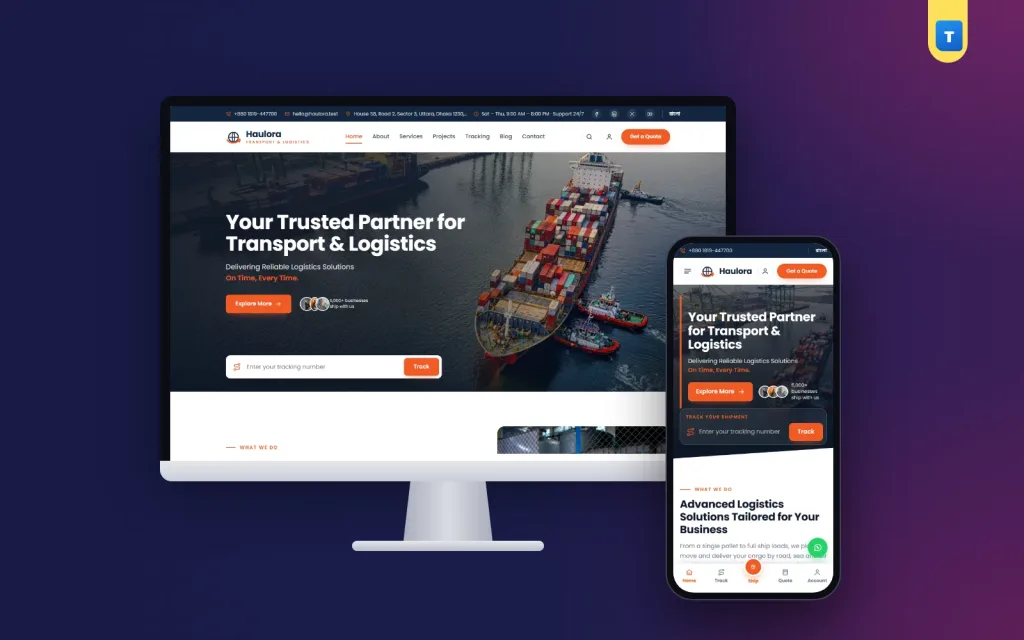
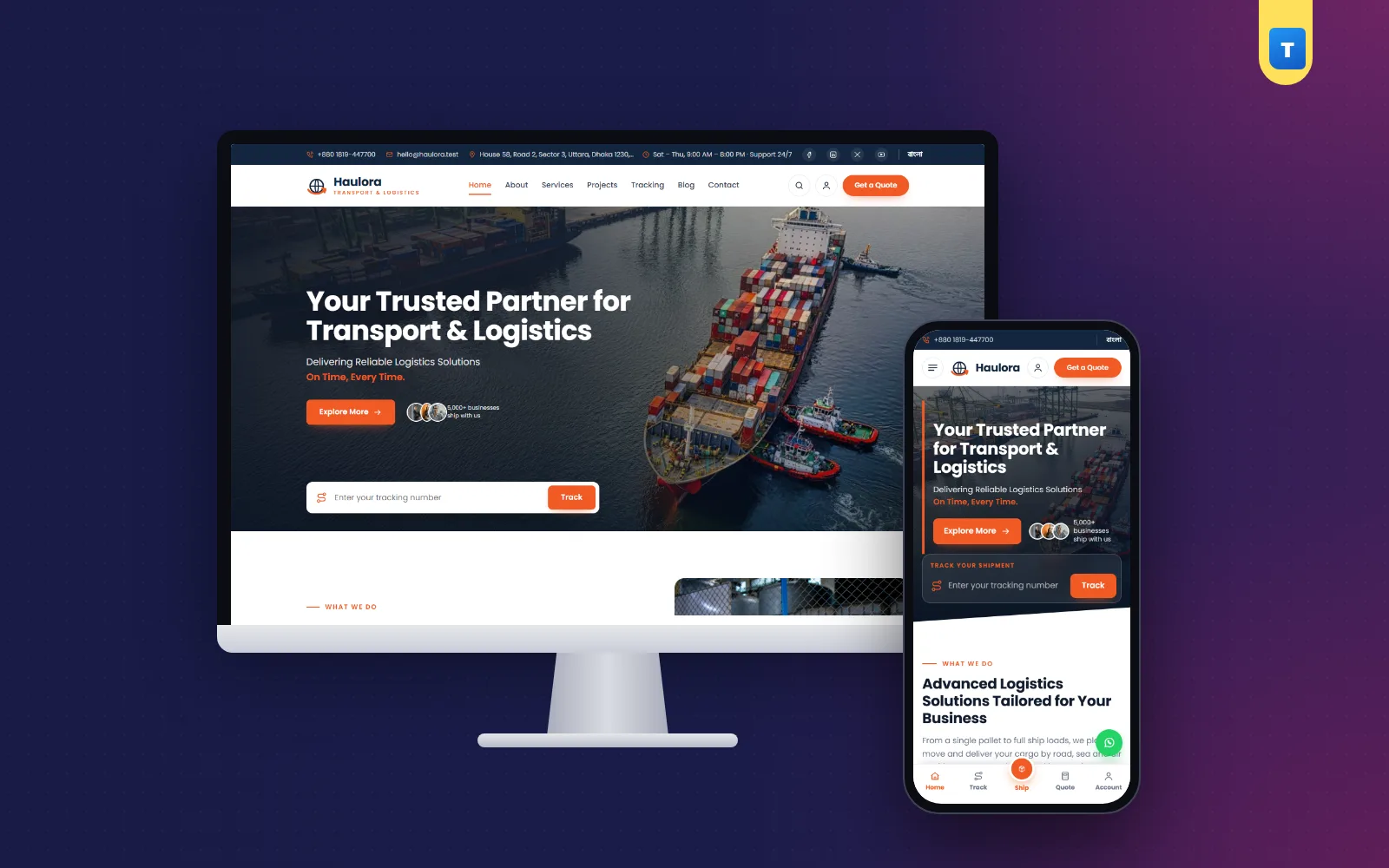
Haulora, a transport website template built in Laravel, is one example.
It pairs a corporate company site, with a tracking hero, a quote form, team, services and a projects gallery of case studies, with the tools above: rate cards, a price calculator, shipments with public tracking, a dispatch board, a driver panel, client credit accounts and reports. You can look around on the Haulora live demo.
Careers and skills in logistics
Logistics is a growing field of work in Bangladesh, driven by exports, ports, e-commerce and new roads and bridges. Common roles include shipping and freight executives, warehouse supervisors, dispatch planners, customs agents, fleet managers and supply chain analysts.
The skills that matter most are practical: planning, clear communication, comfort with numbers and spreadsheets, knowing the rules of customs and transport and staying calm when a shipment goes wrong at 11 at night. Courses help, but most people learn the trade on the job, one route and one client at a time.
Anyone starting out should be able to explain a logistics management definition in one sentence and give two or three real cases from their own work. Interviewers often ask exactly that.
Frequently asked questions
What is the simplest logistics management definition?
Planning and controlling how goods and their information move and are stored, so they arrive at the right place, on time, in good condition and at a fair cost.
Is there one official logistics management definition?
No. Professional bodies and textbooks word it differently, but they all cover flow, storage, timing, cost and information. Pick the wording that your team understands best.
What is the difference between logistics and transport?
Transport is one part of logistics. Logistics also covers storage, stock, order processing, packaging, documents and information, and the planning that links them all together.
What is a third-party logistics provider?
A company that handles transport, warehousing or both for other businesses, often under a contract. It lets the owner of the goods focus on making and selling, while the provider runs the trucks, stores and staff.
Why is logistics expensive in Bangladesh?
Traffic, port delays, empty return trips, festival rushes and paperwork all add time and cost. Better planning, shared loads, early documents and clear tracking reduce some of it, and new roads, bridges and rail links are slowly cutting transit times.