A good panjabi shop website design template saves you weeks of work, but only if it fits the way panjabis are really sold. Buyers want to see the cut, check the fit, pick a delivery date and pay with bKash, all on a phone. A template that looks pretty but ignores these steps will cost you orders.
This guide explains how to plan and build an online panjabi shop in Bangladesh. You will learn which pages you need, how to arrange the homepage, how to prepare for the Eid rush, and which mistakes to avoid. Use it as a checklist, whichever tool you choose.
What a panjabi shop website design template must include
Panjabis are not like T-shirts. Buyers worry about the collar, the length, the fabric and the fit. They often buy for a father, a husband or a son, and they want to be sure before they pay. A panjabi shop website design template should answer these worries on the page itself.
Look for these basics before you choose anything:
- Clear category pages for panjabis, kotis, boys' panjabis, pajamas and nagras.
- A size guide that opens on the product page.
- Large photos with a second photo for the back or the collar.
- A cart and a one-page checkout that works well on a phone.
- Local payments: bKash, Nagad, cards and cash on delivery.
- Courier booking and an order tracking page.
- Easy control over banners, so you can change the offer before each festival.
If a template misses two or three of these, you will end up adding plugins. More plugins mean a slower site and more things to break.
Plan before you pick a panjabi shop website design template
Many sellers open a theme first and think later. That leads to a homepage full of blocks nobody needs. Spend one hour on the plan instead.
Answer five questions
- What do you sell: only panjabis, or also kotis, pajamas and boys' wear?
- Who buys: young men, fathers, or families shopping together?
- What is your price range, and what is your most popular price?
- Do you make the panjabis yourself, or buy from other labels?
- How do you deliver: inside Dhaka only, or the whole country?
Your answers decide the menu, the filters and the homepage blocks. A shop with three labels needs a brand section. A shop that makes its own cloth needs a story section. A shop that sells in Dhaka only needs a clear delivery note.
The pages every panjabi shop needs
Keep the site small at first. These pages are enough to start selling:
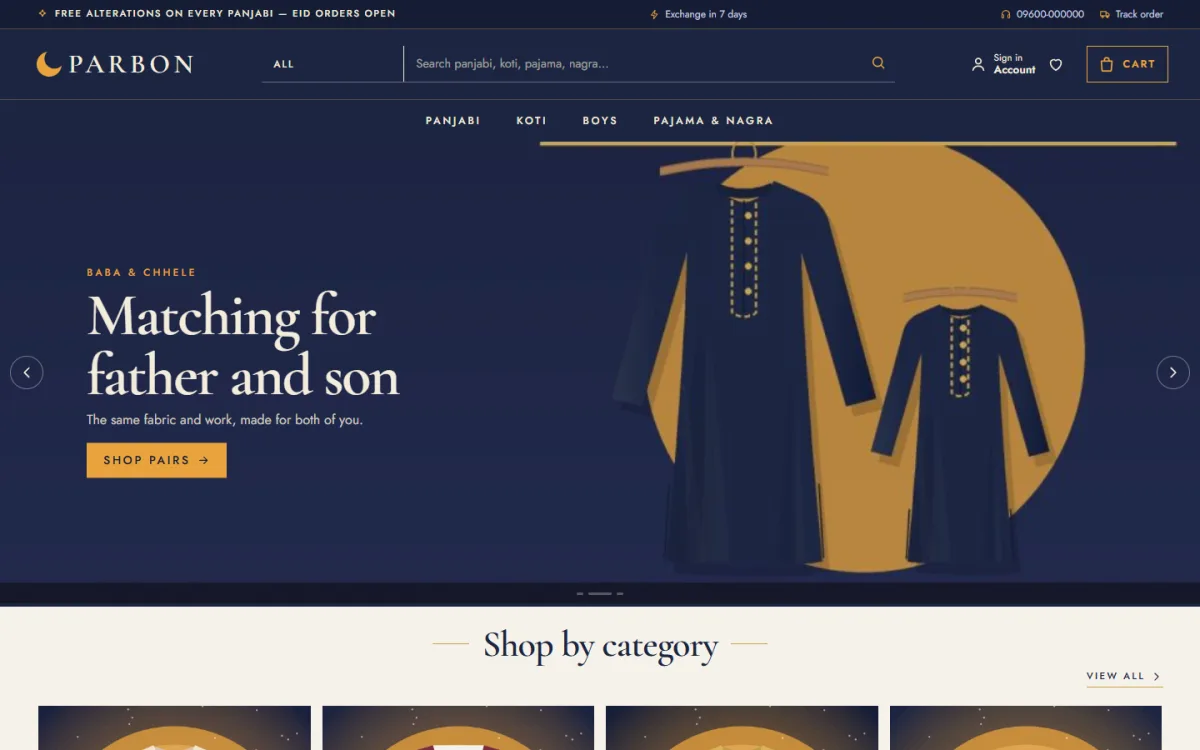
- Home: the offer, the categories and your best sellers.
- Shop and category pages: panjabis, kotis, boys' panjabis, pajamas.
- Product page: photos, price, sizes, fabric, delivery date.
- Cart and checkout: short and clear.
- Track order: so customers stop calling you to ask.
- Size guide: one page with a chest, length and sleeve table.
- Delivery and exchange policy: in plain words.
- About and contact: your address, phone and WhatsApp number.
Add a blog later. A few posts on fabric care or Eid styling can bring new visitors from search, but they are not needed on day one.
How to arrange the homepage
Most visitors decide in a few seconds. Put the most useful things first and keep the order simple. This order works well for a panjabi shop:
- A banner with your main offer or your newest collection.
- Category tiles: panjabi, koti, boys' panjabi, pajama.
- New arrivals, two rows only.
- Best sellers, grouped by category.
- A festival offer with a countdown and a stock bar.
- A promise strip: alteration, exchange, delivery, cash on delivery.
- Customer reviews.
- Your labels or your story.
Do not put twenty things above the first product. A buyer who sees product cards early will scroll further.
Help buyers choose the right cut
This is where a panjabi shop beats a general clothing shop. People often do not know the names of collars. They say "the one my cousin wore". If you can show the four common necklines, you answer the question before it reaches your phone.
Four necklines to explain
- Band collar: a plain standing band, simple and common.
- Mandarin collar: a short standing collar with a small gap at the front.
- Shirt collar: a folded collar like a shirt, good for casual wear.
- Kabli cut: a round neck with a placket, popular for Eid prayers.
Draw them or photograph them, write one line on who each suits, and link each cut to the products made with it. Do the same for fit: a short note such as "regular fit, runs slightly long" removes a lot of exchange requests.
Father and son pairs sell well
Matching panjabis for father and son are an Eid favourite. Families like to buy both in the same fabric. If your shop lets a customer add the pair in one step and shows one total price, you make that choice easy.
You can do it by hand too. Create a small category called "Baba and chhele" and list each pair as one product with two sizes. The key is to show both garments together in the photo.
Photos and text for your panjabi shop website design template
A panjabi is a visual product, but photos alone are not enough. Follow this routine for every product:
- One full-length photo on a model or a hanger, taken in daylight.
- One close-up of the collar and buttons.
- One close-up of the fabric, so the texture is clear.
- A short title: fabric, colour and cut, for example "Cotton white kabli panjabi".
- Three or four lines on fabric, fit, and washing.
- Exact chest, length and sleeve measurements for each size.
Keep photos the same shape and size across the shop. Resize them before uploading, because large files slow the page on mobile data.
Prepare for the Eid rush
For many panjabi houses, a big share of yearly sales comes in the weeks before Eid. Buyers arrive in a hurry, and many buy for the whole family. Start planning at least a month ahead.
An Eid preparation calendar
- Four weeks before: shoot photos, load new products, check stock counts.
- Three weeks before: publish the Eid collection and the homepage banner.
- Two weeks before: start the offer with a countdown. Tell your Facebook followers.
- One week before: show a "last day to order" note for each delivery area.
- Three days before: pause orders you cannot deliver in time, and say so clearly.
A countdown timer works because it is honest: the day really is coming. Pair it with a stock bar so buyers see that popular sizes are running out. Never fake the numbers.
Payments and delivery in Bangladesh
Your buyers expect to pay the way they always do. Offer these options at checkout:
- bKash and Nagad, with a clear payment number or a payment gateway.
- Card payment through a gateway such as SSLCommerz.
- Cash on delivery for first-time buyers.
- Manual payment, with a field for the transaction ID.
For delivery, use a courier that gives you tracking. Steadfast and Pathao are common choices. Show the delivery date on the product page, because people buying for Eid want to know it is not too late. Tell customers the delivery charge before they reach the last step, since a surprise at the end is a common reason for abandoned carts.
Make it fast on mobile data
Most of your buyers will open your shop on a phone, often on mobile data. A slow page loses them. Keep these habits:
- Resize every photo before you upload it.
- Use one clean theme and avoid heavy page builders.
- Load images below the first screen later (lazy loading).
- Choose one or two fonts only.
- Remove plugins you do not use.
- Test the shop on a mid-range phone, not only on your laptop.
Speed also depends on your hosting. A cheap, crowded server can undo all the other work.
Move from a Facebook page to your own website
Most panjabi sellers in Bangladesh start on Facebook. Orders come through Messenger, and every chat repeats the same questions about size, price and delivery. A website removes that repeated work.
Do the move in small steps:
- Keep posting on your page as usual.
- Add each new panjabi to the website with the same photos.
- Put the product link under every post, so buyers can check sizes and pay in one place.
- Pin the shop link at the top of your page and add it to your page button.
- Ask old customers to order through the website next time, and offer a small delivery discount if you like.
Within a few weeks, most routine questions are answered by the product page, and you spend your time on cutting, packing and new designs. A panjabi shop website design template with a track order page helps even more, because customers stop asking where their parcel is.
Common mistakes to avoid
- No size guide. This leads to wrong sizes and returns.
- Dark, blurry photos. Buyers cannot judge the cloth.
- Too many popups. One welcome popup is enough.
- Hidden delivery charge. Show it early.
- No phone number on the page. Many buyers still want to call.
- Copying text from other shops. Write your own, and describe your own cloth.
- Forgetting the exchange policy. State the days and the conditions.
A ready-made option for panjabi shops
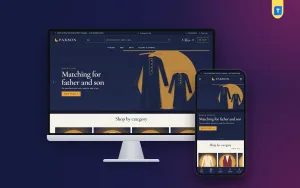
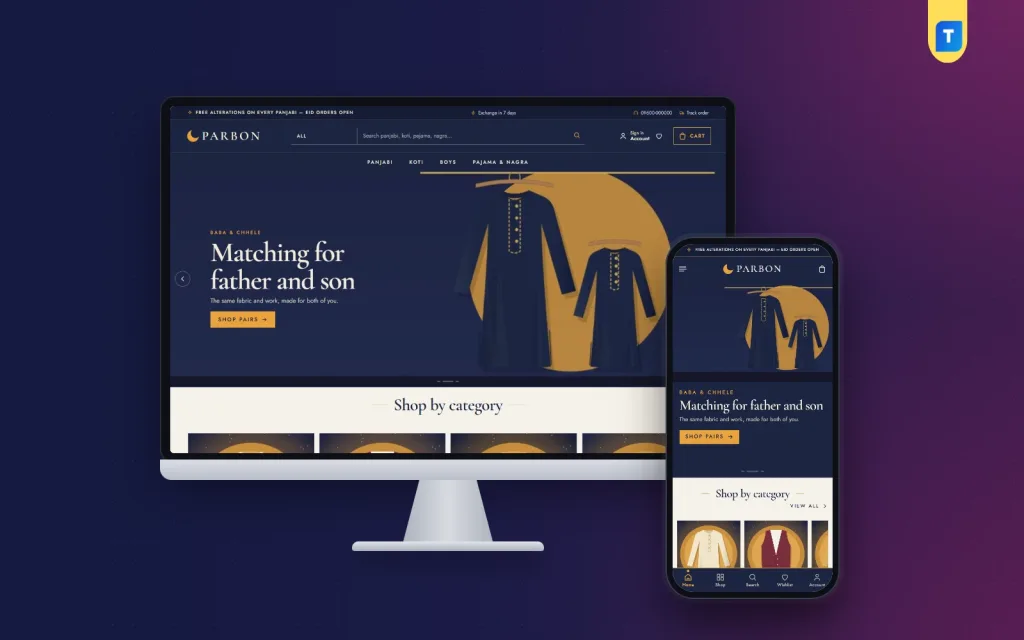
If you want a theme built for this kind of shop, Parbon is one option. It is a WordPress theme made for stores that sell panjabis, kotis, boys' panjabis, pajamas and nagras. It is a good fit if you want a panjabi shop ecommerce website design that handles the Eid season without extra plugins.
These are the facts that matter for this guide:
- A collar and cut guide with four drawn necklines: band, mandarin, shirt collar and kabli cut.
- Father and son pairs added to the bag in one tap, next to a live Eid countdown.
- A fit meter and a delivery date on every product page.
- A size guide, an Eid offer with stock bars, and 24 homepage blocks you can switch off or move.
- bKash, Nagad, SSLCommerz and cash on delivery, with Steadfast and Pathao courier and order tracking.
- A one-click demo with 24 products from three labels, so you can see how the shop looks before you replace the content.
It also has five colour palettes and four font pairs. You can look at the live demo and the admin panel on the product page: see Parbon. Whatever theme you pick, compare it against the checklist in this guide.
Launch checklist
Before you tell your customers, go through this list once:
- Place a test order with each payment method.
- Check the order email and the order placed message.
- Open the shop on two phones and one laptop.
- Read every product title and size table for mistakes.
- Click each menu link and each banner link.
- Confirm your delivery areas and charges.
- Write your exchange policy and link it in the footer.
- Add your phone, WhatsApp and Facebook page links.
- Back up the site.
After launch, post the shop link on your Facebook page and pin it. Share new arrivals with a direct product link instead of a general link, so buyers land where they can pay.
If you want to read more on the technical side, the official WordPress documentation is a good, reliable reference.
Frequently asked questions
What is the best panjabi shop website design template for a small business?
The best choice is one that includes a size guide, local payments, courier booking and fast mobile pages. Check these features first, and only then look at colours and fonts.
Do I need WooCommerce to run a panjabi shop on WordPress?
Not always. Some themes come with their own shop system. Parbon works without WooCommerce, so you do not install extra plugins for payments or couriers.
Can I use a panjabi shop website design template only for Eid?
No. A good template works all year. Use the festival blocks during Eid and switch them off or change them for weddings, Puja season or winter.
How many products should I add before launch?
Start with 20 to 30 well-photographed products across your main categories. It is better to have a small, clean shop than a large one with weak photos.
How do I reduce size and exchange problems?
Give exact measurements in a size table, show a fit note on each product, and add a short collar guide. These three steps remove most wrong-size orders.
Can I sell on Facebook and my website together?
Yes. Post your products on your page and link each post to the product page on your website. This sends buyers to a proper checkout instead of Messenger.
How do I choose between panjabi shop ecommerce website design options?
List the features you need, test each demo on your phone, and check the page speed. Choose the one that handles sizes, Eid offers and payments without extra work.