Good pharmacy website ideas begin with trust, because a person who orders medicine online is handing you something far more serious than a shopping basket. They want the right strength, the right pack, a fair price and proof that a real, licensed shop stands behind the page. A website that makes these things clear will keep customers coming back.
This guide shares practical ideas for a medicine shop website: structure, product pages, search, prescription handling, payments and delivery, with examples that fit Bangladesh. It is written for pharmacy owners, not for designers, so you can use it as a checklist and a briefing note for your developer.
A note on rules. Medicine sales are regulated. Before you sell any medicine online, check the current rules of the drug authority, DGDA, and the terms of your own drug licence. Nothing in this article is legal advice.
Start with what a pharmacy customer needs
People visit a pharmacy site for different reasons. A mother needs baby syrup tonight. An older man needs the same blood pressure tablet every month. A young person wants a vitamin and a face wash. Your site should serve all three without confusion.
Write down the main customer jobs:
- Find a medicine by name, by generic name or by symptom.
- Choose the right strength and pack size.
- Know whether a prescription is needed.
- See the price, and the price per tablet or per unit.
- Order by phone, WhatsApp or checkout.
- Know when the order will arrive.
Every idea below supports at least one of these jobs.
Pharmacy website ideas for a trustworthy homepage
A pharmacy homepage should feel like a clean, well-lit counter, not a noisy market stall. Keep it calm and organised. Use plain colours such as blue, mint and white, and a readable font.
A good order of homepage sections:
- Search bar at the top, large and simple.
- Symptom chips such as fever, cold, stomach, pain and allergy.
- Category tiles: medicines, vitamins, mother and baby, personal care, home health devices.
- Prescription ordering with WhatsApp and call buttons.
- Popular products with price and pack size.
- Trust strip: licence status, delivery area, opening hours.
- Shop details: address, map and phone number.
Avoid flashing banners and countdown timers. Medicine is not a flash-sale product, and loud offers reduce trust.
Pharmacy website ideas for product pages
The product page is where mistakes cost the most. Wrong strength or pack, and a customer could be harmed or simply angry. Give each medicine a clear structure.
- Brand name and generic name side by side.
- Company name and dosage form, such as tablet, syrup or capsule.
- Strength and pack options, for example 500 mg with 10 or 100 tablets, each with its own price.
- Price per unit, so customers can compare packs.
- Prescription mark. A clear red Rx label on prescription-only items.
- Short medical disclaimer that tells people to follow their doctor's advice.
- Delivery date or time estimate.
Do not write long claims about what a medicine cures. Keep to the facts printed on the pack and the information the maker supplies. Avoid language that promises results.
Help people find medicine fast
A pharmacy often stocks thousands of items, and customers rarely know the exact spelling. Search is the most used feature on your site, so build it well.
Useful search ideas:
- Search by brand name, generic name and company.
- Allow small spelling mistakes, because medicine names are hard.
- Show results with strength, pack and price in the list.
- Add symptom shortcuts for common, over-the-counter needs.
- Show "not found? Message us on WhatsApp" when nothing matches.
Symptom chips are only a shortcut to common products. They are not a diagnosis. Place a short line near them saying that serious or lasting symptoms need a doctor.
Handling prescriptions the safe way
Prescription medicine needs more care than any other product you sell. Decide your process, write it on the site, and follow it every time.
A simple and common flow:
- The customer sees the Rx mark on the product page.
- The page offers two buttons: send the prescription on WhatsApp, or call the shop.
- A pharmacist checks the prescription and confirms the items and price.
- The customer pays online or on delivery.
- The delivery person hands over the medicine with the bill.
This keeps the pharmacist in control of what is sold. Do not add prescription-only medicines to a plain cart that anyone can check out without review, unless your licence and local rules allow it. If you are unsure, ask the authority or your lawyer.
Pharmacy website design templates: what to look for
Many shop owners start with ready-made pharmacy website design templates because custom work is expensive. That is a sensible path, as long as the template suits medicine and not general shopping. Check these points before you choose one.
- Variations for strength and pack with separate prices.
- Fields for generic name, company and dosage form.
- A clear way to mark prescription items.
- Fast search and category filters.
- Space for a medical disclaimer on each product.
- Mobile layout that stays readable on a small phone.
- Checkout that supports bKash, Nagad and a card gateway.
- Room to change colours, fonts and homepage order without code.
Treat pharmacy website design templates as a starting point, and test each one with your own products. A template made for fashion or electronics will make you fight the design. A pharmacy-specific one gives you the right fields from the start.
Payments and delivery for medicine orders
Customers in Bangladesh expect simple mobile payment and a clear delivery promise. Offer a short list:
- bKash and Nagad for quick payment.
- Card payment through a local gateway such as SSLCommerz.
- Cash on delivery for trusted areas and regular customers.
Keep checkout on one page. Ask for name, phone, address and delivery area. Add a note field for a landmark or a gate number, which helps the rider.
State your delivery area, hours and charges. Many pharmacies offer same-day delivery inside their neighbourhood, and next day or courier outside. Medicine that needs cool storage should only be sent within an area you can reach quickly. Say so on the page.
Pharmacy website ideas for repeat customers
A large part of pharmacy income comes from regular buyers. Think about the customer who buys the same tablets every month and design for that.
- Offer a "reorder" button on past orders.
- Show the price per unit, so bigger packs are easy to compare.
- Send an SMS or WhatsApp message when an order is ready.
- Keep a simple account page with past orders and addresses.
- Offer a monthly refill list the customer can approve.
Never change a prescription item without the customer and pharmacist agreeing. Reorder tools save time, but a pharmacist should still confirm.
Keep photos, data and stock accurate
Many pharmacy website ideas are about looks, but accurate data matters more. A wrong strength or a missing item causes real trouble, so build habits to keep the catalogue correct.
- Photograph the actual pack front and back, in even light, on a plain background.
- Copy the name, strength and company from the pack, not from memory.
- Update prices when the supplier changes them, and note the date.
- Mark items out of stock the same day they run out.
- Remove expired or discontinued lines.
- Check the catalogue once a month, ten products at a time.
If you carry thousands of items, start with the top two hundred sellers. A small, correct catalogue is better than a large, messy one.
Mobile and speed
Most customers will open your site on a phone, often in a hurry. Check that the search bar sits at the top, buttons are easy to tap and pages open quickly over mobile data. Compress photos, and avoid heavy sliders and auto-playing video. A pharmacy page that loads slowly at night, when someone needs a fever tablet, loses the sale.
Test with a real phone in a weak signal area of your own neighbourhood. Ask a family member who is not technical to place an order and watch where they hesitate.
Content that builds trust
Good pharmacy website ideas should always include a few short pages that show a real pharmacy runs the site.
- About us: the shop's story, pharmacist name and years of service.
- Licence and address: show your drug licence details and a real map location.
- How to order: a step-by-step page for prescription and normal orders.
- Delivery and returns: what you accept back and what you cannot, for safety reasons.
- Health tips: simple pages on storing medicine, reading labels and finishing a course as advised.
Keep health pages general and factual. Add a line asking people to see a doctor for personal advice.
A ready-made option for medicine shops
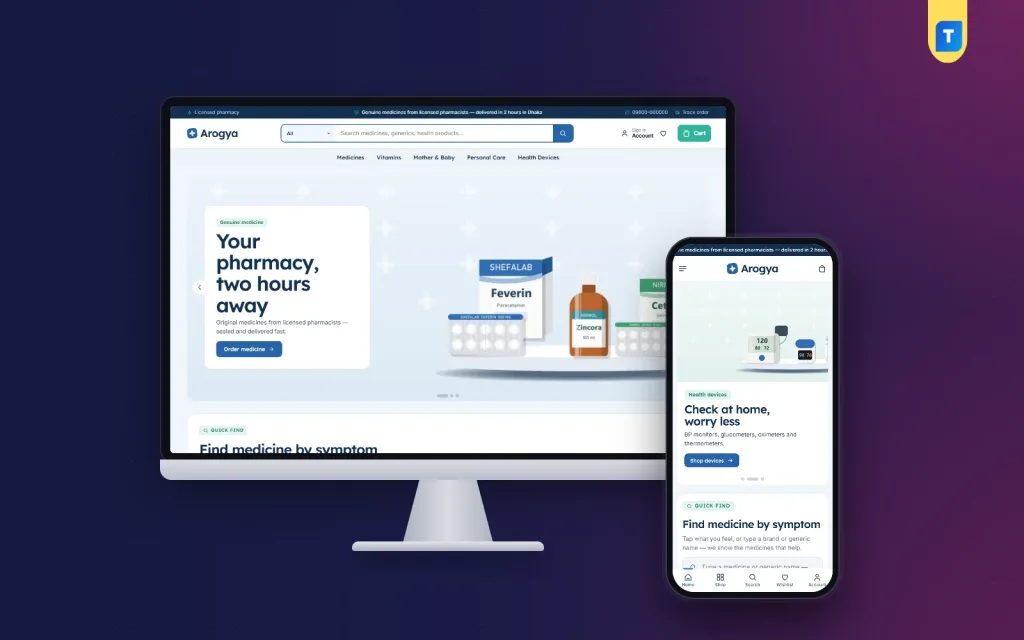
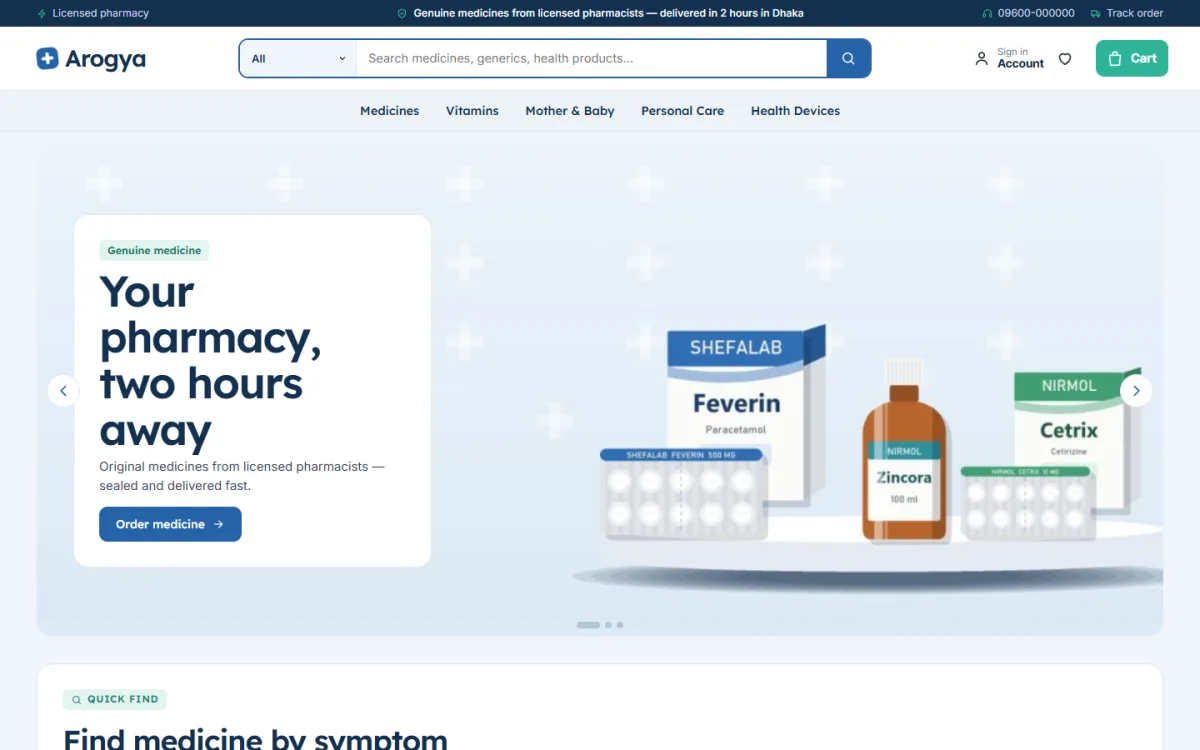
If you want a start that already includes the right fields, Arogya is a clean online pharmacy WordPress theme for licensed medicine shops. It uses clinical blue, mint and white, with Lexend headings that stay easy to read on small screens.
Here is what it includes:
- Strength and pack variations with stepped prices.
- Generic name, company and form on every medicine, with a price per unit.
- A clear red Rx mark on prescription medicines.
- Find medicine by symptom chips and name search.
- Prescription ordering through WhatsApp and call buttons.
- A medical disclaimer and delivery date on product pages.
- 24 homepage blocks you can switch and re-order.
- One-page checkout with bKash, Nagad and SSLCommerz.
- 5 colour palettes, 4 font pairs and a one-click demo with 33 sample products from 6 companies.
All company names and artwork in the demo are invented, so you replace them with your own. The Arogya page shows the live demo and full details.
Mistakes to avoid
- Selling or promoting prescription medicine without a review step.
- Showing only one price when a medicine has several pack sizes.
- Missing generic names, which customers use to compare.
- Making health claims that the pack does not make.
- Hiding the shop address and licence details.
- Using stock photos of medicine that do not match your products.
- Skipping a mobile test.
Most pharmacy website ideas that go wrong do so because of unclear or missing information. Most of these mistakes are about being clear and honest. A pharmacy site that shows its details openly looks safer than one that hides them.
Launch checklist
- Check licence rules and the legal pages for online sale.
- Each product has strength, pack, price, generic name and company.
- Prescription items carry a visible Rx mark and an ordering note.
- Search works on brand, generic and company.
- Payments are tested with real small orders.
- Delivery area, charge and time are written down.
- Contact and licence details are in the footer.
- The site opens quickly on a mid-range phone.
Use these pharmacy website ideas as a rolling to-do list rather than a one-time project. After launch, read the questions customers send you. Add the answers to product pages and the how-to-order page.
If you want to read more on the technical side, the official WordPress documentation is a good, reliable reference.
Frequently asked questions
What are good pharmacy website ideas for a small shop?
Begin with a simple catalogue of your fastest-selling items, a strong search bar, a clear prescription process and bKash plus cash on delivery. Add your licence details and a WhatsApp button. Grow the range slowly.
Can I sell prescription medicine on my website?
That depends on your licence and current rules from the drug authority. Many shops mark such items as Rx and take the order only after a pharmacist checks the prescription. Confirm the rules before you start.
What should pharmacy website design templates include?
Look for strength and pack variations, generic name fields, a prescription mark, fast search, a disclaimer area and a mobile-friendly checkout.
How do I show medicine prices fairly?
Show the price for each pack and the price per unit. This lets customers compare a 10-tablet strip with a 100-tablet box without doing sums.
Are symptom search buttons safe?
They are fine as a shortcut to common, non-prescription products when you add a note that lasting or serious symptoms need a doctor.
Where do I find more pharmacy website ideas?
Listen to the questions people ask at your counter and on the phone. Each repeated question points to something your website should answer. That list is your best source of pharmacy website ideas.