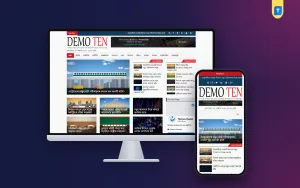
Looking at business website examples is the fastest way to learn what a good company site needs before you spend money on design. You see what real firms put on the homepage, how they explain their work and where they place the contact details. You also see the mistakes you want to avoid.
This guide goes through the main types of company sites, the pages and blocks that appear again and again, and a simple method for turning what you see into your own plan. It is written for owners in Bangladesh who are about to build or rebuild a website for a firm that sells through quotes, contracts, dealers or personal meetings.
What business website examples can teach you
A company website has one job: to make a stranger trust you enough to call, write or visit. Every page you see in a good example supports that job. When you study several sites side by side, patterns appear very quickly.
Here is what you can learn from a careful look:
- Which pages every serious company has, such as About, Services, Projects, News and Contact.
- How much text sits above the fold before a visitor has to scroll.
- Which facts build trust fastest: years in business, number of projects, staff, locations, certificates.
- How the site looks on a phone, where most Bangladeshi visitors will first see it.
- Where the main call to action sits, and what it says.
Good business website examples show you the thinking, so do not copy a site. Copy the thinking behind it. A firm that sells generators does not need the same homepage as a law office, but both need clear proof and an easy next step.
Types of company sites you will meet
Most sites you will find fall into a few families. Knowing the family helps you pick the right examples to study.
- Brochure sites. Five to ten pages that describe a small firm: a local clinic, a coaching centre, a trading house. They are cheap to build and easy to keep up to date.
- Service sites. Built around a list of services, each with its own page and a form to ask for a quote. Typical for agencies, consultants, accountants and repair companies.
- Corporate group sites. Larger firms with several businesses, projects, news, careers and sometimes investor information. Engineering, energy, manufacturing and construction groups use this style.
- Catalogue sites. Product lists without a cart. Buyers browse, then request a price. Common for machinery, building materials and wholesale.
- Online shops. A cart and checkout for selling directly to customers. This is a different job and has different needs.
Decide which family you belong to first. Then you can judge business website examples fairly instead of being impressed by a design that suits some other kind of firm.
Pages and blocks that every good example shares
If you collect ten company sites, you will notice that the homepage follows an order that visitors expect. You can use the same order as your starting point.

- Header. Logo, a short menu, a phone number and one clear button.
- Hero. One strong picture and a headline that says what you do and for whom.
- Numbers. Three or four figures such as years, projects, staff and countries served.
- What you offer. Services or business units, each with a short line and a link.
- Proof. Selected projects, client logos or short testimonials.
- News or insight. A few recent posts that show the firm is active.
- Contact band. Address, phone, email and a simple form.
- Footer. Full menu, social links, registration details.
Beyond the homepage, add an About page with your story and people, one page per service, a Projects or Work page, and a Careers page if you hire. Keep the menu short. Seven items or fewer is easier to read than twelve.
Business website examples by industry
The best way to use business website examples is to look at a few from your own field, then a few from outside it. The mix gives you both familiar ideas and fresh ones.
Construction and engineering
These firms lead with big photographs of finished work and with figures: megawatts, kilometres, tonnes, floors. They show a projects slider with place, year and size. A safety and quality section is common because buyers ask about it.
Manufacturing and trading
Product ranges are grouped by use, not by internal code. Good sites show factory photos, certificates and a clear way to ask for a sample or a price list. Dealers often get their own page.
Professional services
Law, accounting and consulting sites rely on people. They show faces, qualifications and short case stories. A quiet design and plain language work better than loud banners.
Agencies and studios
These sites sell taste. Work comes first, then process and price signals. A short form that asks for budget and deadline saves time on both sides.
Healthcare and education
Trust and simple booking matter most. Doctor profiles, opening hours, a map and a phone button that works on mobile are the basics.
How to study a site in ten minutes
Do not just admire the design. Use a short routine so that every example gives you notes you can act on.
- Open the site on your phone first, then on a computer.
- Count the seconds until you know what the firm does. Aim for five.
- Write down the headline and the button text.
- List the proof you can see without scrolling much.
- Find the contact details. Count the clicks needed.
- Note one thing you like and one thing that annoys you.
After ten sites, your notes will show what you want, and your own list of business website examples becomes a design brief. You will also see which ideas show up everywhere and are probably worth including.
Company website design ideas that work
When you read through company website design ideas, a few simple choices keep returning. They cost little and make the site feel professional.
- Use one accent colour and one neutral. Too many colours look unplanned.
- Pick two fonts at most: one for headings, one for body text.
- Choose real photographs of your team, site or products over stock pictures of handshakes.
- Keep paragraphs short and write in plain words.
- Give each page one main action, not five.
- Show numbers as large figures. Visitors read them first.
Square corners and heavy type feel solid and serious, which suits industry. Rounded shapes and soft colours feel friendlier, which suits clinics and schools. Match the mood to your customers, not to your taste alone.
Mistakes visible in weak company sites
Poor sites teach as much as good ones, so keep a few weak business website examples in your notes too. These are the faults that appear most often.
- A homepage that opens with "Welcome to our website" and says nothing else.
- Stock photos that do not match the company or the country.
- Phone numbers and addresses hidden at the bottom of the contact page.
- A slider that changes too fast to read.
- Pages that are out of date, such as news from three years ago.
- Heavy images that make the page slow on mobile data.
- No page for each service, so search engines and visitors cannot find the detail.
- Forms that ask for too much, so people leave.
If you see two or three of these on a competitor's site, you have found an easy way to look better than them.
Plan your own content before you pick a design
An empty template looks good in a demo because it is full of sample content. Your site will look as good as your content allows. Gather these items first:
- Your logo in a clear file and two or three large photographs.
- Four headline numbers you can prove.
- A short description of each service or business unit.
- Six or more past projects with place, year and a line about the result.
- Office addresses, phone numbers and a working email.
- Names and photos of directors or senior staff.
- Recent news items, even small ones, such as an award or a new contract.
- Trade licence, certificates and memberships you can show.
Start with what you have. A page that is honest and short beats a page full of filler. Hide blocks you cannot fill yet and add them later.
Reading business website examples for Bangladesh
Local context changes a few details. When you review business website examples from your own market, look for these points.
- A Bangla version or a Bangla headline, if your buyers prefer it.
- A WhatsApp or phone button that works with one tap.
- Clear Dhaka, Chattogram or factory addresses with a map link.
- Mention of trade licence, TIN, BIN, IRC or export registration where it helps buyers.
- Fast loading on average mobile connections.
- Facebook page and website that match, so a buyer who finds one trusts the other.
Many small firms still run only a Facebook page. A proper site gives you a place you own, a business email address and pages that can be found when someone searches your service and city.
A ready-made option for industrial and corporate firms
If you run an engineering, energy, manufacturing or infrastructure group, a purpose-built theme can save weeks of work. Bhitti is an industrial corporate WordPress theme made for this kind of firm. It does not have a cart or checkout, because a company site that sells by tender and contract does not need one.
What it gives you:
- 16 homepage blocks that you can switch off or drag into a new order.
- A full-width hero with three quick cards.
- Business cards that widen when a visitor hovers over them.
- A flagship projects slider showing capacity, place and year.
- An investor snapshot with a share chart, for listed companies. You type the share price in Theme Options, so you control what is shown.
- Sustainability targets shown as rings.
- A world map with locations by region.
- A contact form whose messages are kept under Enquiries in the dashboard.
- 6 colour palettes and 5 font pairs.
- A one-click demo of an engineering group, which you replace with your own content.
A family-owned group without a stock listing can simply hide the investor block. The theme also includes page templates for businesses, about pages and careers, so you do not start each page from nothing.
Turning examples into a working site
Once you know what you want, follow a short plan.
- Write the list of pages and the order of homepage blocks on one sheet of paper.
- Collect the content from the checklist above.
- Choose a theme that already has the blocks you listed, rather than building them from scratch.
- Install it, import the demo and replace sample text and pictures one block at a time.
- Set your contact details, menu and footer.
- Test the site on two phones and one computer.
- Ask a colleague who has never seen it to find your phone number and one service. Time them.
- Publish, then add a news item every month.
Treat the first launch as a first version. If you used Bhitti, new projects and news items are just posts, so growth is easy. A company site improves as you add projects and news.
Keeping the site useful after launch
A site that is never touched slowly loses trust. A simple monthly routine is enough.
- Add one project or news item.
- Check that the contact form still reaches your inbox.
- Update numbers and figures once a year.
- Remove old offers and expired notices.
- Keep WordPress, the theme and plugins updated, and keep a backup.
- Look at which pages visitors open most and improve those first.
Reply to every enquiry within a working day. The best design cannot repair a slow answer.
If you want to read more on the technical side, the official WordPress documentation is a good, reliable reference.
Frequently asked questions
Where can I find good business website examples?
Start with the websites of firms you admire in your own industry, then look at suppliers and partners. Check industry associations and trade fair pages as well. Save a screenshot of each page you like, on both phone and computer, and write one line about why it works.
How many sites should I study before starting?
Ten is enough for most owners. Pick five from your own field and five from other fields. After ten, new examples mostly repeat what you have already seen.
What should a small company put on its website?
At least a clear homepage, an About page, a page for each service or product group, a few past projects or clients, and a Contact page with phone, email, address and a form. Add news and careers when you have something to say.
Does an industrial company need an online shop?
Not always. Many industrial firms sell through quotes, tenders and dealers. For them, a strong corporate site with projects, businesses and an enquiry form works better than a cart. A shop makes sense only when buyers actually order small items online.
How long does it take to build a company site?
With a ready-made theme and your content prepared, a basic site can be live in a few days. Most delays come from collecting photos, figures and approvals, not from the technical work.
Can I learn from business website examples outside my industry?
Yes. Layout, clear headlines and good contact sections work everywhere. Looking at business website examples from other fields often gives you ideas your competitors have not used.
Do I need a Bangla version of my site?
It depends on your buyers. If your customers are other companies and exporters, English may be enough. If you sell to local shops, farms or the public, a Bangla headline and contact section help a lot.