A good women ethnic wear website design template has to do what a shop counter does: let the buyer see the true colour, judge the fabric through photos and trust you before she pays. This guide covers the layout, photos, sizes and stitching, product pages, checkout and the festive calendar for saree, salwar kameez and kurti sellers in Bangladesh.
Every idea here is simple and cheap. Pick the ones that fit your shop, try them for a few weeks, and keep what works.
Why a women ethnic wear website design template needs its own plan
Ethnic wear is not like T-shirts or gadgets. A saree has no size, but it has a length, a border, a pallu and often a blouse piece. A kameez may be ready-made, unstitched or stitched to measure. A bridal set can cost more than a month's salary.
- Colour doubts mean your photos must be true to life.
- Fabric doubts mean you must name the fabric: Jamdani, half-silk, georgette and cotton feel very different.
- Fit doubts mean kameez and blouse sizes, or a custom stitching choice.
- Trust doubts grow with the price, so bridal pieces need more proof.
Answer these doubts on the page and you answer them once, instead of in a hundred inbox messages.
Start with your categories
Group what you sell the way buyers shop: Saree, Salwar Kameez, Kurti, Bridal, Half-silk, Jamdani, Three-piece and Orna & Jewellery. Five to eight main categories are enough for most shops.
Show them as portrait photo tiles near the top of the homepage, each with its name. Portrait tiles suit ethnic wear, because a draped saree or a long kameez is taller than it is wide. On a phone, one row that scrolls sideways keeps the page short.
Every women ethnic wear website design template should keep the main menu short too. Saree, Salwar Kameez, Kurti, Bridal, New Arrivals and Sale are often enough.
Use the words buyers search
Write product titles the way buyers say them: "Red Banarasi Saree", "White Jamdani Saree with Red Border", "Georgette Three-piece Kameez". Add the Bangla or Banglish words buyers type, such as "jamdani", "tant" or "three piece", in tags or in the short text.
A homepage order that works
Buyers scroll an ethnic wear shop like a boutique window. Each block should answer one question. Here is an order many shops use:
- Offer bar with one real offer and its code.
- Hero slider with your festive collection.
- Category tiles so people can jump to sarees or kameez.
- A kameez row with your best sellers.
- A saree row with this season's pieces.
- Latest products for regular buyers who check every week.
- Promises: delivery, cash on delivery, exchange and a quality check.
- Reviews, with customer photos when you can get them.
- FAQ about colour, stitching and delivery.
- A style journal with draping and styling tips.
Each row should have a "See more" link to the full list. Five products per row on a laptop and two on a phone keep the page tidy.
Soft, warm colours such as cream, yellow, maroon or deep green suit a women ethnic wear website design template, because they sit well beside red sarees and gold borders. Keep one accent colour and plenty of white space.
Photos that sell sarees and kameez
Photos do most of the selling in a clothing shop. Plan them before you plan the design.
- The full drape on a model or a mannequin.
- A close-up of the border and the pallu.
- A close-up of the weave or the embroidery.
- The blouse piece or orna shown on its own.
- A folded shot, the way the piece arrives.
Shoot in daylight near a window, never under yellow bulbs. Red and maroon are the hardest colours to photograph, so check them on a phone screen before you upload. A buyer who gets maroon when she expected red will send it back.
Crop every photo to the same shape and compress it before upload; 1000 to 1200 pixels wide is enough for most pieces.
The same light and background for every product is the cheapest upgrade in a women ethnic wear website design template. Ten pieces shot the same way look like a boutique. Ten pieces shot ten ways look like a reseller.
Sizes, length and custom stitching
For sarees, write the length in haat or metres, the width, and whether a blouse piece comes with it. For half-silk and Jamdani, say whether the saree has a fall and pico done.
For kameez, give the chest, length and sleeve for each size. If you sell Free Size pieces, write the measurements in the short text. If you stitch to measure, offer Custom Stitch as a separate choice with its own price, so the buyer sees the extra cost before checkout.
For custom orders, call the buyer for measurements and write the extra days on the product page. A buyer who knows the kameez takes five more days will wait. A buyer who is surprised will cancel.
Make exchange rules clear
Write your rule in plain words: "Exchange within 7 days if unused with tags. Custom-stitched pieces can be exchanged only for a stitching fault." Put it in the promise strip, the FAQ and the Return Policy page.
Product pages that answer questions
A buyer on a product page wants six answers: what fabric is it, what length or size, is the colour true, how much, how fast, and what if it is wrong. Put all six near the top.
- A gallery with zoom and four or five photos.
- The price, with the old price crossed out on sale items.
- The fabric, length and work, such as "half-silk, 12 haat, with blouse piece".
- The size or stitching choice.
- Add to Cart and a Buy Now button that goes straight to checkout.
- Short promises: delivery days, cash on delivery and the exchange rule.
Write the description yourself. Say where the piece comes from, such as Tangail, Narayanganj or Rajshahi, how it drapes and how to care for it: dry clean for silk, a gentle wash for cotton. Many buyers in Bangladesh still message before ordering, so keep your phone number and WhatsApp easy to find.
Bridal and high-price pieces
A bridal lehenga or a Banarasi can cost ৳15,000 to ৳50,000. Buyers want more proof before paying that much: more photos, a short video, real customer photos and a phone number that answers.
Give bridal its own category tile, and its own hero slide in the wedding season from November to February. Offer a call-back or a video call so the family can see the piece. Show the delivery date clearly, because a bride cannot wait.
Many shops ask for a part payment by bKash or Nagad before shipping a costly piece. If you do, say the rule clearly on the product page and in the FAQ.
Festive seasons and offers
Ethnic wear in Bangladesh follows the calendar: Pohela Falgun in yellow and orange, Pohela Boishakh in red and white, both Eids, Durga Puja, the wedding season and winter shawls. Change the hero, the first category tiles and the offer bar for each one.
Here are a few saree website design ideas for the season: a Falgun row of yellow sarees, a red-and-white Boishakh tile, a Puja collection slide and a wedding guide post linked from the homepage.
Use coupons with care. A first-order coupon shown in the offer bar and the sign-up box brings new buyers in. A coupon on every page all year makes the full price look fake.
A women ethnic wear website design template for phones
Most saree and kameez orders start from a Facebook live or a post opened on a phone, often on mobile data. Design the phone view first, then the desktop.
- A clean top bar with the logo, search and the cart.
- A bottom tab bar with Home, Categories, Cart, Chat and Account.
- Product cards two per row, with the price easy to read.
- Buttons big enough for a thumb.
- No pop-up that hides the cart or the size choice.
Test the shop on a cheap Android phone over 4G. If the homepage feels slow there, it is slow for most of your buyers. A light women ethnic wear website design template loads fewer heavy pieces and keeps buyers scrolling.
Keep the shop light
Every extra second of loading costs orders. Compress photos before upload. Use a shop theme with small files instead of a heavy page builder. Keep plugins few, and remove the ones you do not use. Check your shop speed once a month, especially after adding a new plugin.
Checkout, delivery and payment in Bangladesh
A long checkout loses orders. Ask only what the delivery needs: name, mobile number, district, area and a short address line.
Show delivery charges early. Many shops charge about ৳80 inside Dhaka and ৳120 outside Dhaka. Put this in the FAQ, on the product page and in the cart, so nobody feels tricked at the last step. Delivery in one day in Dhaka and two to four days elsewhere is a common promise.
Cash on delivery is still the main payment method. Add bKash, Nagad and card payments with a payment plugin as you grow, and show the logos you accept on the product page and in the footer.
Packing sarees
Fold sarees with tissue paper, put them in a clear bag, and use a firm box for silk and bridal pieces. Add a small thank-you card and write the order number on the parcel. A neat parcel gets photographed and shared, which is free marketing.
Accounts and fake orders
Fake cash on delivery orders cost real money: the rider's time, the courier fee and the return. Many shops start with guest checkout and ask for an account once fake orders grow.
Make sign-up quick when you ask for it. A popup that accepts a Bangladeshi mobile number (01XXXXXXXXX) or an email with a password is enough. The address is saved, so the next order is faster.
Repeat buyers are where an ethnic wear shop earns its profit. Someone who bought an Eid kameez often comes back for Puja or a wedding. A saved account, a wishlist for slow decisions and a Track Order page make that next visit easy, which is a quiet win of a women ethnic wear website design template.
Common mistakes to avoid
- Photos under yellow light that change the colour.
- No close-up of the border or the weave.
- No length, width or blouse piece details.
- Custom stitching with no price or delivery days.
- Delivery charges shown only at the last step.
- Countdown timers that never end.
- Product text copied from a supplier, word for word.
Google's guide to helpful content is a good reminder here. Write product text for buyers, in your own words, and answer the questions they really ask.
Content and trust pages
An ethnic wear shop needs clear help pages. Buyers check these before their first order:
- About: who you are, and the weavers or tailors you work with.
- Shipping: areas, charges and delivery days.
- Return and exchange: days, conditions and custom-stitch rules.
- FAQs: the questions you hear most.
- Contact: phone, WhatsApp, address and a form.
- Track Order: order number and email.
- Privacy and Terms.
A small blog helps too. Short posts such as how to drape a saree in five minutes, Jamdani or half-silk and festive looks for Eid bring visitors from search. A women ethnic wear website design template should give those posts a place on the homepage.
A launch checklist
- Every product has drape, border and close-up photos in one style.
- Every product has its fabric, length or size written clearly.
- Custom stitching has its own price and delivery days.
- Category tiles sit near the top of the homepage.
- Delivery charges and the exchange rule are visible before checkout.
- Help pages are written and linked in the footer.
- You placed three test orders from a phone.
Growing after launch
Add new categories slowly. Before you add one, ask whether you can keep stock, photos and details up to date. Thirty well-kept pieces sell more than a hundred half-empty listings.
Ask happy buyers for a review after delivery, ideally with a photo of them wearing the piece. Reply to every review, including the unhappy ones, with a calm answer. New buyers read those replies.
Track a few numbers every week: visitors, orders, average order value, returns and returning buyers. Change one thing at a time in your women ethnic wear website design template and watch whether the numbers move.
Turning these ideas into a shop with Angina
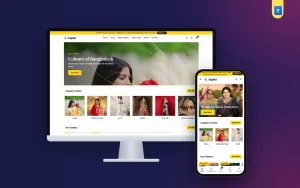
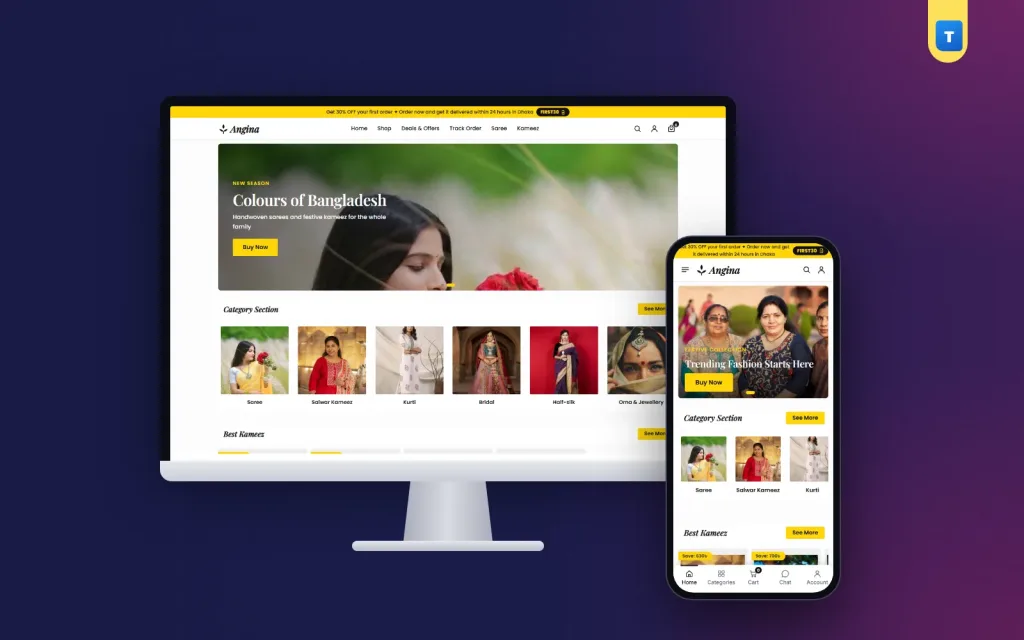
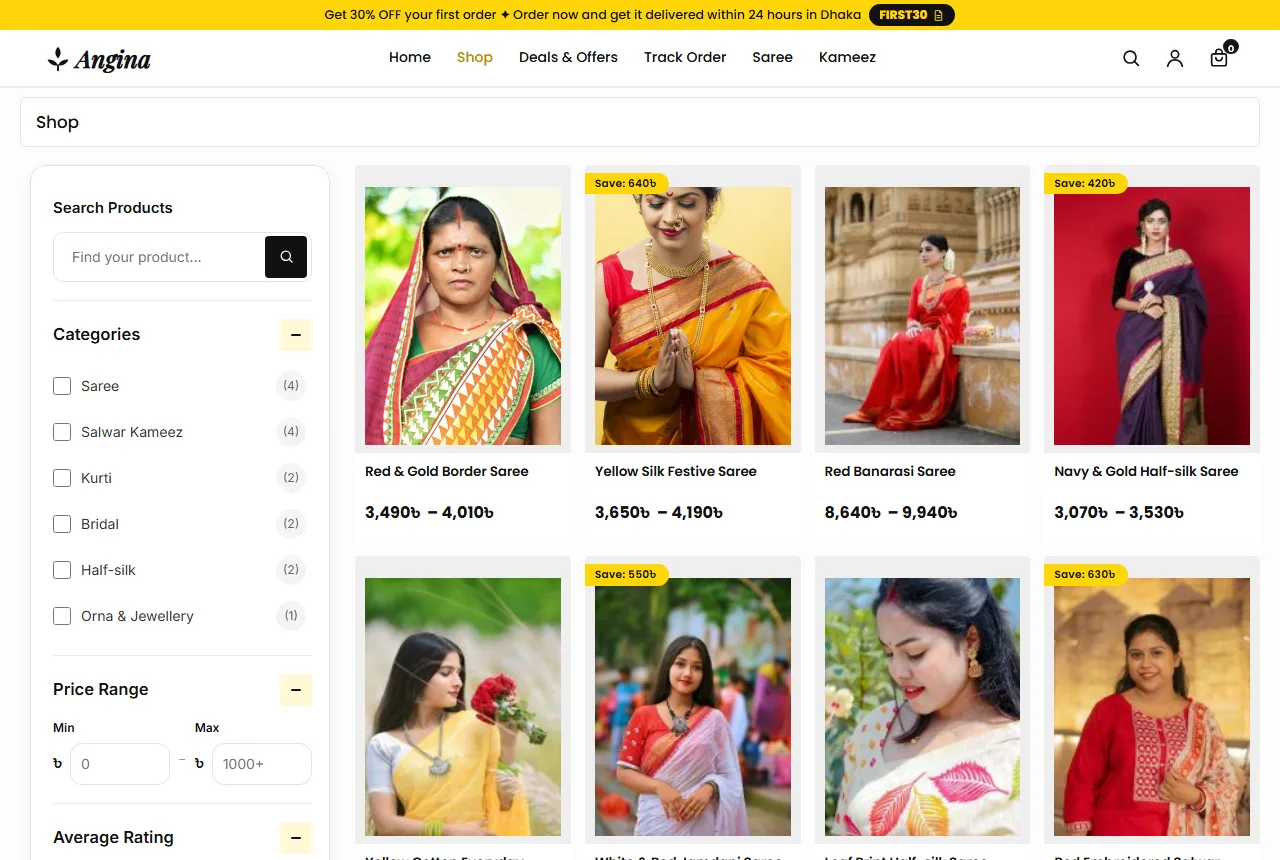
These saree website design ideas are easier to use when the theme already follows them. The Angina ethnic wear theme for WordPress and WooCommerce has an offer bar with a copyable code, a large photo slider, portrait category tiles, product rows for any category or tag, a features strip, reviews, an FAQ and a blog block.
Every demo product has a Free Size and a Custom Stitch choice, and the product page has Add to Cart and Buy Now. Buyers get mobile number or email sign-in, a wishlist and a Track Order page, and phones get a bottom tab bar with a WhatsApp chat button. Import the demo, add your pieces, and you can take orders the same week.
Frequently asked questions
What should a women ethnic wear website design template show first?
A festive hero slide, then category tiles for sarees, kameez and kurtis, then your best sellers.
What is the best colour for a women ethnic wear website design template?
One warm accent colour, such as yellow or maroon, with plenty of white. It lets the colours of the fabric stand out.
Do I need online payment from day one?
No. Cash on delivery is enough at first. Add bKash, Nagad or cards later.
Should I offer custom stitching online?
Yes, if you can keep the promise. Show it as a separate choice with its own price and delivery days.
How many products should I start with?
Start with 30 to 60 pieces you always have in stock, then grow.